Cold Water
Lingcod
Ophiodon elongatus · Bony fish, family Hexagrammidae (greenlings); not a true cod
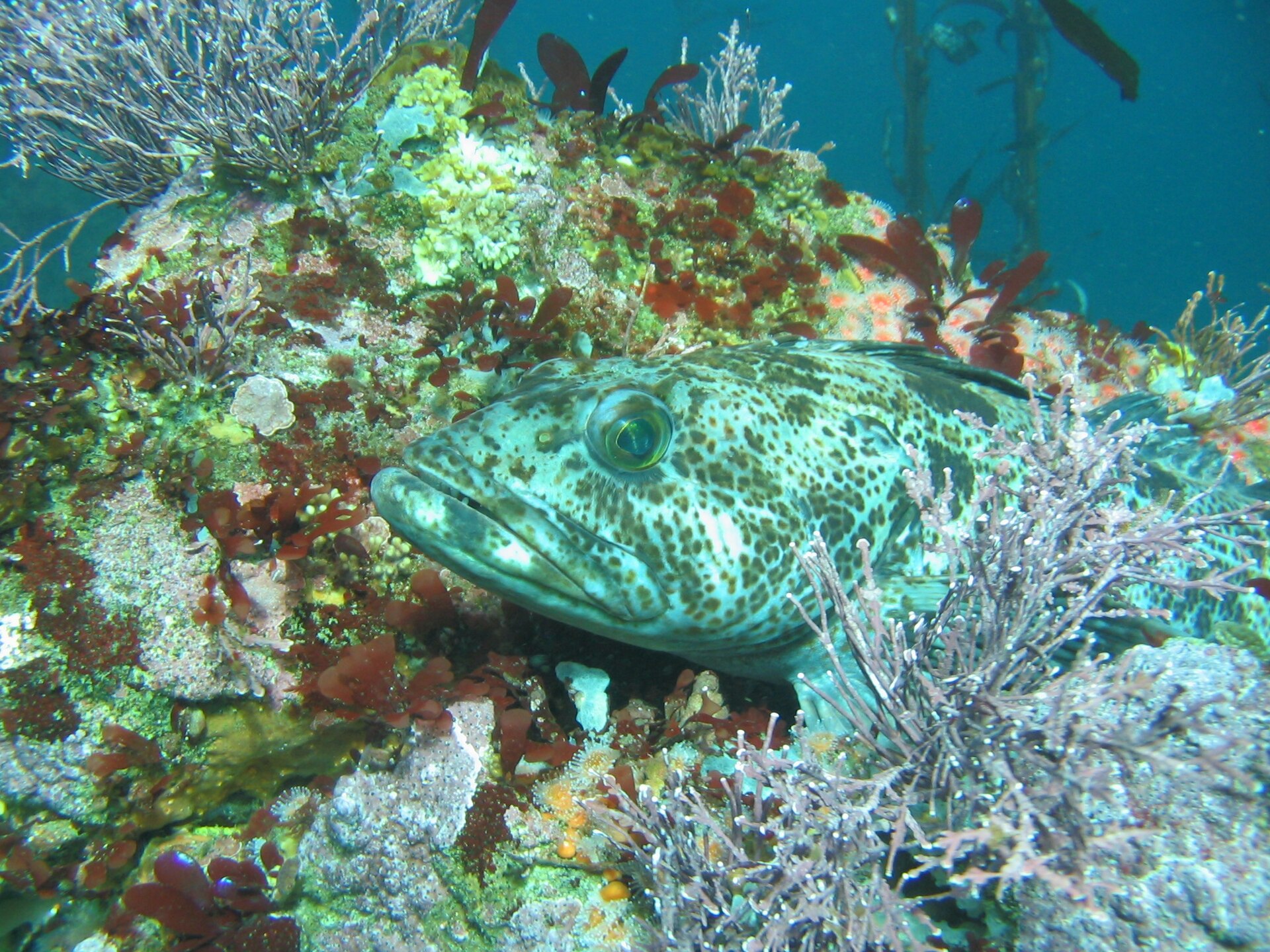
Lingcod are the bulldogs of Northeast Pacific reefs: mottled, big-headed predators with a mouth full of fangs, built to sit still and strike. Despite the name they are neither ling nor cod but outsized greenlings, and the biggest, usually females, reach about 1.5 m. In British Columbia they are fixtures of walls, wrecks and breakwaters, and where spearfishing is banned, as at Victoria's breakwater, they grow big, bold and unbothered by divers. Winter is the time to look closer. After spawning, the male stays with the egg mass, a white lump from grapefruit to watermelon size wedged into the rock, and guards it for weeks until it hatches. He fans his gills, bares his teeth and holds his ground, because a nest left unguarded can be stripped by predators within two days. Divers who flush a male off his eggs do real harm, and BC divers survey these nests each winter.
Where and when to see one
"Resident" means most dives at that destination encounter them; "seasonal" means reliably present in the listed months; anything else is a bonus, not a plan.
| Destination | Reliability | Months | Notes |
|---|---|---|---|
| British ColumbiaCanada | Resident: seen on most dives | Year-round | |
| California Channel IslandsUnited States | Occasional | Year-round |
Best month, at a glance
| Month | Reliable destinations |
|---|---|
| January | British Columbia · California Channel Islands |
| February | British Columbia · California Channel Islands |
| March | British Columbia · California Channel Islands |
| April | British Columbia · California Channel Islands |
| May | British Columbia · California Channel Islands |
| June | British Columbia · California Channel Islands |
| July | British Columbia · California Channel Islands |
| August | British Columbia · California Channel Islands |
| September | British Columbia · California Channel Islands |
| October | British Columbia · California Channel Islands |
| November | British Columbia · California Channel Islands |
| December | British Columbia · California Channel Islands |
Understanding them
Habitat: Rocky reefs, kelp beds and wrecks, where adults rest on the bottom near rock; juveniles settle on sand or mud in bays. The full range runs from the intertidal to about 475 m.
Range: Northeast Pacific from the Gulf of Alaska to Baja California, most abundant off British Columbia and Washington.
Behavior: An ambush predator that lies motionless on rock until prey comes close. In winter the male guards a white egg mass, grapefruit to watermelon size, for weeks until it hatches, fanning his gills and baring his teeth at anything that approaches.
Diet: Mostly other bottom fishes, including smaller lingcod, plus squid, octopus and crabs, taken with a huge mouth lined with fang-like teeth.
Size: typically around 70 cm; documented up to 1.52 m (total length; FishBase gives maturity at about 70 cm and a top weight of 59 kg, and by age 10 to 12 females are about twice the size of males of the same age).
How to behave around one
In winter, look for a motionless male lying over a white egg mass and keep your distance: NOAA notes an unguarded nest can be destroyed within 48 hours. Never poke a male or push him off the eggs for a photo, and give resting adults room rather than hovering in their face.
Conservation
Not assessed by the IUCN. NOAA reports US West Coast stocks are not overfished; guarding males are the weak link, since an unguarded egg mass can be lost within 48 hours.
Charted sites known for them
Highlighted sites were charted for this species by our editors; numbers are GBIF occurrence records logged within about 5 km of a site since 1990.
Recently recorded near our dive sites
35 verified records within 5 to 10 km of 3 of our dive sites over the last 12 months (17 Nov 2025 to 16 Nov 2026), 12 of them in the last 30 days. Latest: 9 Nov 2026, near Whytecliff Park, by owenkzy ↗ (iNaturalist, CC BY-NC).
Most records near
Research-grade iNaturalist observations shared under CC0, CC BY or CC BY-NC, plus human sightings from GBIF and OBIS datasets under the same licences, within 5 km of a site with a sourced position or 10 km of an approximate one. A record near two sites counts once in the total and once on each site. Each site page credits the observers and datasets behind its records. How these are collected →
Watch
From the official channels

Giant Pacific Octopus

Live African Penguin Cam After Hours | Monterey Bay Aquarium

African Penguin Cam After Hours | Monterey Bay Aquarium
Videos are embedded links to their creators' own channels. We host nothing and credit everything.