Discover where to dive, when to go, and what you could see.

Discover where to dive, when to go, and what you could see.
★
Menu
Destinations Dive Sites Marine Life Wrecks News
Plan a trip Trip planner When to dive Cost calculator Comparisons Marine-life calendar Water temperature Liveaboards Operators & resorts Marine parks Hyperbaric chambers World map
Cave Diving All cave diving Destinations & Dive Sites Cave Systems & Maps Training & Qualifications Dive Centers & Guides Equipment & Technology Safety & Incident Research Science, History & Conservation Resources & Updates
Regions Australia, New Zealand & East AsiaCaribbean & Western AtlanticEurope, Atlantic & MediterraneanIndian Ocean & East AfricaPacific Islands & MicronesiaRed Sea & Middle EastSoutheast Asia & Coral TriangleThe Americas & Eastern Pacific Countries
Learn & Tools All guides Certifications Gear guides Videos Ask the Data AI Agents API
About About us Methodology Disclaimer Contact
Your view
★ Saved

Your starred destinations, sites and species, stored in this browser.

API GATEWAY

Free read-only JSON access to the atlas's cached data.

Dark mode

Guided View
New to diving? Depths, currents, certification levels? We explain every term as you browse, in plain English. Same data, with the help built in.

Expert View
You already know the difference between a wall and a drift. Just the data: clean, fast and compact. This is the default view.

Interface language
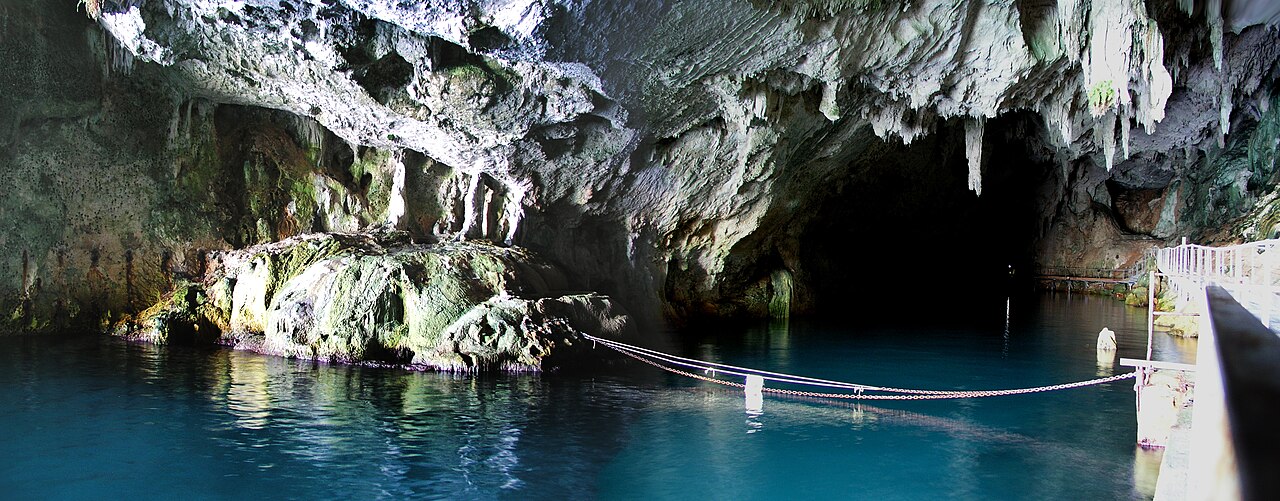
Inside the Grotte del Bue Marino

Bue Marino Cave (dive from the sea)

Photo: JYB Devot · CC BY-SA 4.0
Access status not verified Dived from the sea with a local operator; no official diving permit regime was found in the sources consulted. Access rules change: confirm with the landowner or managing authority before you travel.
Editorial estimate Also known as: Grotta del Bue Marino dive, Bue Marino Cave, Grotte del Bue Marino
Entrance depth
Not published
Commonly dived areas
10 m (33 ft)
Maximum depth here
15 m (49 ft)
Published category
Technical dive (operator classification)

Technical dive (operator classification): operator zone [1] (Operator requires TDI Full Cave Diver or equivalent.). These categories are the named scheme's own; they describe the training a site calls for.

A boat dive into the flooded passages of the Grotte del Bue Marino, about 15 minutes by boat from Cala Gonone, described by the operator that runs it as a technical cave dive.

Argonauta, a Cala Gonone dive centre, lists the Bue Marino as a technical dive into a large underwater cavern system with three main passages, chambers and tunnels decorated with fossil stalactites and stalagmites that formed when the cave was dry. It gives depths of 10 to 15 m and a boat ride of about 15 minutes.

The same caves are a busy show cave above water, visited by boat and walkway, so divers share the area with tourist boats in season.

ProTec Sardinia describes the approach as a very shallow swim-through from the sea entrance into a large air chamber, then a short dive under a bridge to the cave entrance, where outflowing fresh water forms a halocline and several sumps follow.

The environment

Flooded karst passages with old speleothems, where sea water meets fresh water from underground rivers.

Sources: [1] Argonauta Diving Cala Gonone ↗[2] SardegnaTurismo (Regione Autonoma della Sardegna) ↗[3] ProTec Sardinia ASD ↗ · checked 2026-10-14
Every fact on this page, with its source (6)
FactStatusSource
The operator gives depths of 10 to 15 m. Reported [1]
The operator gives a maximum of 15 m for its Bue Marino dive. Reported [1]
The operator calls it a purely technical dive with three main passages. Reported [1]
Certification required: TDI Full Cave Diver or equivalent.Operator requirement. Reported [1]
No official diving rules are given on the regional tourism page; the show cave is visited by boat with paid entry. Reported [2]
The dive starts in about 1.5 m of water at the large entrance, surfaces in a large room with old walkways, and continues under a bridge to the entrance proper, which reaches about 15 m with a halocline. Reported [3]

Verified: stated by an official or primary source we opened. Reported: from a secondary source only. Sources conflict: the note gives both versions. May be out of date: the newest source we found is old.

Written in our own words from the sources above. Report a correction

Australia, New Zealand & East Asia

Cairns & the Ribbon ReefsNingaloo ReefCoral Sea & Osprey ReefOkinawa & the Kerama IslandsPoor Knights IslandsTownsville & the YongalaGreen IslandIzu Peninsula

Caribbean & Western Atlantic

BonaireCozumelRiviera Maya & the CenotesBelize Barrier ReefGrand CaymanIsla Mujeres & CancúnRoatánTiger Beach & Grand Bahama

Europe, Atlantic & Mediterranean

Malta & GozoSilfra & IcelandThe AzoresCanary IslandsLarnaca & the ZenobiaScapa FlowArctic NorwayMadeira

Indian Ocean & East Africa

North & South Malé AtollsAri AtollBaa Atoll & Hanifaru BayAliwal Shoal & UmkomaasMafia IslandMauritiusSeychellesSodwana Bay

Pacific Islands & Micronesia

PalauChuuk (Truk) LagoonFakaravaKona, HawaiʻiRangiroaTaveuni & Rainbow ReefBeqa Lagoon & Pacific HarbourEspiritu Santo

Red Sea & Middle East

Sharm El Sheikh & Ras MohammedBrothers, Daedalus & St John'sDahabHurghada & El GounaMarsa Alam & the Deep SouthAqabaDaymaniyat IslandsMusandam Peninsula

Southeast Asia & Coral Triangle

Bali & Nusa PenidaKomodoRaja AmpatSipadan & MabulAnilaoCoronKoh TaoLembeh Strait

The Americas & Eastern Pacific

Galápagos IslandsCocos IslandFlorida KeysSea of Cortez & Cabo PulmoSocorro & the RevillagigedosBritish ColumbiaCalifornia Channel IslandsCosta Rica Pacific Coast