Discover where to dive, when to go, and what you could see.

Discover where to dive, when to go, and what you could see.
★
Menu
Destinations Dive Sites Marine Life Wrecks News
Plan a trip Trip planner When to dive Cost calculator Comparisons Marine-life calendar Water temperature Liveaboards Operators & resorts Marine parks Hyperbaric chambers World map
Cave Diving All cave diving Destinations & Dive Sites Cave Systems & Maps Training & Qualifications Dive Centers & Guides Equipment & Technology Safety & Incident Research Science, History & Conservation Resources & Updates
Regions Australia, New Zealand & East AsiaCaribbean & Western AtlanticEurope, Atlantic & MediterraneanIndian Ocean & East AfricaPacific Islands & MicronesiaRed Sea & Middle EastSoutheast Asia & Coral TriangleThe Americas & Eastern Pacific Countries
Learn & Tools All guides Certifications Gear guides Videos Ask the Data AI Agents API
About About us Methodology Disclaimer Contact
Your view
★ Saved

Your starred destinations, sites and species, stored in this browser.

API GATEWAY

Free read-only JSON access to the atlas's cached data.

Dark mode

Guided View
New to diving? Depths, currents, certification levels? We explain every term as you browse, in plain English. Same data, with the help built in.

Expert View
You already know the difference between a wall and a drift. Just the data: clean, fast and compact. This is the default view.

Interface language
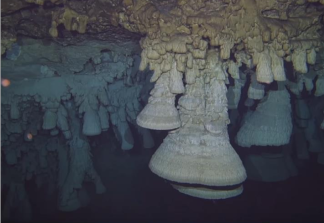
The Hells Bells formations in Cenote El Zapote

Cenote El Zapote (Hells Bells)

Sinkholeto 51.8 mMexico
Photo: Simon Michael Ritter, Margot Isenbeck-Schröter, Christian Scholz, Frank Keppler, Johannes Gescher, Lukas Klose, Nils Schorndorf, Jerónimo Avilés Olguín, Arturo González-González and Wolfgang Stinnesbe · CC BY 4.0
Open to qualified divers, with conditions · as published 2026-10-14 CREER listed cavern diving as open. Access rules change: confirm with the landowner or managing authority before you travel.
Documented Also known as: Cenote Zapote, El Zapote, Zapote, Hells Bells, Hell's Bells, Cenote Hells Bells
Entrance depth
Not published
Commonly dived areas
Not published
Maximum depth here
51.8 m (170 ft)
Published category
Level 4 - Expert

Level 4 - Expert: CREER cenote level (guided cavern diving) [1] [2] (CREER describes Level 4 as beyond Level 3, dark and for experienced divers only; maximum 3 divers per guide.). These categories are the named scheme's own; they describe the training a site calls for.

A deep, stratified sinkhole about 52 m deep, known for bell-shaped calcite formations ('Hells Bells') hanging in and above a turbid layer; CREER rates it Level 4 (Expert).

Cenote El Zapote is a deep sinkhole whose walls carry large bell-shaped calcite formations, nicknamed Hells Bells, that partly extend into a white, cloudy layer in the water. A 2022 study in Geobiology links that turbid layer to a pelagic redoxcline, a boundary where oxygen-poor, sulphide-rich water meets the water above, and argues that microbes there promote calcite precipitation that may help the bells grow.

QRSS lists 'Cenote Zapote (Cenote Hells Bells)' among the deep underwater caves of Quintana Roo at 51.8 m, with 301 m of surveyed length. CREER rates it Level 4 (Expert), its most demanding regular category for guided cavern tours, limited to experienced divers at no more than three per guide. Under the Jungle describes the sinkhole sites on the Ruta de los Cenotes outside Puerto Morelos as advanced.

The Hells Bells are fragile and scientifically important; divers are expected to keep clear of them.

The environment

Deep, dark sinkhole with stratified water, a turbid redoxcline layer and hanging calcite bells.

Conditions

Stratified water with a cloudy turbid layer at depth; light is limited. Typical conditions only.

Typical ranges from published sources, not current conditions.

Sources: [1] CREER (Comité Regional de Espeleobuceo, Ecología y Regulación) ↗[2] CREER ↗[3] Quintana Roo Speleological Survey ↗[4] Geobiology / PubMed record ↗[5] Under the Jungle ↗[6] Under the Jungle ↗ · checked 2026-10-14
Every fact on this page, with its source (6)
FactStatusSource
QRSS lists Cenote Zapote (Cenote Hells Bells) at a depth of 51.8 m and a surveyed length of 301 m (Bertoni/Harris, 11/2013).Survey figure from 2013. May be out of date [3]
Large bell-shaped calcite formations called Hells Bells were found underwater in the stratified cenote El Zapote, together with a white turbid layer that overlaps the pelagic redoxcline; the study proposes microbially induced calcite precipitation as a contributor to their growth.Abstract read via the PubMed record (doi:10.1111/gbi.12492). Verified [4]
CREER rates Zapote as Level 4 (Expert), with cavern diving listed as open.Identification of CREER's 'Zapote' with the Hells Bells cenote is based on the shared name; QRSS also lists a separate Sistema Zapote-Camilo. Verified [1] [2]
CREER Level 4 requires the Level 3 requirements plus a previous Level 3 cenote dive and advanced open-water certification, with at most 3 divers per guide. Verified [2]
Under the Jungle describes the sinkholes of the Ruta de los Cenotes just outside Puerto Morelos as advanced sites that are sinkholes rather than caverns.The sources used do not state El Zapote's exact location, so no area is given. Reported [6]
Under the Jungle adds a 50 USD surcharge for Zapote and groups it with sites requiring previous cavern experience and advanced open-water certification.January 2026 price list. Reported [5]

Verified: stated by an official or primary source we opened. Reported: from a secondary source only. Sources conflict: the note gives both versions. May be out of date: the newest source we found is old.

Written in our own words from the sources above. Report a correction

Australia, New Zealand & East Asia

Cairns & the Ribbon ReefsNingaloo ReefCoral Sea & Osprey ReefOkinawa & the Kerama IslandsPoor Knights IslandsTownsville & the YongalaGreen IslandIzu Peninsula

Caribbean & Western Atlantic

BonaireCozumelRiviera Maya & the CenotesBelize Barrier ReefGrand CaymanIsla Mujeres & CancúnRoatánTiger Beach & Grand Bahama

Europe, Atlantic & Mediterranean

Malta & GozoSilfra & IcelandThe AzoresCanary IslandsLarnaca & the ZenobiaScapa FlowArctic NorwayMadeira

Indian Ocean & East Africa

North & South Malé AtollsAri AtollBaa Atoll & Hanifaru BayAliwal Shoal & UmkomaasMafia IslandMauritiusSeychellesSodwana Bay

Pacific Islands & Micronesia

PalauChuuk (Truk) LagoonFakaravaKona, HawaiʻiRangiroaTaveuni & Rainbow ReefBeqa Lagoon & Pacific HarbourEspiritu Santo

Red Sea & Middle East

Sharm El Sheikh & Ras MohammedBrothers, Daedalus & St John'sDahabHurghada & El GounaMarsa Alam & the Deep SouthAqabaDaymaniyat IslandsMusandam Peninsula

Southeast Asia & Coral Triangle

Bali & Nusa PenidaKomodoRaja AmpatSipadan & MabulAnilaoCoronKoh TaoLembeh Strait

The Americas & Eastern Pacific

Galápagos IslandsCocos IslandFlorida KeysSea of Cortez & Cabo PulmoSocorro & the RevillagigedosBritish ColumbiaCalifornia Channel IslandsCosta Rica Pacific Coast