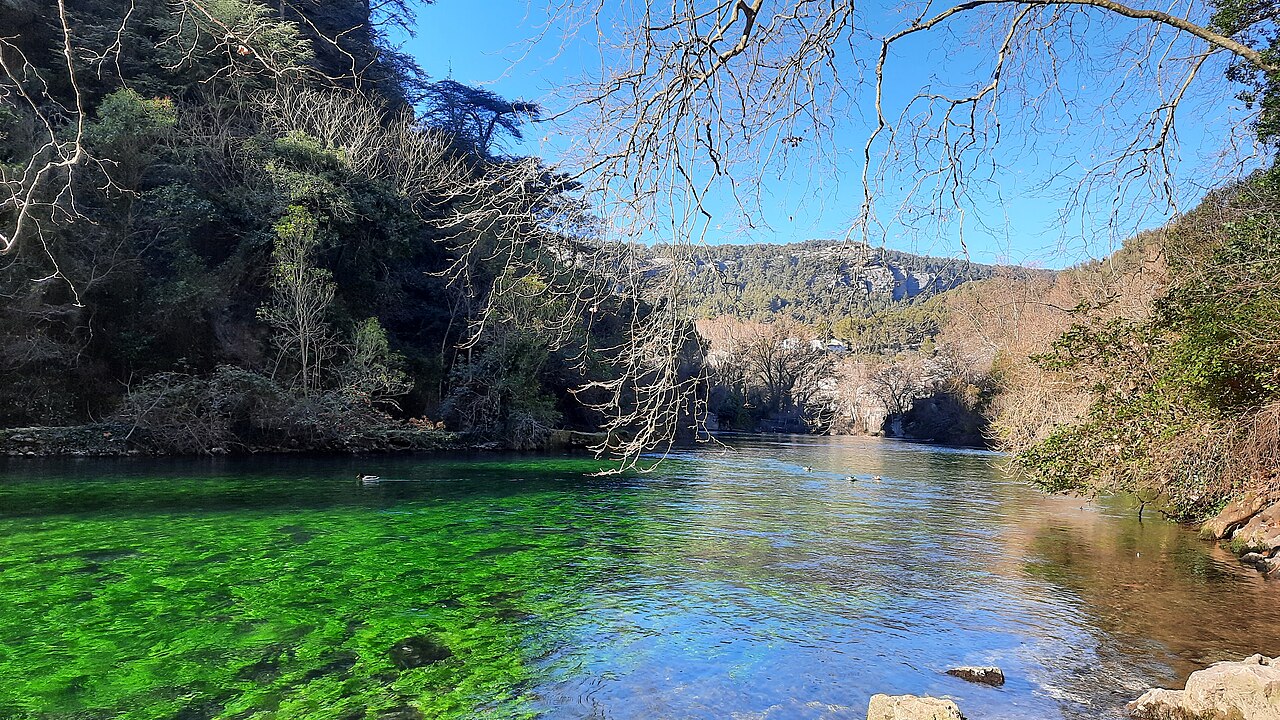
Fontaine de Vaucluse
Floor reached by the robot Modexa on 2 August 1985; the deepest human dive reported on the FFS fiche is Hasenmayer's 205 m in 1983.
The source of the Sorgue and the largest karst spring in metropolitan France according to its commune. Its flooded shaft has been explored by divers and robots to a sandy floor at 315 m; the municipality banned diving in 1974, and later work has been research-led.
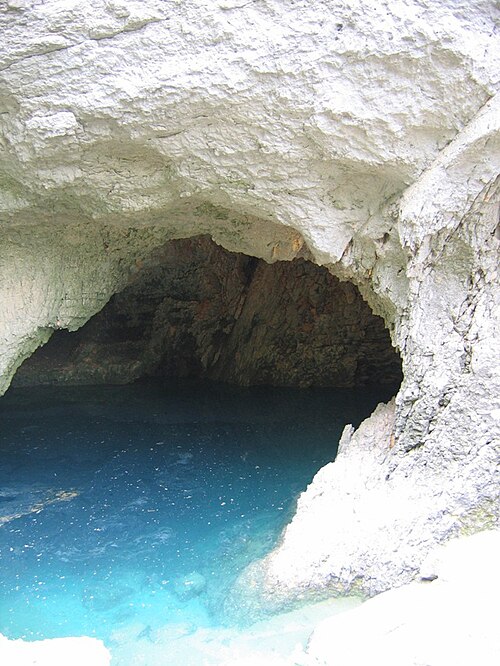
The Fontaine de Vaucluse lies at the foot of a cliff more than 240 m high and drains rain and snowmelt from a catchment of about 1,240 km², including the southern slopes of Mont Ventoux, the Monts de Vaucluse and the Montagne de Lure. In spring and autumn floods the pool overflows spectacularly; at other times the Sorgue is fed by lower secondary springs.
The flooded shaft below the pool has drawn divers since a Marseille helmet diver reached 23 m in 1878. Cousteau and Dumas made the first self-contained dives here in 1946, reaching 46 m. In 1981 Claude Touloumdjian reached 153 m with COMEX support; Jochen Hasenmayer, who had dived to 140 m without authorisation a few days earlier, returned alone in 1983 and reached 205 m. On 2 August 1985 the remotely operated Modexa landed on a sandy floor at 315 m, still the known terminus.
The local caving club, the Société spéléologique de Fontaine de Vaucluse (SSFV), has led most later work, including its own Spélénaute robot (1989-1996) and, from 2001, archaeological prospection that recovered more than 1,600 Roman-era coins and objects under the direction of the State's underwater archaeology service.
The commune states that a 1974 survey dive with an undisclosed commercial aim led the municipality to prohibit all diving. Visitors are asked not to cross the safety barriers at the pool because rocks fall from the cliff with potentially fatal force.
Nước, dòng chảy và lũ lụt
The commune gives an annual discharge of 630 to 700 million cubic metres, flood flows of around 90 m³/s and a near-constant water temperature of 12.5 to 13 °C. Showcaves notes that for much of the year the main shaft does not overflow and water emerges from lower outlets in the riverbed. In August 2022, when flow at the station fell to the regulatory threshold of 4 m³/s for two days, navigation and underwater activities were banned on the Sorgues under a prefectural order of 28 May 2019.
Tại sao điều này quan trọng
A classic site in the history of diving and cave exploration, from early helmet dives to Cousteau's first autonomous dives and record robot descents, and an archaeological site whose submerged Roman coins led to protection measures by the Ministry of Culture.
Điều kiện
Flow varies greatly with season: floods in spring and autumn, low summer flow when the pool may sit below its rim. Rockfall from the cliff is a hazard at the pool.
Phạm vi thông thường từ các nguồn đã công bố, không phải điều kiện hiện tại.
Lịch sử khảo sát và khám phá
| 1878-03 | Helmet diver Nello Ottonelli reaches 23 m. [1] [2] |
| 1946-08-27 | Cousteau and Dumas reach 46 m in the first self-contained dives at the spring. [1] [2] |
| 1974 | After a survey dive to 78 m by divers from Angoulême, the municipality prohibits all diving. [1] [2] |
| 1983-09-09 | Jochen Hasenmayer dives solo to 205 m. [1] |
| 1985-08-02 | The robot Modexa lands on a sandy floor at 315 m. [1] [2] |
| 2003-08 | SSFV divers working with the archaeology service recover about 400 antique pieces; a 2004 campaign brings the total above 1,600. [1] |
| 2005 | Thomas Soulard (SSFV) dives to 125 m to explore the Prado gallery and shows it joins the main shaft. [1] |
Lối vào và địa điểm lặn
One entrance, the spring pool at the foot of the cliff, reached by a public footpath from the village.
Mọi thông tin trên trang này kèm theo nguồn (10)
| Thông tin | Trạng thái | Nguồn |
|---|---|---|
| The commune describes the Fontaine de Vaucluse as the largest exsurgence in metropolitan France, fed by a catchment of 1,240 km². | Đã xác minh | [2] |
| On 2 August 1985 the Modexa robot settled on a sandy floor at 315 m, which remains the known terminus. | Đã xác minh | [1] [2] [3] |
| Jochen Hasenmayer dived alone to 205 m on 9 September 1983. | Đã xác minh | [1] |
| Claude Touloumdjian reached 153 m in September-October 1981 with COMEX gas mixtures. | Đã xác minh | [1] |
| Annual discharge is 630 to 700 million m³, flood flow around 90 m³/s, and water temperature 12.5 to 13 °C. | Đã xác minh | [2] |
| The Sorgue's water temperature is near-constant between 12.5 and 13 °C. | Đã xác minh | [2] |
| A 1974 topography dive with an undisclosed commercial aim led the municipality to prohibit all diving.The commune repeats this on its current site; the text of the 1974 decision was not found. | Đã xác minh | [1] [2] |
| Under a prefectural order of 28 May 2019, navigation and underwater activities on all the Sorgues and the Canal de Vaucluse were banned from 23 August 2022 after flow at Fontaine de Vaucluse stayed at the 4 m³/s threshold for two days.Applies to the rivers below the spring; a seasonal, flow-triggered rule. | Đã báo cáo | [4] |
| The commune reports a ban on all diving dating from 1974. | Đã xác minh | [2] |
| SSFV divers found a deposit of antique coins in 2001; excavations in 2003 and 2004 with the Ministry of Culture raised the number of pieces and objects above 1,600, spanning roughly 40 BC to AD 450. | Đã xác minh | [1] |
Đã xác minh: được nêu bởi nguồn chính thức hoặc nguồn gốc mà chúng tôi đã truy cập. Đã báo cáo: chỉ từ nguồn thứ cấp. Nguồn mâu thuẫn: ghi chú cung cấp cả hai phiên bản. Có thể đã lỗi thời: nguồn mới nhất chúng tôi tìm được đã khá cũ.
Được viết theo lời của chúng tôi dựa trên các nguồn trên. Báo cáo lỗi