Снаряжение · Accessories
Knives & Cutting Tools
Line cutters, shears, and compact blades for entanglement - what actually cuts monofilament, where to mount it, and the travel and legal realities of carrying edged tools.
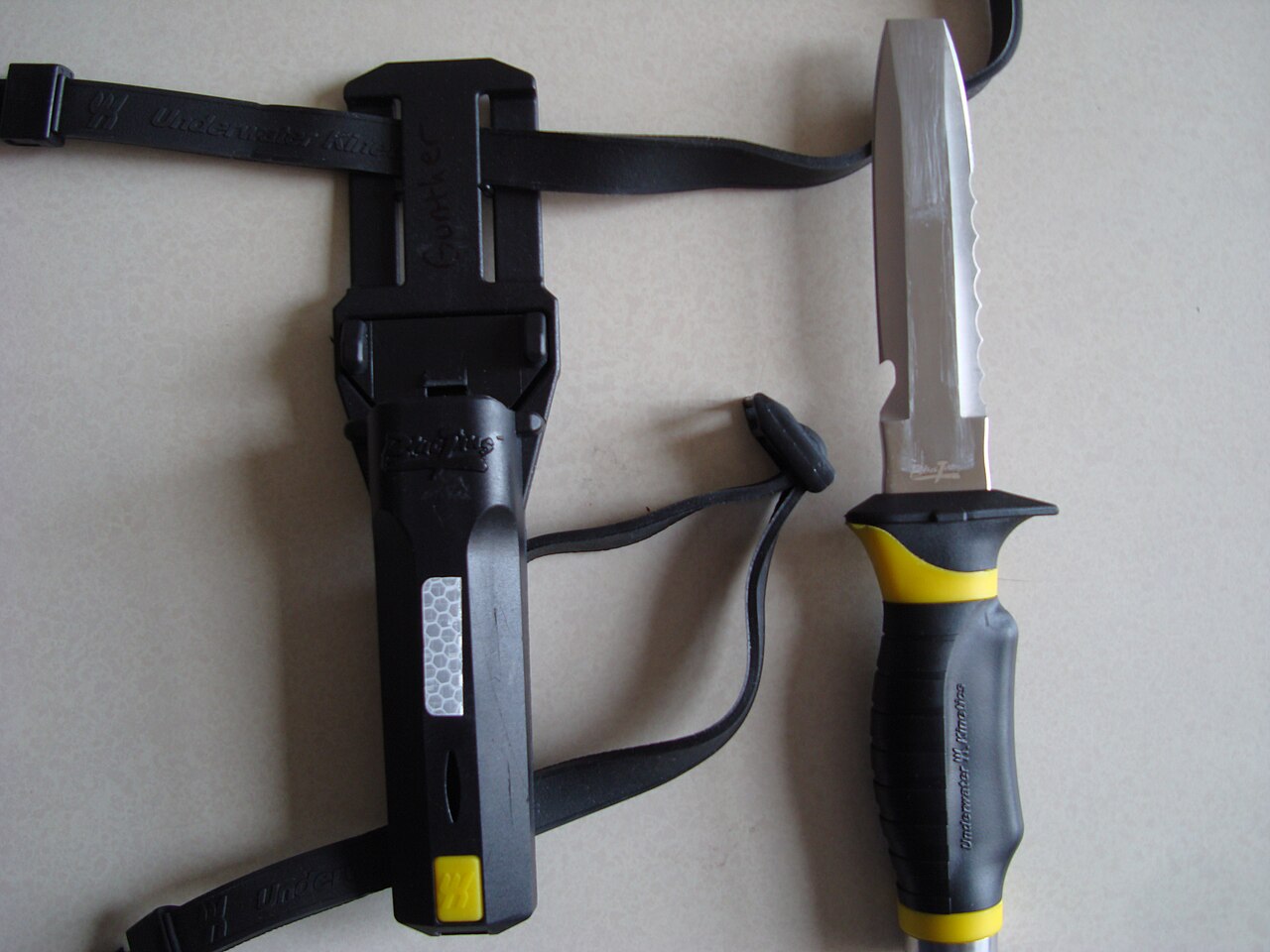
The dive knife's image problem is that movies gave it the wrong job. Nobody fights anything with one; the realistic scenario is quieter and more common - monofilament fishing line, ghost net, or kelp wrapped around a fin post or manifold, usually noticed as a gentle tug that does not let go. The tool for that scenario is whatever cuts line quickly with one hand while you stay calm and horizontal, and on that test the traditional big blade finishes behind two humbler designs. The compact line cutter - a hooked notch with a replaceable razor inside - zips through mono and braid with a pull and cannot stab you or your gear while doing it. Blunt-tipped EMT-style shears chew through net, webbing, and wire that defeat knives, work fine in gloved hands, and cost less than lunch. Serious entanglement environments - wreck interiors, kelp, fishing-pressured reefs - argue for carrying two different cutters in two different places, on the sensible theory that the entanglement may involve the arm your first tool lives on.
If you do want a knife proper - and they remain genuinely useful as prying, tapping, digging, and general expedition tools - the buying advice is compact and specific. Blunt tips beat spear points for diving: nothing to puncture a hose, a suit, or you, and a screwdriver-like utility end into the bargain. A few centimeters of blade with one serrated edge and a line-cutting notch covers every realistic task. Titanium resists corrosion nearly effortlessly and holds its price; good stainless is cheaper and merely asks to be rinsed and lightly oiled. The sheath matters as much as the blade - positive click retention, workable with either gloved hand.
Mounting is where tradition and sense diverge. The calf-strap position of postcard fame puts the tool where currents snag it and your hands are not; modern practice favors close to the body's midline - clipped to the BCD, on a waistband, on the shoulder strap, or a small cutter riding the inflator hose - reachable by both hands with either arm disabled. Wherever it lives, it should live there every dive, because tools migrate to gear bags and stay there.
Prices run friendly: line cutters about US$15-35, shears US$15-40, compact stainless knives US$30-80, and titanium or premium models US$80-150. Rental fleets do not include cutting tools, so this is owned kit, and among the cheapest safety purchases in the sport.
Two non-diving realities deserve plain words. Travel: every knife, cutter, and shear flies in checked baggage, never carry-on - the security tray has ended more dive knives than corrosion has. Law: some jurisdictions restrict knife carry or treat dive knives inconsistently, and a few destinations frown on them at ports of entry; a low-profile line cutter and shears raise no eyebrows anywhere and cut better anyway. Rinse whatever you carry, touch up edges yearly, replace cutter razors when they drag - and let the big Hollywood blade stay in the movies.
Цены, это честные рыночные диапазоны, а не предложения; ни один производитель не платит за размещение здесь.