Perlengkapan · Accessories
Dive Lights
Primary and backup torches, beam angles versus lumen marketing, burn times, and battery rules for flying - the accessory that returns color to diving even at noon.
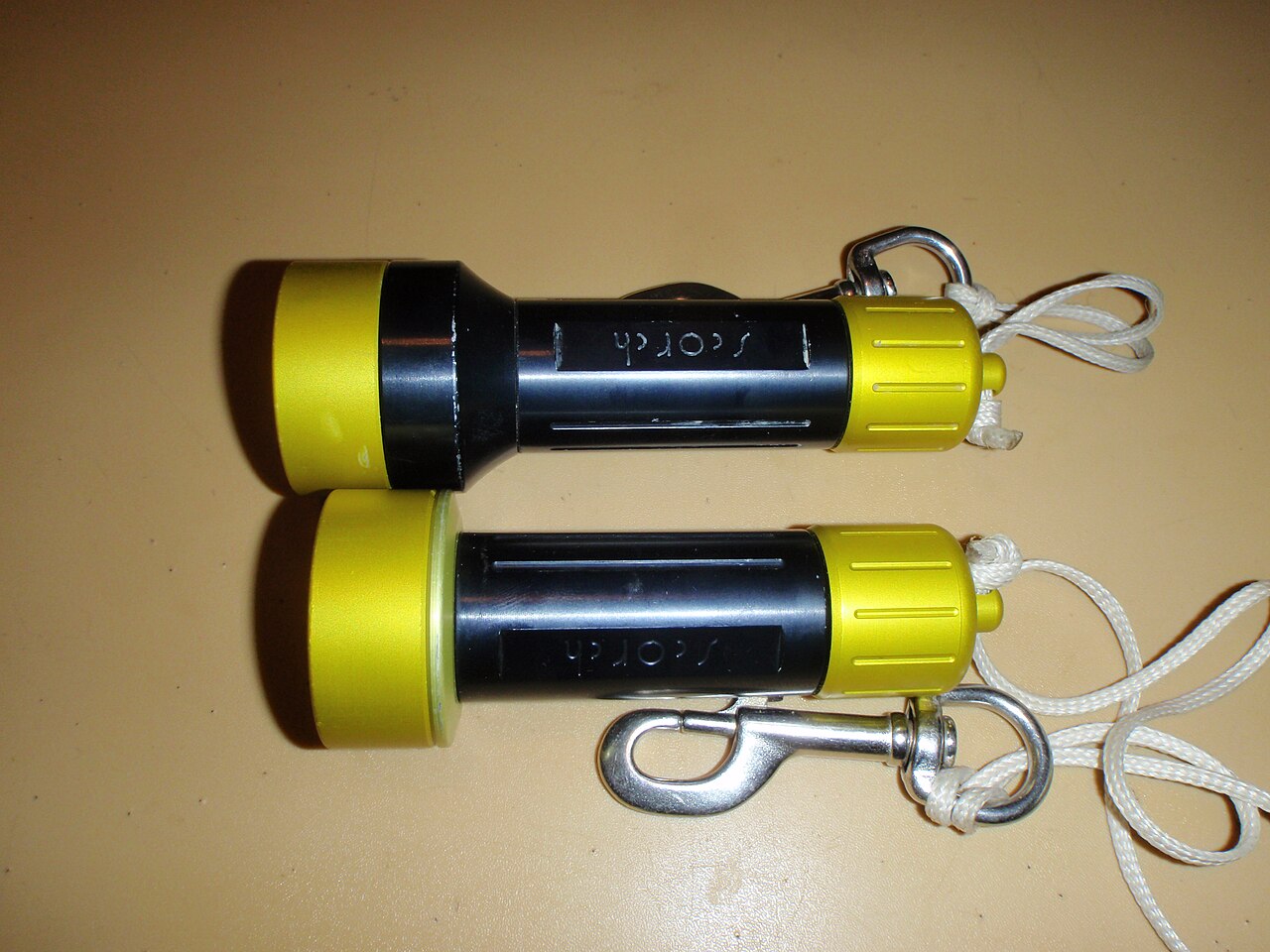
Water eats light selectively: reds go within the first few meters, oranges and yellows follow, and by 20 m the most flamboyant reef on earth runs on blues and grays. A dive light reverses the theft. Point one into a crevice at midday and the sponge that looked dull maroon flares scarlet - which is why lights are not night-diving equipment that happens to work by day, but everyday equipment that becomes mandatory at night. Wrecks, overhangs, and every hole a moray might occupy repay carrying one on any dive.
The taxonomy is simple. Primary lights are your main beam: for recreational night diving, a solid handheld unit; at the technical end, canister lights with umbilical cords and long burn times. Backup lights are small, pocketable torches carried against the primary's failure - night-diving doctrine says every diver carries at least one light plus a backup, and the habit serves day divers too. Video and photo lights are a different tool, trading throw for wide, even flood. Beam angle matters more than the lumen arms race suggests: a narrow 6-12 degree beam punches through particles and doubles as a daytime signaling tool, while wide beams illuminate scenes gently but scatter back at you in silty water. Lumen numbers are marketed enthusiastically and measured inconsistently; treat mid-hundreds as ample for backups, around a thousand as a comfortable recreational primary, and several thousand as video territory, then weight burn time and build quality over raw output. A published burn time shorter than your dive plus reserve is a disqualification, not a detail.
Handling and features worth their cost: a positive mechanical switch or twist head that gloves can work, a lanyard or soft Goodman-style hand mount that frees fingers, sensible weight, and double O-ring seals on the battery compartment. Rechargeable lithium cells dominate now - cheaper per dive and brighter - with the one discipline that battery compartments open only on dry hands, dry towels, and inspected O-rings, because flooded lights die of operator error far more often than design.
Money: dependable backup torches run about US$40-80, recreational primaries US$80-250, serious primaries and video lights US$250-600, and canister systems US$600-1,200 and beyond. Rental exists for night dives at resort destinations and is fine for a first taste; owning starts to make sense the day you realize you want a light on every dive, which for most divers is the day after their first good crevice.
Travel notes are mostly battery law: spare lithium batteries and power banks belong in carry-on baggage under airline rules, quantities are capped generously for typical dive lights, and lights should fly locked or with cells removed so nothing switches on in a bag. Rinse after diving with the compartment closed, dry before opening, grease O-rings sparingly, and store long-term with batteries out and partially charged. A well-kept light lasts many years; its O-rings and your habits decide which years those are.
Harga yang tertera adalah kisaran pasar yang jujur, bukan penawaran; tidak ada produsen yang membayar untuk ditampilkan di sini.