Gear · Accessories
Reels & Spools
Finger spools, ratchet reels, and the line habits that go with them - for DSMB deployment first, and for the guideline work that overhead training builds on.
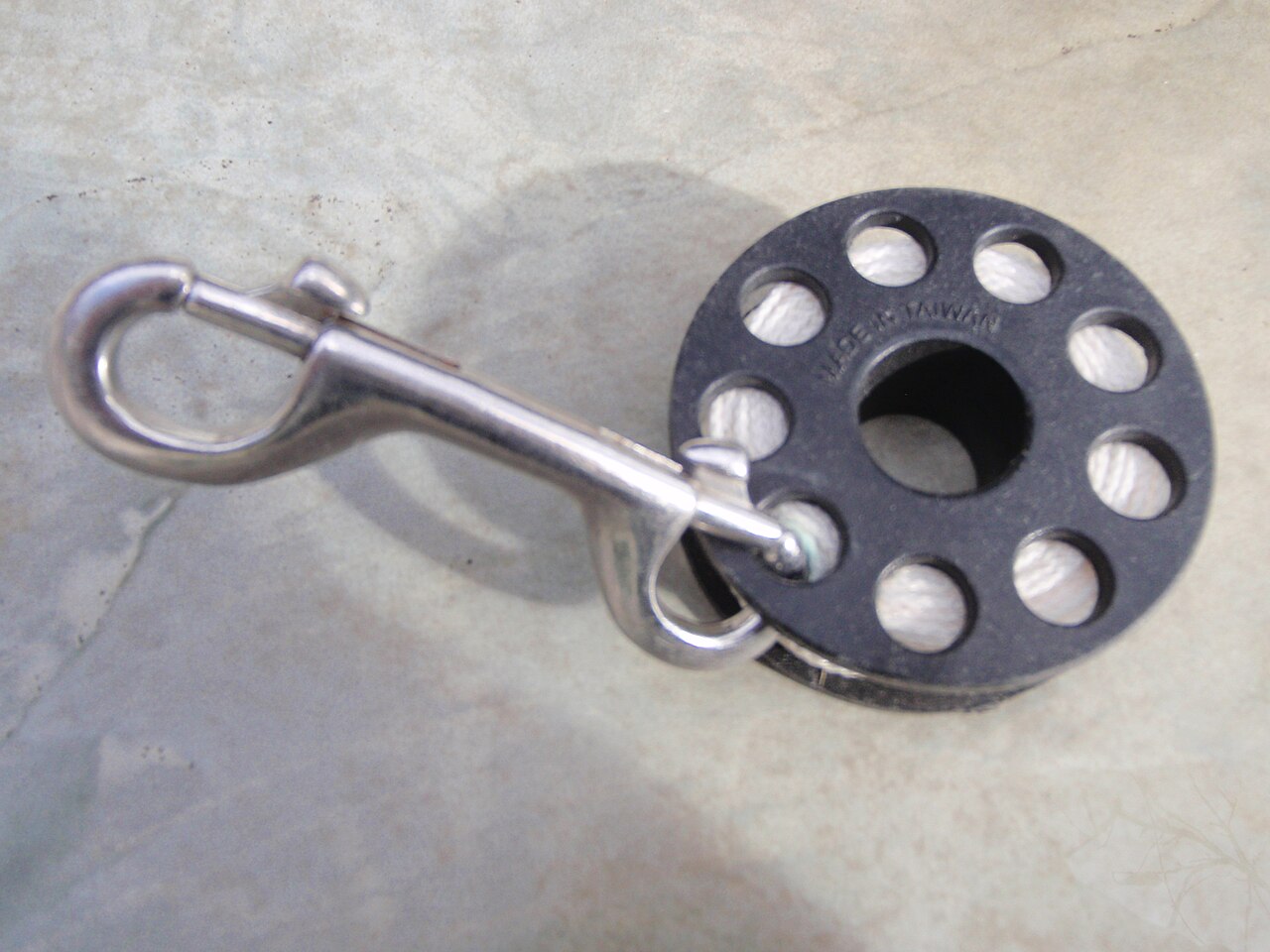
Line management sounds like a technical diver's obscure chore until the first time you send a marker to the surface from 15 m, and then it becomes obvious: whenever a diver and a fixed point need to stay connected - to a buoy above, an exit behind, or a search pattern around - something has to store, pay out, and recover line without turning into macramé. That something is a spool or a reel, and the choice between them is the whole topic.
The finger spool is the minimalist answer: a plastic or delrin disc wound with line, run on a thumb through the center hole, with a double-ended snap clipping off the free end. No moving parts means nothing to jam - the failure that matters most when a marker is pulling line upward - which is why spools have become the default DSMB partner across recreational and technical diving alike. Sizes run by line length: 15 m covers safety-stop deployments, 30 m is the versatile standard, and longer spools serve deeper work. Technique is friction and rhythm - controlled release under light thumb pressure, then winding on the ascent - and it rewards practice in a pool far from any audience.
Ratchet and open-frame reels add a crank, a spindle, and usually a locking mechanism, storing far more line - 50-120 m and beyond - and recovering it quickly. They shine where distance does: laying a guideline into a wreck or cavern, running a search pattern, towing a surface float on a long drift. The cost is complexity, because a reel can jam, bird-nest, or lock at the wrong moment, and bulk on the harness. Guideline work itself - tie-offs, placements, following line by touch - belongs to overhead and search training rather than to a shopping page, and the honest note is that owning a reel confers none of it; wreck, cavern, and cave courses are where the reel earns meaning.
Line choice is quietly important: braided nylon around 2 mm (the #24-class cord of cave convention) balances strength and bulk, thinner line stores longer but cuts and tangles more readily, and bright colors help in gloom. Check that the swivel and snap are stainless or brass, that the spool's line is actually secured to the core, and that any reel's crank works in the gloves you dive.
Money barely registers against the rest of the bag: simple spools run about US$20-45 including line and clip, quality machined spools US$40-80, and reels US$60-200 depending on capacity and build. Rental shops almost never stock them, so this is owned equipment by default, usually bought alongside the DSMB it partners.
Care: rinse after salt water, let line dry before long storage, rewind neatly - lazy winding today is a tangle at depth tomorrow - and inspect for nicks where line crosses metal. Replace line when it fuzzes; cores last decades. Travel is effortless, a spool being the densest useful object in any dive bag. Start with a 30 m spool, learn it until deployment is dull, and let training - not catalog pages - tell you when a bigger reel has a job for you.
Prices are honest market ranges, not offers; no manufacturer pays for placement here.