Attrezzatura · Tecnico
Technical Diving Equipment
Twinsets, manifolds, stage cylinders, backplate-and-wing, long hose, reels: the open-circuit technical rig explained as a system of self-reachable redundancy. An orientation primer, not a configuration to dive.
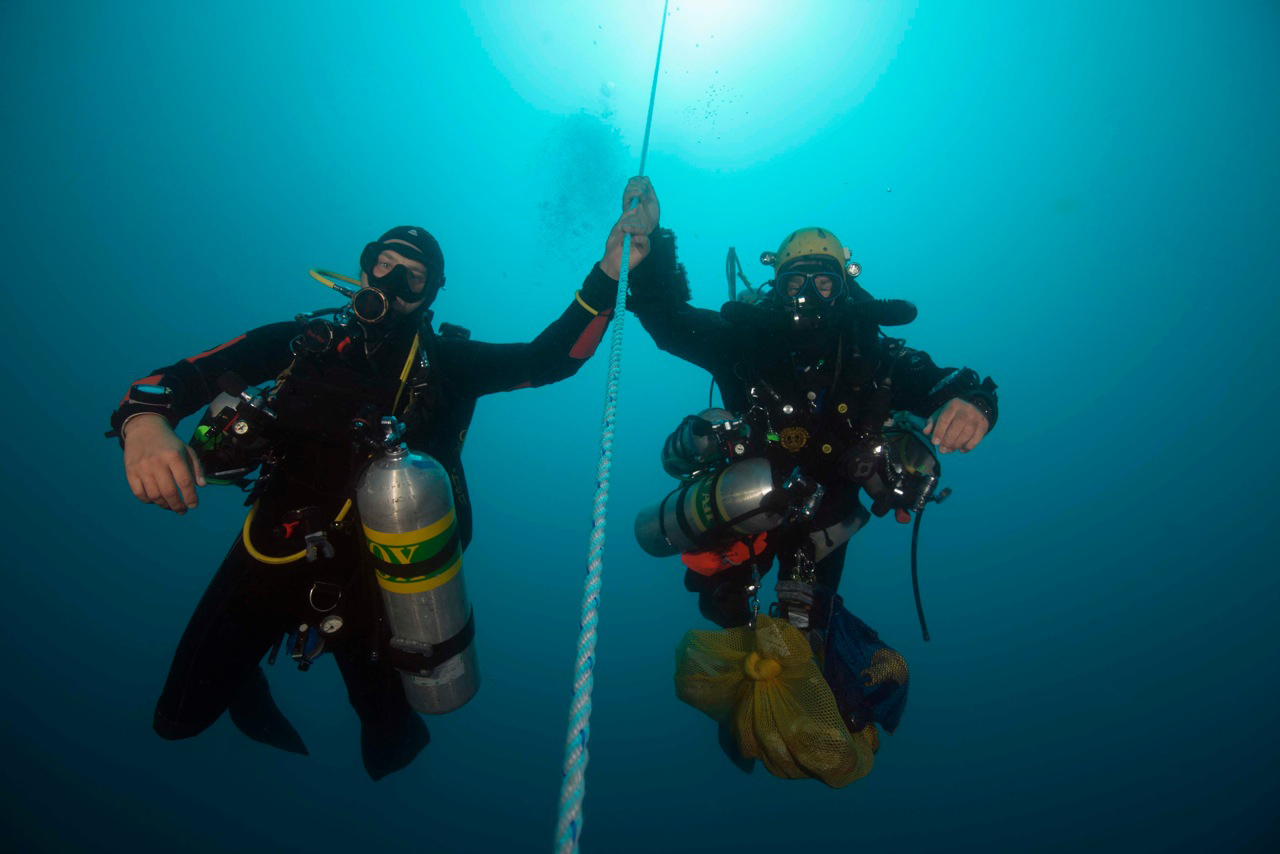
Cross the line from recreational into technical diving (decompression obligations, caves, deep wrecks) and the defining fact changes: you can no longer simply swim to the surface when something breaks. Equipment philosophy flips accordingly. Every function that keeps you alive gets a backup you can reach yourself, and the familiar single-cylinder rig grows into a system. This primer explains what the pieces are for, so the catalog pages make sense; it is not a configuration to copy, because configurations are exactly what technical courses teach.
The classic backbone is the twinset: two back-mounted cylinders (commonly 12 liters each) joined by an isolation manifold. One gas supply feeds two fully independent regulators, and any single failure can be contained by shutting down one valve or isolating the two halves, preserving most of your gas. The drills for doing this by feel, behind your own head, are a core technical skill. Sidemount achieves the same redundancy with cylinders clipped along your flanks instead, the norm in caves and for divers who prefer the trim and logistics.
Under the cylinders sits a backplate and wing: a steel or aluminum plate on a continuous webbing harness, with a rear buoyancy bladder sized to the rig. It is modular, rugged, and stable in flat trim, which is why plenty of purely recreational divers adopt it too. The regulators are arranged for donation: the primary sits on a roughly two-meter long hose and is handed to an out-of-gas teammate, while your backup hangs on a necklace under your chin. Team standardization (everyone's gas in the same place, popularized by the DIR movement) is itself a safety device.
Beyond bottom gas come stage and decompression cylinders, aluminum tanks clipped to your side carrying travel gas and rich oxygen mixes for the ascent. Each wears its maximum operating depth in large numbers, each has its own regulator, and switching to one follows a verified, trained procedure: breathing a rich mix deeper than its limit is one of technical diving's classic fatal errors, which is why the labeling and the ritual are non-negotiable. Around this core cluster the supporting cast: a primary reel and spools with a surface marker to shoot from depth, two cutting devices, wet notes, redundant dive computers or a backup timer and tables, a powerful primary light with backups where overhead or darkness is involved, and in cold water a drysuit, which doubles as backup buoyancy.
Cost scales with redundancy. As wide, honest ranges: plate, harness, and wing $500–1,200; a manifolded twinset $700–2,000; two first and second stages $800–2,000; each rigged stage a few hundred more. Most traveling technical divers buy regulators, wing, and instruments, then rent cylinders at destination tech centers rather than flying with steel. Buy after the course, not before: your instructor's pool sessions will teach you what actually belongs on your harness.
I prezzi sono intervalli di mercato realistici, non offerte; nessun produttore paga per essere inserito qui.