Seguridad · 4 min de lectura
Ascent Rates: Why Slow Wins
The speed limits agencies and computers actually enforce, the physiology behind them, and practical technique for keeping an ascent under control without a line.
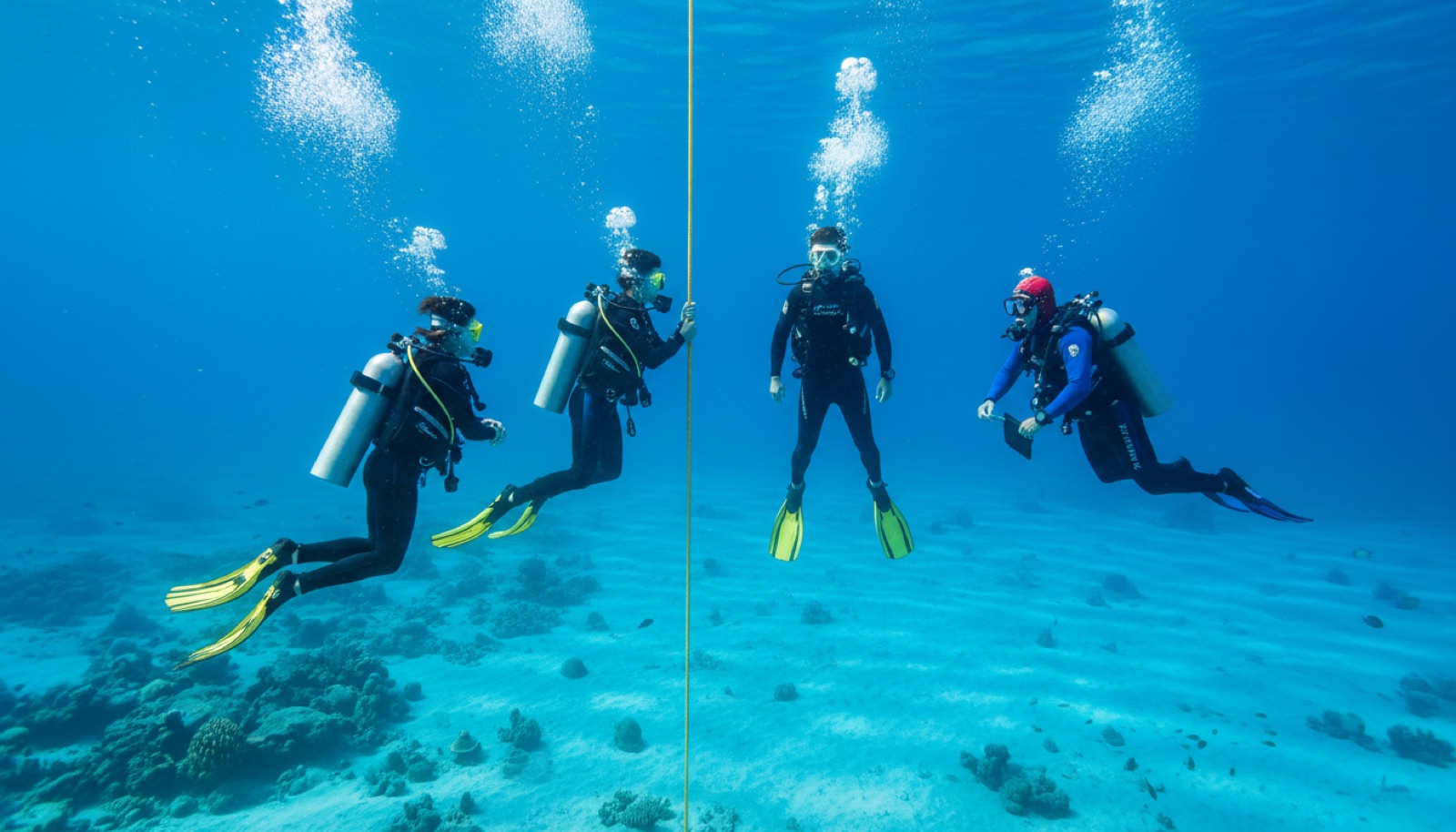
Nothing about a dive is more routinely underestimated than the trip back up. Descents get briefings, bottom time gets planning, and ascents get whatever attention is left; yet ascent speed is one of the few variables in diving where the diver has total control and the physiology is unforgiving of carelessness. The rule fits on a wetsuit sleeve: slow, and slower near the surface.
The numbers in use
Older training standards and tables were built around a maximum of 18 meters per minute. Modern practice has tightened: most agencies now teach, and most dive computers enforce, something close to 9–10 meters per minute as the working maximum, with audible alarms when you exceed it. Ten meters per minute means a full minute from 10 meters to the surface: genuinely slow, slower than feels natural, roughly the pace of your smallest exhaled bubbles rather than the big tumbling ones. Combined with a safety stop at 5 meters, this makes the last stretch of a dive take several unhurried minutes, by design. Whatever your computer specifies is the number that governs; when devices in a buddy team disagree, the team follows the most conservative one.
Two separate reasons to obey
The first is decompression physiology. Ascending is when tissues off-load nitrogen, and the pressure gradient is steepest, proportionally, near the surface. A controlled rate lets gas leave through the lungs in solution; a fast one encourages bubble formation and raises decompression stress even on dives well inside no-deco limits. The second reason is blunter: lung overexpansion. Gas in your lungs expands as pressure falls, and the change is most violent in the last 10 meters. Breathing continuously and ascending slowly gives that expansion an exit; a breath-holding or rocketing diver risks pulmonary barotrauma and arterial gas embolism, taught from the first pool session as the never-hold-your-breath rule. Both mechanisms punish exactly the same behavior, which is why the discipline is absolute rather than situational.
Technique: how divers actually stay slow
- Start negative-to-neutral, not buoyant. Vent the BCD before you begin, then ascend by finning gently, venting further as the remaining air expands. An ascent driven by inflation is a runaway waiting to happen.
- Stay ahead of your buoyancy. Small, early vents beat one panicked dump; know your dump valves by feel, and remember a shoulder dump needs that shoulder high.
- Watch something. A line, a sloping bottom, your computer's rate indicator, your bubbles. Blue-water ascents without references are where speed quietly doubles.
- Flare if it runs away: spread out horizontally to add drag, vent everything, exhale. Practicing controlled recovery in a course setting beats improvising it.
- Treat the last 5 meters as its own event: after the safety stop, surface at a crawl, one hand up, looking and listening for boat traffic.
The habits around the rule
Plan ascents into gas and time budgets instead of treating them as overhead; an eight-minute ascent-plus-stop from 25 meters is normal arithmetic, not lost bottom time. Agree in the buddy team who leads the ascent and stay level with each other, because separation happens vertically more often than horizontally. And extend the same patience to the small ascents inside a dive: sawtooth profiles, bouncing repeatedly up and down over terrain, work your tissues harder than a clean profile does. Divers brag about depth, but the professionals watching a boatload surface can identify the skilled ones by a single trait: they come up like they have all the time in the world, because they planned it so they do.

