Editorial · 4 min de leitura
The Best Warm-Water Diving on Earth
Where the ocean genuinely stays at 27 °C and up: the always-warm equatorial belt, the seasonal peaks worth timing, and the cold traps hiding at tropical latitudes.
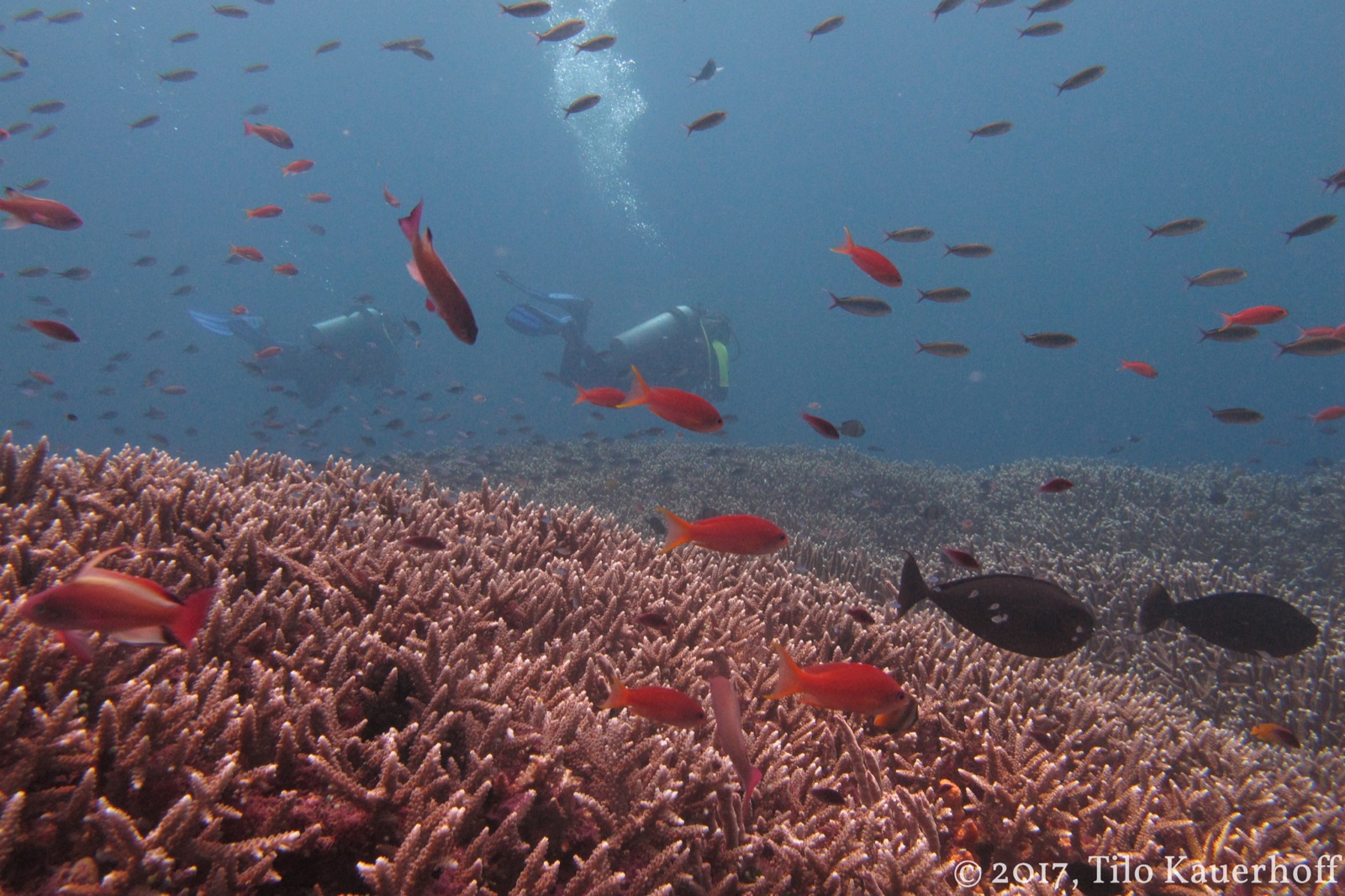
Warm water changes the whole experience: at 27 °C and above, most divers are comfortable in a 3 mm suit or less, carry less lead, dive longer, and end the week less worn down. Two honest caveats before the list. Warmest often coincides with storm season or plankton blooms, so peak temperature is not automatically peak diving. And prolonged heat is what bleaches coral: the same warmth divers enjoy is the reef's stress test. Bands worth memorizing: at 29–30 °C many divers skip neoprene entirely, 27–28 °C is classic 3 mm territory, and from the mid-20s down most people want more suit than the brochure photo shows, with personal tolerance swinging those lines several degrees either way.
The always-warm belt
A band of destinations essentially never drops below 27 °C. The Maldives holds 27–30 °C year-round, as does most of Raja Ampat and the Celebes Sea around Sipadan. Palau runs similarly warm, with rain rather than cold marking its seasons. In French Polynesia, Rangiroa's passes stay in the high 20s while the sharks ride the tide. For pure thermal reliability, book inside this belt and the wetsuit question answers itself. Stability simplifies logistics too: one thin suit covers a whole multi-stop itinerary with nothing to repack between destinations.
Seasonal peaks worth timing
Elsewhere, warmth arrives on a schedule. Egypt's south (Marsa Alam and beyond) peaks near 28–30 °C in August and September, a different sea from its low-20s winter. The Caribbean tops out in early autumn: Bonaire, conveniently south of the usual storm track, lets you harvest September's bath-warm water with less hurricane anxiety than its neighbors. Mexico's Sea of Cortez swings hardest of all: genuinely cool in winter, then 27–29 °C from August into October when the sea lions and schooling fish put on their best show. Off East Africa, Zanzibar rides the monsoon calendar in the mid-to-high 20s, warmest in the austral summer.
Warm, with an asterisk
Fiji's soft-coral capitals around Taveuni spend the austral summer near 28–29 °C but cool markedly by July (still tropical, no longer bathwater). Thailand's Andaman season and much of the Coral Triangle behave similarly: warm by any sane standard, with a cooler shoulder that surprises the unprepared. Pack for the month, not the brochure.
The cold traps at tropical latitudes
Latitude lies. The Galápagos sit on the equator and dive cold: upwelling and the Humboldt Current drive thermoclines into the teens. Nusa Penida off Bali serves its famous mola encounters precisely because austral-winter upwellings chill the water sharply. Even reliably warm regions hide thermoclines below 25–30 m. The pattern to remember: wherever cold, rich water rises, the big-animal diving improves and the wetsuit thickens.
What warm water changes in the bag
Warm-water packing is subtraction with two exceptions. The suit shrinks to a 3 mm, shorty, or rash guard, the lead follows it down, and the luggage gets lighter. But keep a thin hood or hooded vest anyway, because four dives a day cools even tropical divers by day three, and favor full coverage wherever stinging plankton drifts in season. Thermoclines supply the second exception: a site reading 29 °C at the surface can hold water several degrees cooler below 25 m, which is precisely where the deeper channel and wall dives on this page spend their time.
Making warm water count
Heat management replaces cold management: long boat days in the tropics punish hydration and skin, covered honestly in sun, heat and hydration. Thin suits still matter for stings and scrapes, and reef-safe habits matter more where corals already run hot. To match a specific month to a region, work from best time to dive where. Temperature is one input, and rarely the deciding one.