Habilidades · 4 min de lectura
Buoyancy Fundamentals
The skill that defines good diving: how weighting, your BCD and your lungs actually interact, and a practical path from bouncing off the bottom to a genuine motionless hover.
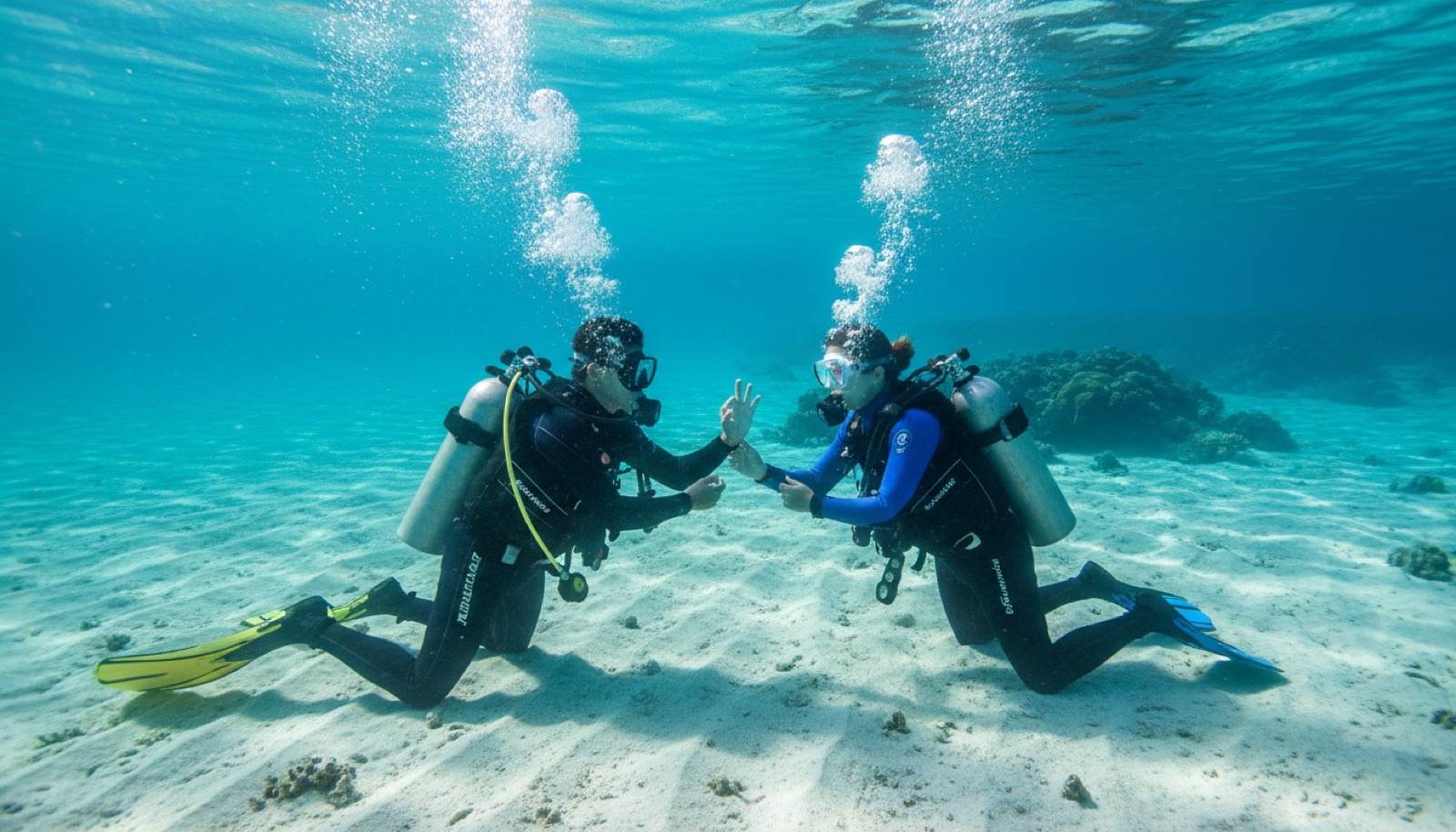
Watch any dive guide hang motionless at a safety stop, arms folded, fins still, and you are looking at the entire difference between diving and struggling underwater. Buoyancy control is not one skill among many; it is the platform every other skill stands on. It protects reefs, halves air consumption, sharpens photographs and turns diving from exercise into flight. It is also learnable by anyone willing to be systematic about three things.
Start with correct weighting
Most buoyancy problems are weighting problems wearing a disguise. Overweighted divers must inflate the BCD heavily to compensate, and that large air bubble expands and contracts dramatically with every depth change, demanding constant correction. The classic check: at the surface with a normal breath held, an empty BCD and your regulator in, you should float at eye level, sinking slowly when you exhale. Do this check with a near-empty tank in mind: an aluminum cylinder becomes roughly 1.5–2 kg more buoyant as it empties, so a diver perfectly weighted at the start of a dive floats away from the safety stop at the end. Log the weight that works for each suit and tank combination and stop guessing.
The BCD is for depth changes, the lungs are for everything else
Think of the two controls as coarse and fine adjustment. Add or vent small puffs from the BCD when you change depth enough that your wetsuit and BCD air compress or expand: descending, arriving at the bottom, beginning an ascent. Between those moments, fly on your lungs: a fuller inhale lifts you gently over a coral head, a long exhale settles you back down, all with a delay of a second or two you learn to anticipate. Divers who chase every wobble with the inflator ride an elevator all dive; divers who breathe their way through swim level and quiet.
Trim turns control into stillness
Neutral buoyancy with a head-up, feet-down posture still produces motion, because every fin kick drives you upward and every pause lets you sink. Horizontal trim (body flat, knees bent, fins up behind you) points your propulsion where you actually want to go. Move weight to fix posture: trim pockets or tank-band weights shift ballast toward the shoulders if your feet sink, and lighter fins or ankle repositioning help the rare floaty-foot case.
A practice progression that works
- Hover practice: in mid-water over sand, cross your ankles, fold your arms and hold position for two minutes using breath alone. Wobble, correct, repeat.
- Pivot to hover: from lying on sand, use inhales to lift to a hover without touching the inflator.
- Controlled tours: follow a reef contour holding a fixed distance of about a meter, up and over features, using lungs first and BCD only for sustained depth changes.
- The end-of-dive test: hold a 5 meter safety stop, still and level, with 50 bar and no line in hand. This is the honest exam.
Formal help accelerates all of this: buoyancy specialty courses (Peak Performance Buoyancy at PADI, comparable workshops elsewhere) and, at a higher standard, courses like GUE Fundamentals rebuild weighting, trim and propulsion together. Ten deliberate dives with these drills beat a hundred dives of habit. The reef, your gas gauge and every photographer near you will notice the difference.

