Gezondheid · 5 min leestijd
Decompression Sickness, Explained
What actually happens to dissolved nitrogen when a diver ascends, why limits and slow ascents exist, and where the real risk factors lie. Conceptual grounding, not a substitute for training.
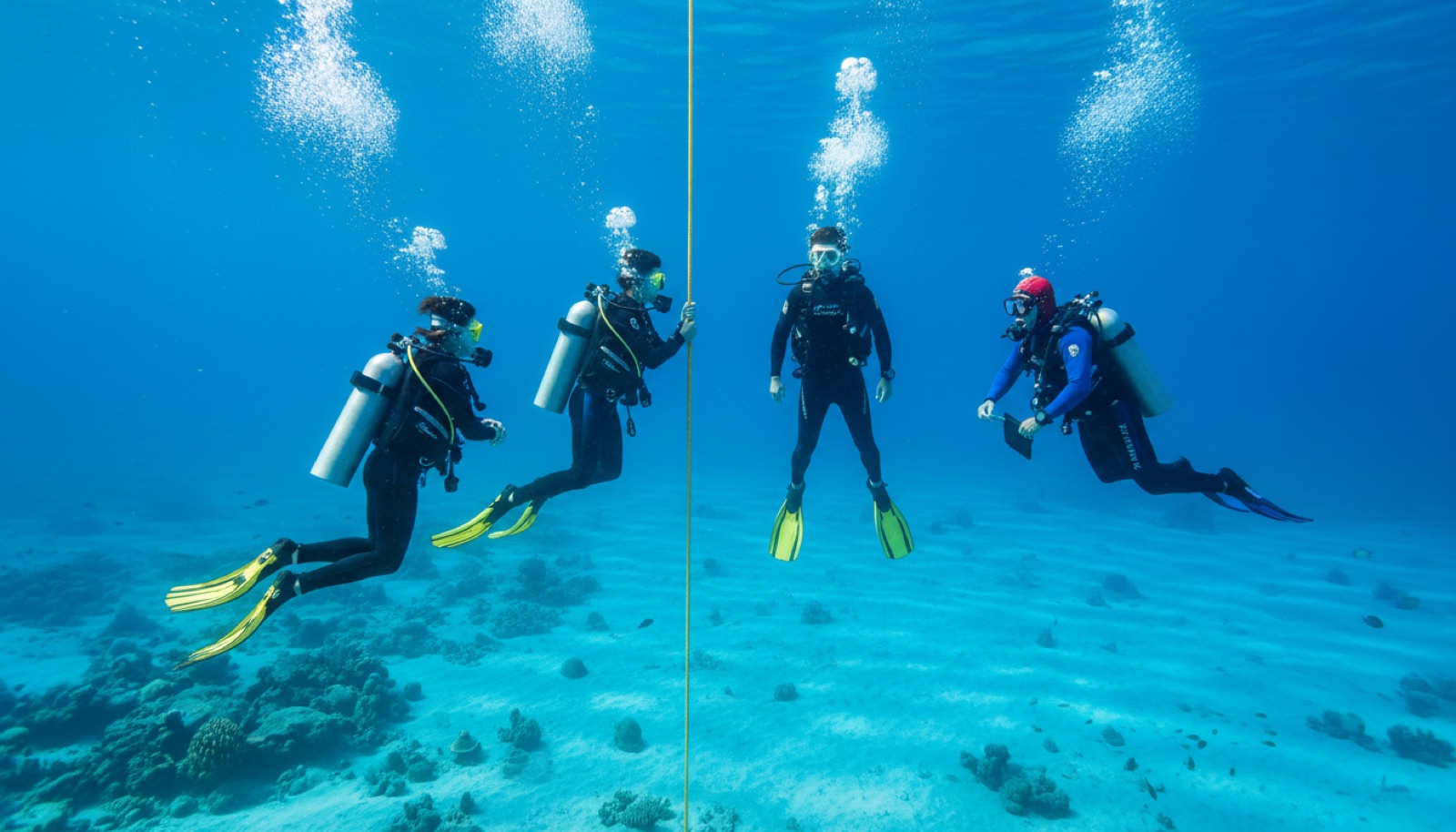
Every certification course teaches the same core physiology, and it is worth genuinely understanding rather than memorizing: breathing compressed air at depth loads your tissues with dissolved nitrogen, and how you release that load determines whether the ascent is uneventful or harmful. Decompression sickness (DCS, the bends) is what happens when the release goes wrong.
The gas story, briefly
At depth, the air from your tank arrives at ambient pressure, so each breath carries more nitrogen molecules than a surface breath. Since the body does not consume nitrogen, it simply dissolves into blood and tissues, faster into some (blood, brain) and slower into others (fat, joints), for as long as pressure stays elevated. Ascend, and the process reverses: tissues off-load nitrogen to the lungs. Done slowly enough, the gas leaves in solution, invisibly. Ascend too fast or after too much loading, and nitrogen can come out of solution as bubbles in tissues and blood, the way a soda fizzes when opened quickly. Bubbles can distort tissue, obstruct vessels and trigger inflammatory responses, producing symptoms from joint pain and profound fatigue to numbness, weakness, skin mottling, and in serious cases neurological injury. That, mechanically, is DCS.
Why the rules look the way they do
Everything your course drilled exists to manage this one process. No-decompression limits cap time at depth so tissues stay within a loading that permits direct ascent. Slow ascent rates give the gas gradient time to work through the lungs instead of forming bubbles. Safety stops add a low-cost buffer near the surface where pressure change per meter is greatest. Repetitive-dive planning, surface intervals and no-fly waiting periods exist because slow tissues keep off-gassing for many hours after you surface: you end every dive still carrying extra nitrogen. Dive computers track a mathematical model of all this in real time, which is why training and your computer, not any article, govern actual dives.
What actually moves the risk
DCS in recreational diving is rare, and it is not randomly distributed. Risk climbs with depth and time (more loading), fast ascents and skipped stops (worse unloading), and repetitive, multi-day diving without breaks. Dehydration, hard exercise around dives, being cold during ascent and significant fatigue are all taught as contributing factors. Two honest caveats belong in every diver's mental model. First, DCS occasionally occurs on dives that broke no rules: computers model populations, not your body on that day, which is why conservative habits and margins beat riding limits. Second, individual factors matter: some medical conditions and a form of heart anatomy called a PFO are associated with elevated risk in some divers, questions that belong with a physician trained in dive medicine, not with self-diagnosis.
If it goes wrong anyway
The trained response is straightforward and worth keeping sharp: stop diving, place the diver on the highest-concentration oxygen available, and get emergency help, local EMS plus the Divers Alert Network emergency line (+1-919-684-9111, collect calls accepted, with regional DAN hotlines in Europe and Asia-Pacific). Definitive treatment for significant cases is recompression in a hyperbaric chamber under medical direction; chamber availability changes, which is why the call goes through EMS and DAN rather than directly to a facility. Denial is the classic complication: divers explain away tingling or crushing fatigue for hours. The professional habit is the opposite: report symptoms early, accept oxygen, let dive-medicine physicians make the call. Understanding the mechanism, in the end, is what makes the discipline feel like sense rather than superstition.

