スキル · 4 分で読めます
The Frog Kick
The cave-diving kick that became the recreational gold standard: how the motion actually works, the faults that keep it from working, and a drill sequence for learning it.
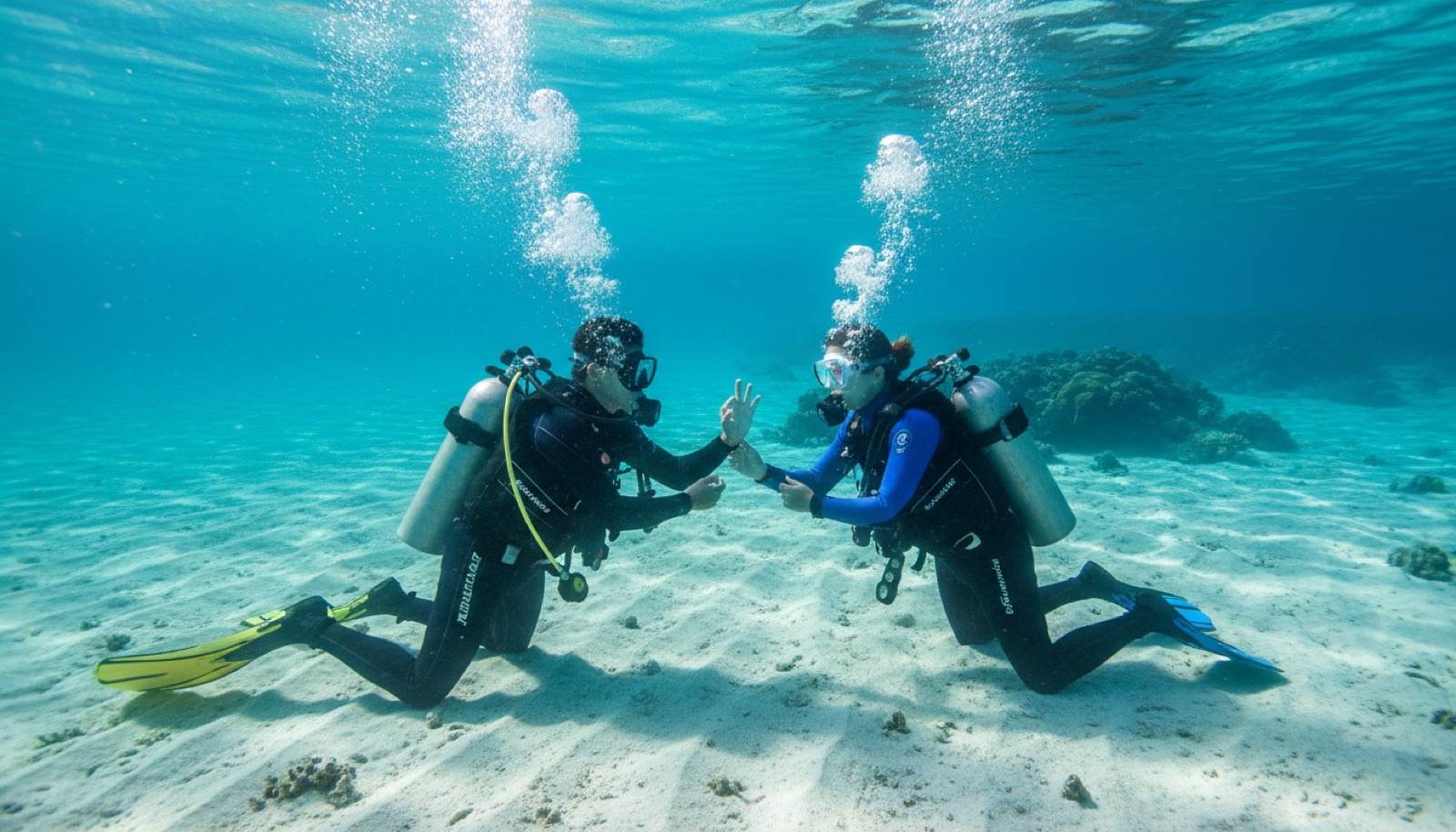
Watch a line of divers cross a sandy bottom and you can sort them by their wake: behind some, a rolling storm of stirred silt; behind others, nothing. The clean ones are almost certainly frog kicking. Borrowed from cave and wreck diving, where a single careless flutter can erase visibility for everyone behind you, the frog kick has become the default propulsion of skilled recreational divers for a simple reason (it sends water straight back, not down), and it carries a pleasant bonus: a built-in glide that suits the unhurried pace good diving rewards anyway.
The motion, broken down
Start from proper trim: horizontal, knees bent around ninety degrees, fins up behind you, soles facing the sky. The kick has three phases. First, the load: keeping knees roughly in place, rotate your ankles outward and sweep your feet apart and slightly back, fin blades turning to face each other like a pair of doors closing. Second, the power stroke: sweep both fins together in a smooth arc (the soles clap toward each other), squeezing the water captured between them straight backward. Third, and most neglected: the glide. Legs return to the relaxed bent-knee position and you do nothing while momentum carries you a body length or more. The rhythm is kick... and... coast, perhaps ten to fifteen unhurried cycles a minute, not the continuous churn of a flutter. Ankle flexibility does most of the fine work, which is why the kick feels foreign for the first sessions: those rotations are not swimming-pool movements.
The faults instructors see constantly
- Bicycle kicking: letting the knees drop and pump as if pedaling, which points the wash downward and defeats the purpose. Knees stay high and quiet; ankles and lower legs do the work.
- Skipping the glide: firing kick after kick, which doubles effort for little added speed. If you are always kicking, you are doing it wrong.
- Sagging trim: a head-up posture converts even a perfect frog kick into partial down-wash. Fix trim first; the kick lives on top of it.
- Half-hearted ankle rotation: without turning the blades to face each other, the power stroke pushes water sideways and the kick feels weak, prompting divers to churn harder instead of rotating further.
Learning it deliberately
Land rehearsal genuinely helps: lie flat on a bench or bed, feet hanging off, and pattern the out-turn, sweep, glide cycle until it stops requiring thought. In the pool, exaggerate slowly (big deliberate sweeps, long counts on the glide) and have someone shoot ten seconds of video, which will disagree with your inner picture in educational ways. Then take it to an easy dive over sand and grade yourself by the honest metric: look back along your path. No silt, no grade to dispute. Stiff, oversized or extremely soft fins each change the feel; most divers find a medium-stiff blade the easiest teacher. Expect competence in a few sessions and elegance in a season.
Keep the flutter kick in the toolkit (against current, on the surface, whenever raw speed matters, it still wins) and add the frog's refinements as they come: the modified, ankles-only version for tight spaces, and the back kick that grows naturally out of a reversed frog motion. But for the ordinary business of moving calmly along a reef with your visibility intact and your gas gauge grateful, the frog kick is the technique the sport quietly standardized on, and a weekend of deliberate practice is all it asks.