An toàn · 4 phút đọc
Oxygen Toxicity Basics
Why the gas that keeps you alive has a depth limit, what partial-pressure limits mean in practice, and how nitrox training manages the risk. Conceptual only: courses and computers govern real dives.
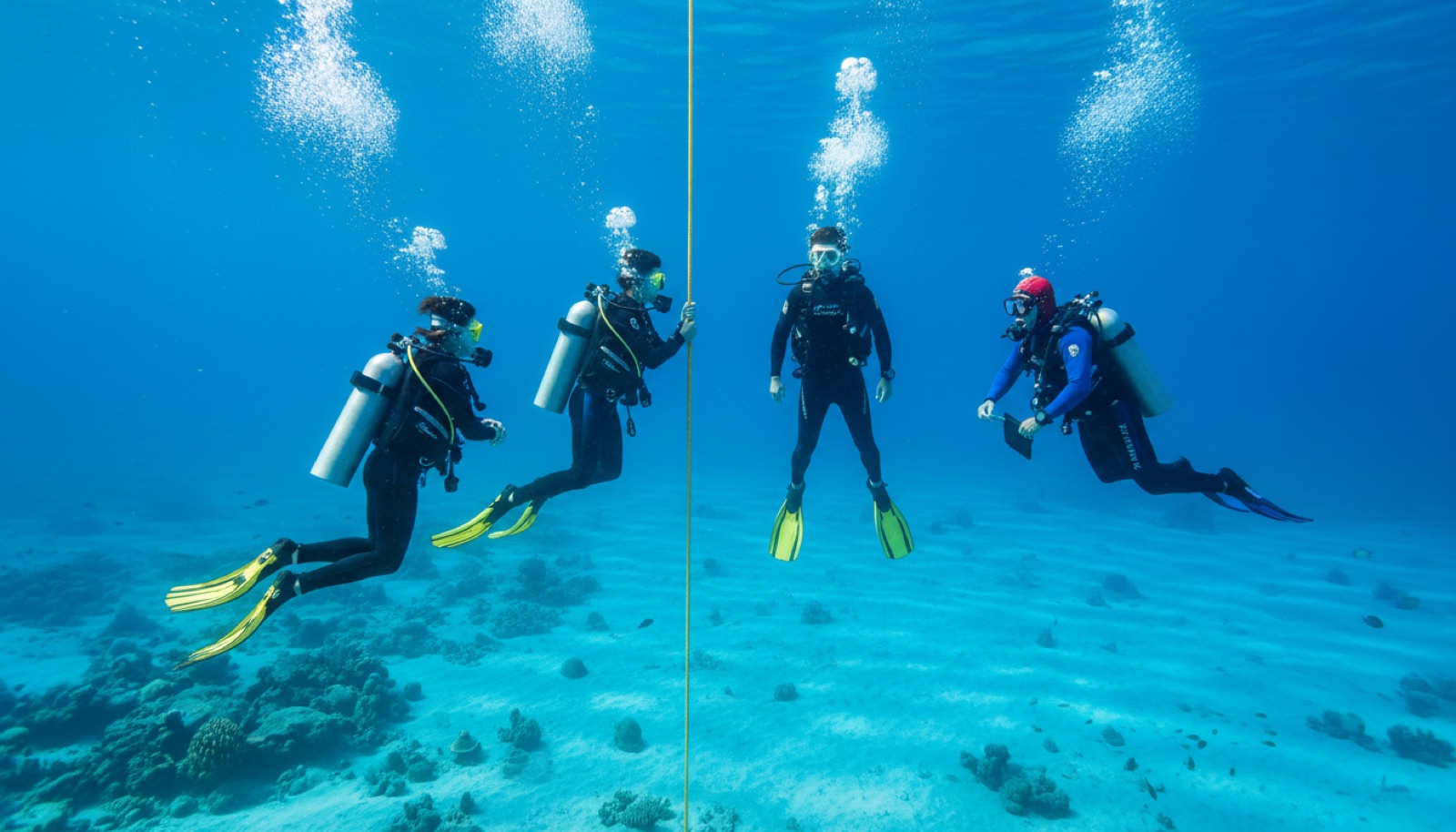
The counterintuitive lesson of nitrox training is that oxygen, breathed at high enough pressure, becomes a hazard in its own right. For air-breathing recreational divers inside standard limits this is a background fact; for anyone diving enriched air, it becomes the central planning constraint. The concept is worth genuinely understanding, because everything about nitrox procedure (the analysis, the stickers, the depth limits) flows from it.
Partial pressure: the number that matters
Your body responds not to the percentage of oxygen in a mix but to its partial pressure: the fraction multiplied by the ambient pressure, written as PO2 in bar. Surface air delivers about 0.21 bar of oxygen. At 30 meters (4 atmospheres) the same air delivers about 0.84; enriched air with 32 percent oxygen at the same depth delivers about 1.28. Mainstream recreational training sets a working maximum of 1.4 bar, with 1.6 treated as a contingency ceiling, and from that limit every mix acquires a maximum operating depth, or MOD: around 33 meters for 32 percent and 28 meters for 36 percent at PO2 1.4. This is the arithmetic behind the ritual every nitrox course drills: personally analyze your tank's oxygen fraction, label it, and plan the dive inside that mix's MOD, set into your computer.
What the limit protects against
Elevated oxygen partial pressures can affect the central nervous system, and the feared outcome is abrupt: CNS oxygen toxicity can produce a seizure with little or no warning, which underwater generally means a lost regulator and drowning risk. Training courses teach a symptom list: visual disturbance, ringing ears, nausea, twitching (especially facial), irritability or anxiety, and dizziness, with the honest caveat that a convulsion may arrive first. Risk rises with PO2 and with time at elevated PO2, is worsened by exertion and CO2 buildup, and varies unpredictably between individuals and days, which is exactly why the sport manages it with hard depth limits rather than with symptom-watching. A second, slower form (pulmonary oxygen toxicity, irritation of the lungs from very long exposures) belongs to technical, saturation and clinical settings rather than recreational profiles, and appears in courses mostly for completeness.
Where recreational divers actually meet this
- Nitrox diving: the everyday context. The entire management scheme is analysis, MOD planning, computer settings and respecting the working limit, taught in a one-day course that is among the most worthwhile in the sport.
- Air at recreational depths: comfortably below the limits; at 40 meters air carries a PO2 of about 1.05 bar. One more reason the 40-meter recreational ceiling is a well-chosen fence.
- Rich mixes and pure oxygen: decompression gases above roughly 40 percent, oxygen handling, and cylinder cleaning requirements are technical-diving and gas-blender territory with dedicated training; surface oxygen for first aid, by contrast, is unambiguously beneficial and taught in oxygen-provider courses.
- Rebreathers: machines that hold a chosen PO2 constant, making oxygen management the continuous, central discipline, with training to match.
Keeping it in proportion
Oxygen toxicity incidents in recreational diving are rare precisely because the fences work: analyze the gas, know the MOD, set the computer, stay above the limit, and the risk is engineered down to background levels. What deserves respect is the failure mode's speed: this is a hazard with limits rather than negotiations. Understand the concept here, then let a nitrox instructor, current agency materials and your own labeled analysis govern anything you actually breathe.