L'essentiel · 5 min de lecture
Pressure and Depth, Explained
Why water squeezes air, what happens to a balloon at 10, 20 and 30 meters, and how one law of physics explains your ears, your gas gauge, and the rule against holding your breath.
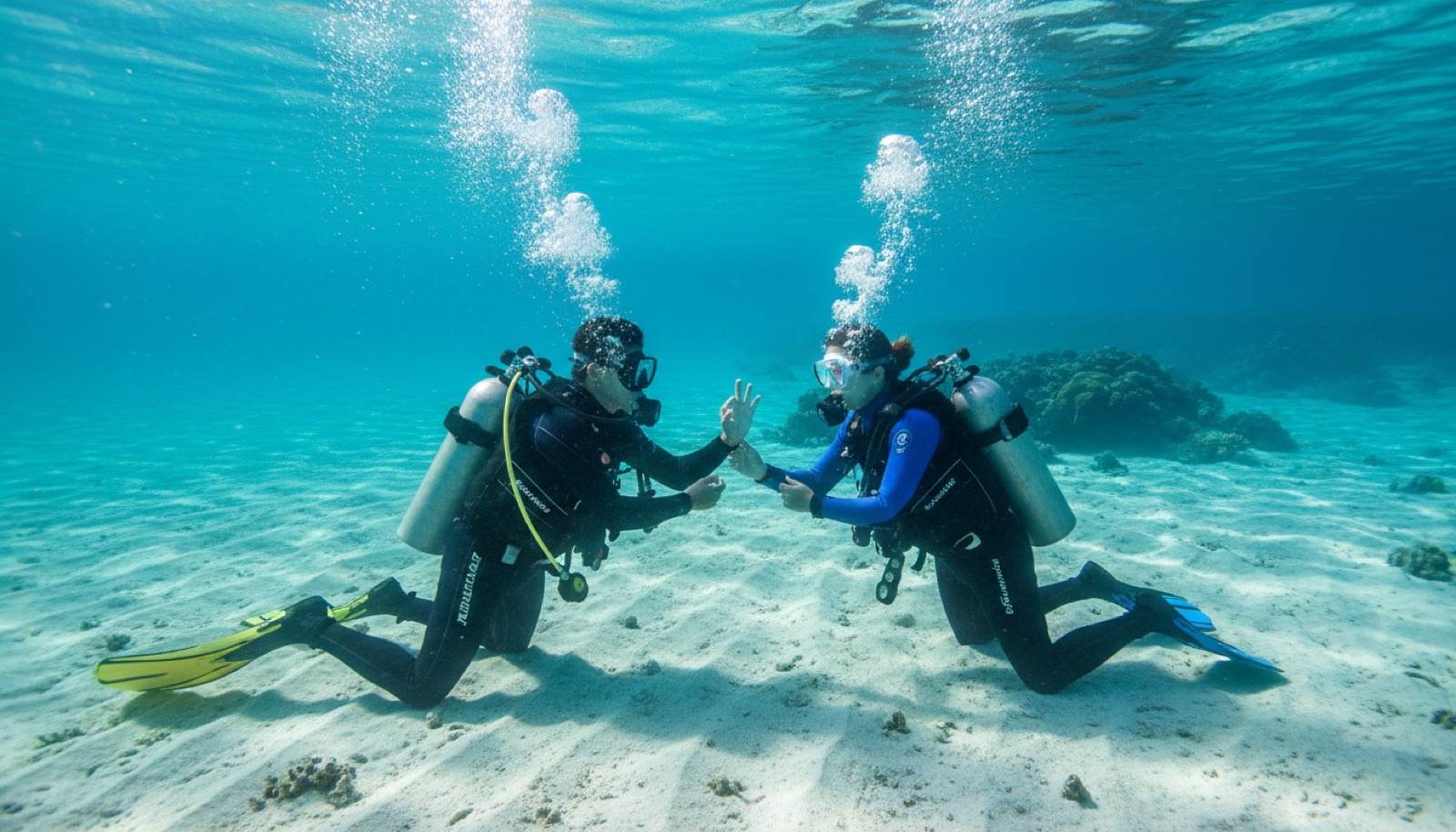
Push an upside-down cup straight down into a swimming pool and you can feel the water fighting you, squeezing the trapped air into a smaller and smaller pocket. Water is heavy (a single bucket of it weighs about ten kilograms), and the deeper you go, the more of it is stacked on top of you, pressing in from every side. Ten meters down, the squeeze on your body is already double what it was at the surface. A balloon carried there shrinks to half its size; carry it deeper and it keeps shrinking.
Divers put numbers on this. At the surface, the atmosphere presses on you with about 1 bar. Each 10 meters of seawater adds roughly 1 bar more. So the total, absolute pressure is about 2 bar at 10 meters, 3 bar at 20, 4 bar at 30, and 5 bar at 40 (the edge of recreational diving). In fresh water the steps are almost the same, just a touch deeper, because fresh water is slightly lighter than salt.
Boyle's law, the diver's law
The balloon is obeying Boyle's law: squeeze a gas with twice the pressure and it occupies half the volume; three times the pressure, a third of the volume. Density mirrors the shrinkage: at 30 meters and 4 bar, every lungful your regulator delivers is four times as dense as a surface breath, four times the molecules per liter. Two everyday consequences follow. First, gas goes fast at depth: a cylinder that would last well over an hour in the shallows is gone in roughly a quarter of that time at 30 meters, breathing calmly. Deep dives are short dives. Second, and this is the detail worth tattooing somewhere, the biggest change happens nearest the surface. Between 10 meters and the surface, pressure halves and any trapped air doubles. The last few meters of an ascent involve more expansion than the rest of the dive put together.
The rule and the air spaces
That is why the first rule taught in every scuba course is breathe continuously and never hold your breath. Your lungs are an air space; if a diver locks air in them and rises, that air expands, and lung tissue can be injured by an ascent of even a few meters. Breathe normally and the problem cannot occur, because each breath leaves through the regulator at the new pressure. The body's other air spaces make themselves known on the way down instead. Ears and sinuses feel the squeeze first (equalizing early and often is its own skill), and the mask must get a puff of air through the nose so it does not press against your face. Even a wetsuit joins in: its gas bubbles compress with depth, so it insulates less and floats less, which is why divers add air to the BCD as they descend and vent it climbing back up.
Numbers divers actually use
In practice the arithmetic stays simple. Depth gauges and computers read pressure and display it as meters. Gas planning leans on the density rule of thumb: expect roughly half the endurance at 10 meters, a third at 20, a quarter at 30, compared with the surface. And pressure drives one more story that deserves its own telling: the deeper you go, the more nitrogen each breath pushes into your body, which is where decompression theory begins. Once "1 bar per 10 meters" is second nature, most of dive theory stops being memorization and starts being obvious: the ears, the gas gauge, the slow ascent, and the shrinking balloon are all the same fact wearing different masks.