수중 촬영 · 4 분 분량
Strobe Positioning: Lighting the Subject, Not the Water
Backscatter is geometry, not bad luck. Where to put your strobes for wide angle and macro, how to feather beam edges, and the faults each mistake leaves in your frames.
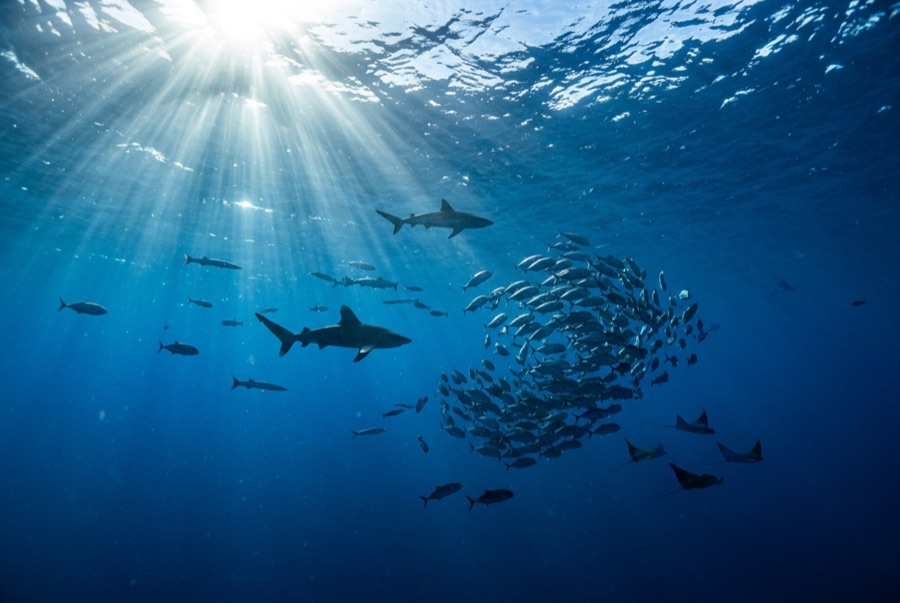
Almost every disappointing flash photograph from underwater fails the same way: a blizzard of bright specks hanging between the lens and the subject. That snow is backscatter: your own strobe light bouncing off particles in the water column and straight back into the lens. The cure is not a cleaner ocean and it is not more power. It is geometry.
Why backscatter happens
A strobe mounted near the lens and aimed straight ahead lights everything in front of the port, including every particle drifting between you and the subject. Particles lit head-on reflect toward the camera as crisp white dots. Move the strobes away from the lens axis and feather the beams so their hot centers pass beside or in front of the subject, and those same particles fall into shadow while the subject stays lit by the soft edge of the beam. Nearly all strobe technique is a variation on that one idea: light the subject, not the water you are shooting through.
Wide-angle starting positions
For reef scenes, pull the strobes out wide on their arms, level with the housing or slightly behind the plane of the port, sitting roughly at ten and two o'clock. Aim them straight ahead or fractionally outward so the beam edges brush the subject. Diffusers widen and soften the light and are worth leaving on by default. The frame itself will tell you what to fix: a washed-out hotspot in the middle means the strobes are too close to the lens axis or angled too far inward; black lower corners mean they are riding too high; a spray of specks across the whole image means the beams are lighting the water column between you and the reef.
Macro starting positions
Close range gives backscatter little water to live in, so macro strobes come in tight. A dependable starting point is one or both strobes just above the port, angled steeply down toward the subject. From there, experiment deliberately: light from one side rakes texture out of rough skin and coral; pulling a strobe behind and to the side of a translucent subject makes it glow at the edges. Because working distances are short, small strobe movements change the picture a lot; treat each adjustment as its own test shot.
Power, distance, and testing
Start around half power in manual mode and judge results from the screen and the histogram rather than memory. Light falls off with the square of distance: a subject twice as far away needs four times the light, which is why closing the gap usually beats cranking power. TTL automation earns its keep in macro, where distances are stable; wide angle rewards manual control. Two strobes give even coverage across a broad frame, but plenty of strong shooters work with one, using its position and the ambient blue to shape the scene.
A dive-by-dive routine
- Before descending, check arms move freely and connections fire.
- Open each dive with a test frame on a rock or your fin, and read the histogram.
- When a shot fails, move the strobes first and change power second.
- Re-feather after every big composition change: positions that suited a reef scene will not suit the seahorse ten minutes later.
Strobe craft is unglamorous and repetitive, and it is also the fastest visible improvement in underwater photography. A modest camera with well-placed light beats an expensive one with a blizzard in front of it every single time.