Temel Bilgiler · 5 dk okuma
What Is Scuba Diving?
The plain-language answer: what the gear does for you, what a dive really looks like from descent to safety stop, who can learn, and how the sport keeps genuine hazards manageable.
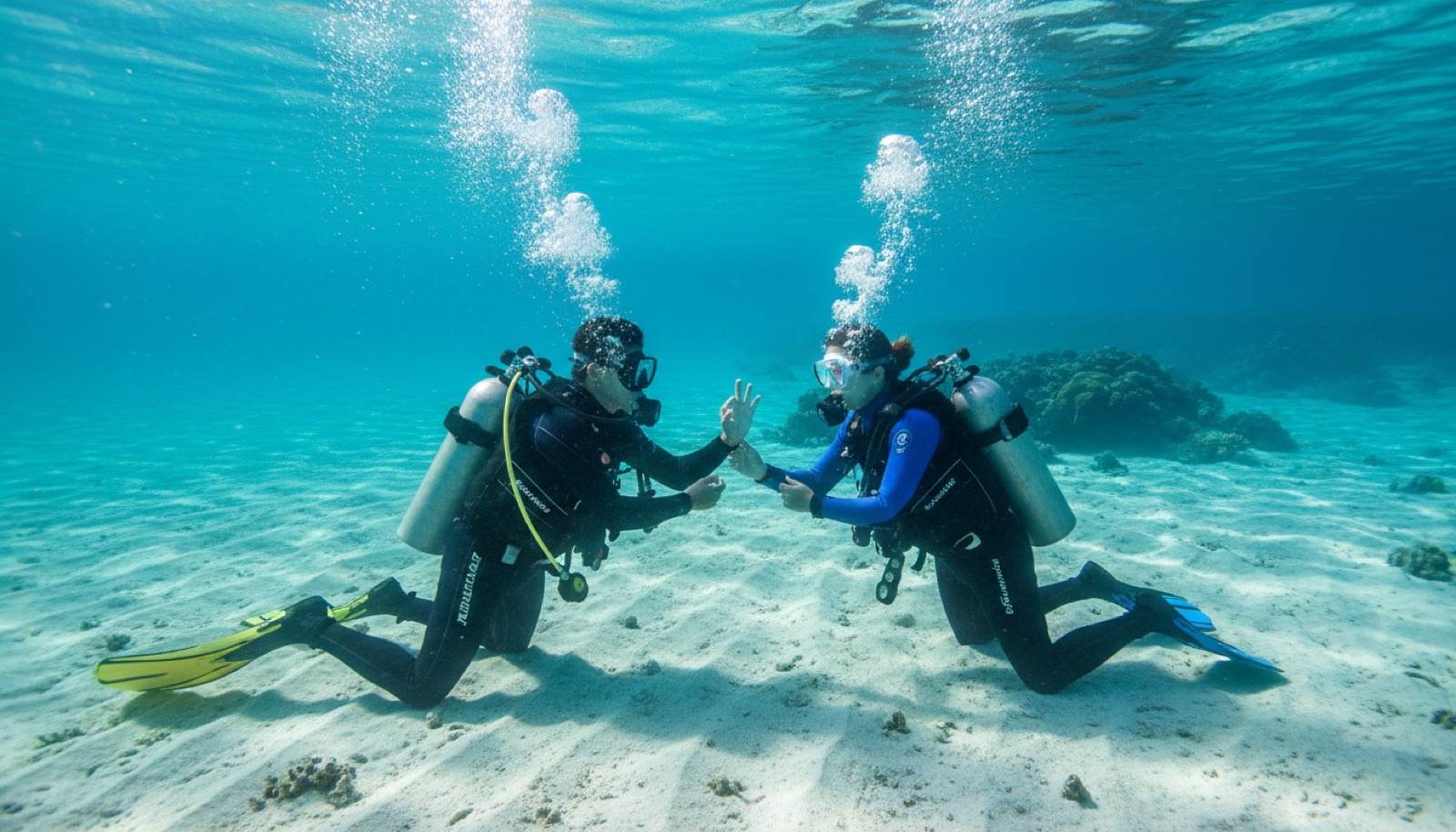
Scuba diving is swimming underwater while carrying your own air. A metal tank on your back holds air squeezed into a small space, a mouthpiece called a regulator hands it to you one breath at a time, and an inflatable jacket lets you rise, sink, or hang perfectly still, the way an astronaut floats. Add a mask so your eyes can focus and fins so your legs do the pushing, and you can stay down for the better part of an hour while the ocean carries on around you: fish keep feeding, turtles keep chewing, and you drift past like a polite guest.
The word itself is an acronym (self-contained underwater breathing apparatus) coined in the early 1950s, and "self-contained" is the part that matters. Earlier divers walked the seabed in brass helmets fed by hoses from the surface; a scuba diver carries everything and goes wherever the dive plan allows. The equipment most divers use today descends from the 1943 Aqua-Lung of engineer Émile Gagnan and a young French naval officer, Jacques-Yves Cousteau, whose demand valve released air only when the diver breathed in. Every regulator since has worked on the same principle.
What a dive actually looks like
A typical recreational dive lasts thirty to sixty minutes, mostly between 10 and 30 meters. You roll backward off a boat or walk in from shore with a buddy, vent the air from your jacket, and sink at the pace of a slow elevator, pinching your nose to make your ears pop as the pressure builds. At depth you glide along a reef or a wall (the loudest sound is your own exhaled bubbles), then come up even more slowly than you went down, pausing about three minutes a few meters under the surface as a safety margin. Newly certified divers are trained for depths to 18 meters; further training extends recreational diving to a firm ceiling of 40 meters. Within those limits, dives are planned so that a direct, unhurried swim to the surface remains available at every moment.
Who can dive
Most major agencies certify children from age ten through junior programs, and there is no upper age limit given reasonable health. The physical bar is lower than most people expect: you need to be a comfortable swimmer, able to cover a modest distance and float for a few minutes, and you fill out a medical questionnaire. Certain answers (asthma, heart or ear history among them) simply route you to a physician, ideally one trained in dive medicine, before you start. People who wear glasses dive with prescription masks or soft contact lenses, and adaptive programs certify divers with a wide range of physical disabilities.
How risky is it, honestly
Diving involves real hazards (pressure, compressed gas, open water), and training exists precisely to manage them. The sport's safety record rests on a handful of absolute rules: breathe continuously and never hold your breath, ascend slowly, watch your gas supply, stay inside the limits of your certification, and dive with a buddy. Respected, those rules make serious incidents rare; ignored, the ocean is unforgiving. That is why certification is genuine instruction rather than paperwork, and why good divers treat the rules as habits rather than tests.
How you start
There are two doors in. A try-dive experience puts you underwater the same day, in a pool or calm shallow water, under an instructor's direct supervision (no certification earned, no commitment made). The entry-level course, Open Water Diver or its equivalent, takes three to four days: theory you can largely do online, skill practice in a pool, then four open-water dives. The card is recognized worldwide and never expires, though after a long layoff a short refresher is the honest move. And while the postcard version of the sport is tropical, people dive quarries, lakes, kelp forests, and beneath ice with the right suit and training. Wherever there is water deep enough to matter, someone is happily sinking into it.

