Fotografía · 4 min de lectura
Wide-Angle Underwater Photography: Reefs, Wrecks, and Open Blue
The counterintuitive rule of big underwater scenes: the wider the lens, the closer you get. Dome ports, balancing strobe light against blue water, and compositions that give scale.
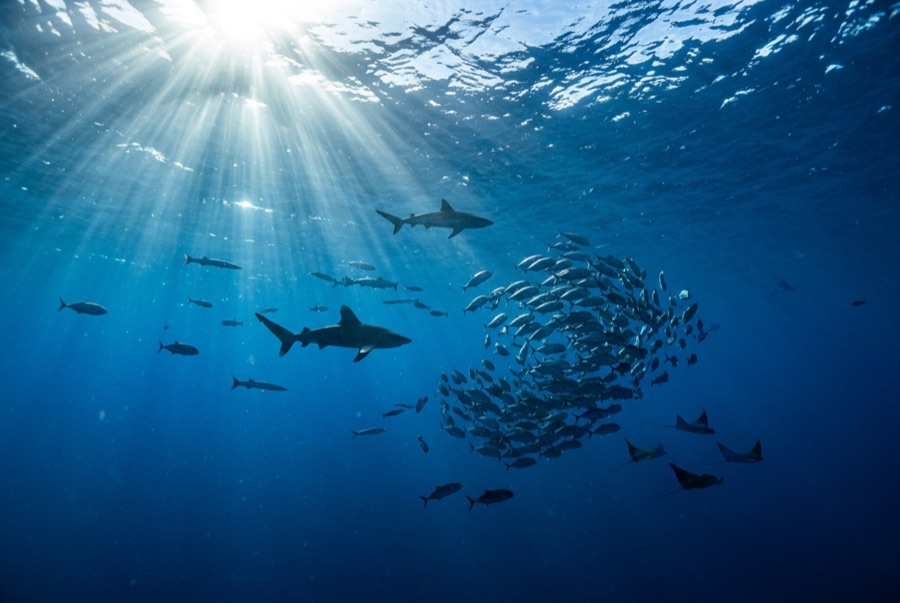
Wide-angle underwater photography runs on a rule that sounds backwards: the wider your lens, the closer you should be. Beginners buy a wide lens to fit more in, then shoot sweeping scenes from ten meters away and wonder why everything looks pale and flat. The water in between did that. Wide angle exists so you can be a meter from your foreground subject and still show the reef, the wreck, or the shark behind it.
Lenses, domes, and why they matter
Two families of lens dominate. Fisheye lenses give huge, curved fields of view and focus almost on the glass, ideal for reef scenes and close-focus work where a little bend flatters coral rather than distorting it. Rectilinear wide lenses keep straight lines straight, which suits wrecks and divers, at the cost of narrower coverage. Behind either sits a dome port, which corrects the way water bends light at a flat surface; the dome creates a virtual image close to the port, so sharpness depends on stopping down and letting the lens focus near. Compact and action-camera shooters get a real taste of the same discipline with wet wide conversion lenses.
Balancing two exposures at once
Every wide-angle frame is two photographs: ambient blue water exposed by shutter speed and ISO, and a strobe-lit foreground exposed by flash power and distance. Useful starting points in tropical water are f/8–f/13, shutter 1/60–1/200 within your sync limit, ISO 200–400, strobes wide and feathered. Meter for the blue you want first (darker and moodier with faster shutter, lighter and airier with slower), then bring strobe power up until the foreground shows color without glare. For sunbursts, a fast shutter and small aperture hold the sun's disc together; shooting up through Snell's window, the bright circle that frames the surface world overhead, remains one of the genre's oldest reliable tricks.
Composition with scale and depth
- Get low and shoot upward; separating the subject against water or sky beats shooting down onto clutter.
- Build frames in layers: a strong foreground within a meter or two, a midground reef line, blue water behind.
- Add a diver for scale (briefed in advance, trimmed flat, torch angled deliberately) rather than hoping a buddy drifts through usefully.
- Leave breathing room in the direction an animal is moving.
Reading conditions honestly
Wide angle is the discipline most dependent on conditions. Clean water and sun overhead multiply everything good; milky water punishes distance without mercy, and on those days the smart move is tighter close-focus wide-angle frames or a switch to macro. Plan wide-angle dives for the best visibility of the trip, keep your strobes feathered, and accept that some scenes are simply bigger than the day's water will allow. Destinations built of clear water and dramatic topography (the ridges of Raja Ampat, the coral heads and channels of Palau) are where a wide lens repays every gram of luggage it cost.
Above all, wide angle rewards restraint. One deliberate frame, built low and close with the light balanced, outlasts a hundred hopeful snapshots taken on the swim past.

