Sites de plongée, saisons et vie marine — recherchés, cartographiés, planifiés.
Menu
Destinations Sites de plongée Vie marine Épaves Actualités
Planifier un voyage Planificateur de séjour Quand plonger Calculateur de coût Comparaisons Calendrier de la faune marine Température de l'eau Liveaboards Opérateurs & resorts Parcs marins Caissons hyperbares Carte du monde
Régions Australie, Nouvelle-Zélande & Asie de l'EstCaraïbes & Atlantique occidentalEurope, Atlantique & MéditerranéeOcéan Indien & Afrique de l'EstÎles du Pacifique & MicronésieMer Rouge & Moyen-OrientAsie du Sud-Est et Triangle de CorailLes Amériques et Pacifique Est Pays
Apprendre & Outils Tous les guides Certifications Guides d'équipement Vidéos Interroger les données Agents IA API
À propos À propos de nous Méthodologie Avertissement Contact
Votre vue
★ Enregistré

Vos destinations, sites et espèces favoris — enregistrés dans ce navigateur.

API GATEWAY

Accès JSON gratuit en lecture seule aux données en cache de l'atlas.

Mode sombre

🧭 Vue Guidée
Nouveau dans la plongée — profondeurs, courants, niveaux de certification ? Nous expliquons chaque terme au fil de votre navigation, en langage clair. Les mêmes données, avec l'aide intégrée.

⚡ Vue Expert
Vous connaissez déjà la différence entre un tombant et un drift. Juste les données — claires, rapides et compactes. C'est la vue par défaut.

Langue de l'interface
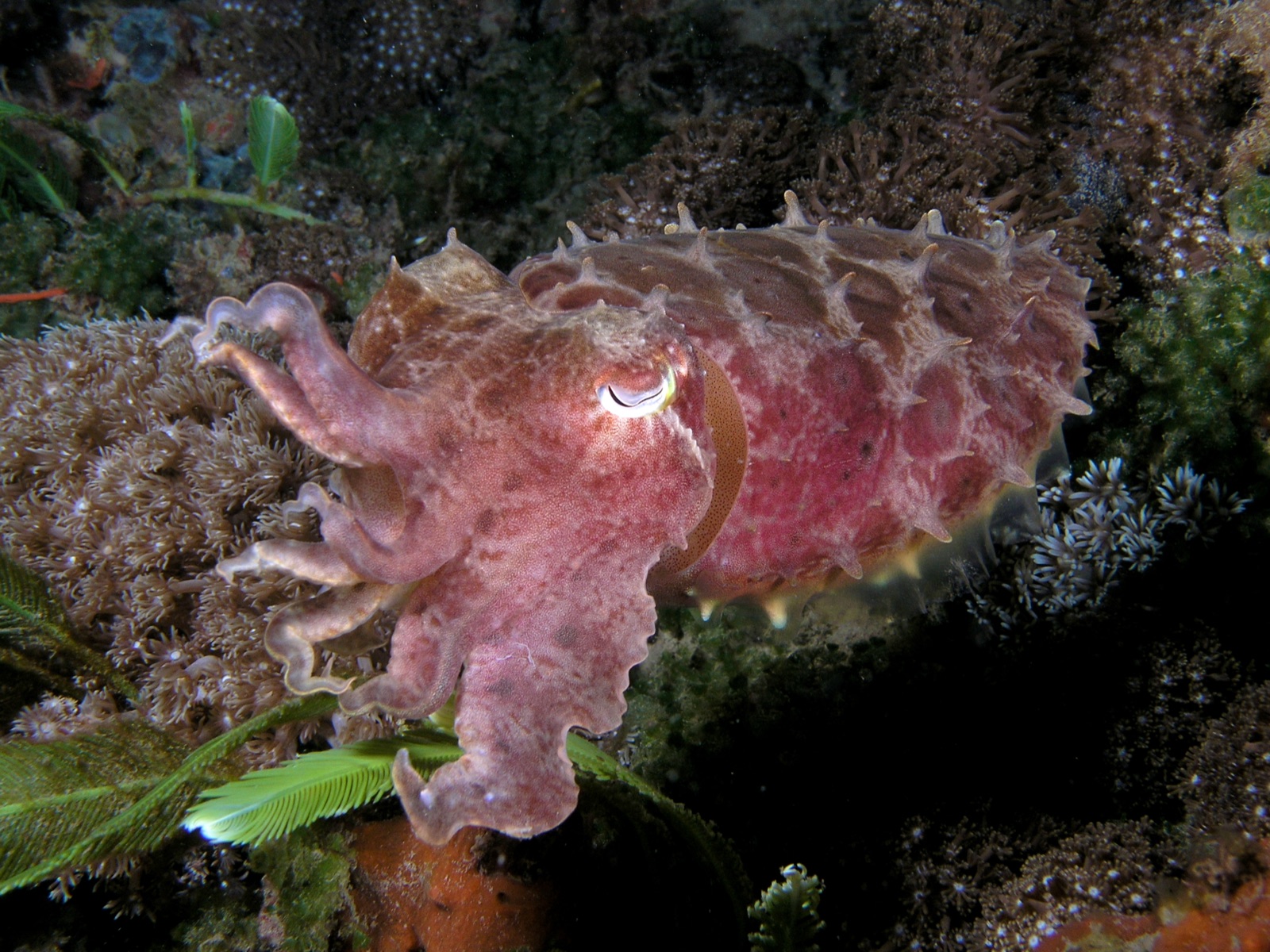
Broadclub Cuttlefish — illustration
Illustration générée par IA pour The Scuba Atlas — illustrative, et non une photographie documentaire.

Cephalopods

Broadclub Cuttlefish

Sepia latimanus · Cephalopod mollusk — family Sepiidae; the largest cuttlefish on tropical Indo-Pacific reefs

IUCN: DD ~0.3 m mantle length; heavyweights reach roughly 10 kg 2–30 m tranche de profondeur Documenté

The broadclub cuttlefish is the big, watchable cuttlefish of tropical reefs — second in size only to Australia's giant — and the one most likely to meet a diver's gaze with its strange W-shaped pupil and simply hold position, hovering on the ripple of its fin skirt. Its party piece is the passing cloud: bands of dark color strobing forward across face and arms while it stalks a crab, apparently dazzling the prey into stillness before the twin feeding tentacles fire. Individuals often tolerate long, close observation, cycling camouflage and curiosity in equal measure. In breeding aggregations males guard females and flash zebra patterns at rivals, sometimes courting on one body half while warning on the other. Eggs go deep into branching coral like clusters of white grapes. Approach slowly; ink means the show is over.

Où et quand en observer un

« Résident » signifie que la plupart des plongées sur ce site permettent de les observer ; « saisonnier » signifie qu'ils sont présents de manière fiable durant les mois indiqués ; tout le reste est un bonus, pas une certitude.

DestinationFiabilitéMoisNotes
Sipadan & MabulMalaysia Resident — seen on most dives Toute l'année
Raja AmpatIndonesia Resident — seen on most dives Toute l'année
PalauPalau Resident — seen on most dives Toute l'année
Cairns & the Ribbon ReefsAustralia Resident — seen on most dives Toute l'année
Similan Islands & Richelieu RockThailand Resident — seen on most dives Toute l'année
MoalboalPhilippines Resident — seen on most dives Toute l'année

Meilleur mois, en un coup d'œil

MoisDestinations fiables
January Sipadan & Mabul · Raja Ampat · Palau · Cairns & the Ribbon Reefs · Similan Islands & Richelieu Rock · Moalboal
February Sipadan & Mabul · Raja Ampat · Palau · Cairns & the Ribbon Reefs · Similan Islands & Richelieu Rock · Moalboal
March Sipadan & Mabul · Raja Ampat · Palau · Cairns & the Ribbon Reefs · Similan Islands & Richelieu Rock · Moalboal
April Sipadan & Mabul · Raja Ampat · Palau · Cairns & the Ribbon Reefs · Similan Islands & Richelieu Rock · Moalboal
May Sipadan & Mabul · Raja Ampat · Palau · Cairns & the Ribbon Reefs · Similan Islands & Richelieu Rock · Moalboal
June Sipadan & Mabul · Raja Ampat · Palau · Cairns & the Ribbon Reefs · Similan Islands & Richelieu Rock · Moalboal
July Sipadan & Mabul · Raja Ampat · Palau · Cairns & the Ribbon Reefs · Similan Islands & Richelieu Rock · Moalboal
August Sipadan & Mabul · Raja Ampat · Palau · Cairns & the Ribbon Reefs · Similan Islands & Richelieu Rock · Moalboal
September Sipadan & Mabul · Raja Ampat · Palau · Cairns & the Ribbon Reefs · Similan Islands & Richelieu Rock · Moalboal
October Sipadan & Mabul · Raja Ampat · Palau · Cairns & the Ribbon Reefs · Similan Islands & Richelieu Rock · Moalboal
November Sipadan & Mabul · Raja Ampat · Palau · Cairns & the Ribbon Reefs · Similan Islands & Richelieu Rock · Moalboal
December Sipadan & Mabul · Raja Ampat · Palau · Cairns & the Ribbon Reefs · Similan Islands & Richelieu Rock · Moalboal

Les comprendre

Habitat: Coral reefs and adjacent seagrass and rubble, hovering near branching coral where it hunts and breeds.

Aire de répartition: Indo-Pacific from the Andaman Sea through the Coral Triangle to northern Australia, Micronesia, and southern Japan.

Comportement: Famous for the passing-cloud display — bands of dark color strobing forward over the face and arms to mesmerize prey; breeding males guard females and flash zebra patterns at rivals, sometimes displaying differently on each body half.

Régime alimentaire: Crabs, shrimp, and fishes struck with twin feeding tentacles after a slow stalk.

Taille: généralement autour de 0.3 m; documenté jusqu'à 0.5 m (mantle length; heavyweights reach roughly 10 kg).

Comment se comporter avec lui

Move gently and stay to one side; a relaxed animal will hold position and cycle displays for minutes, while a startled one inks and the audience is over. Leave egg clusters in branching coral untouched.

Conservation

Formally Data Deficient; taken in reef fisheries across parts of the range, and breeding-season animals are conspicuously easy targets.

Sites répertoriés connus pour leur présence

Regarder

Depuis les canaux officiels

Toutes les vidéos →

Les vidéos sont des liens intégrés vers les chaînes de leurs créateurs — nous n'hébergeons rien et créditons tout.

Sources: Wikipedia ↗IUCN Red List ↗ · Informations vérifiées par rapport aux sources ci-dessus ; les champs sans référence sont marqués non encore vérifiés.

Australie, Nouvelle-Zélande & Asie de l'Est

Cairns & the Ribbon ReefsNingaloo ReefCoral Sea & Osprey ReefOkinawa & the Kerama IslandsPoor Knights IslandsTownsville & the YongalaGreen IslandIzu Peninsula

Caraïbes & Atlantique occidental

BonaireCozumelRiviera Maya & the CenotesBelize Barrier ReefGrand CaymanIsla Mujeres & CancúnRoatánTiger Beach & Grand Bahama

Europe, Atlantique & Méditerranée

Malta & GozoSilfra & IcelandThe AzoresCanary IslandsLarnaca & the ZenobiaScapa FlowArctic NorwayMadeira

Océan Indien & Afrique de l'Est

North & South Malé AtollsAri AtollBaa Atoll & Hanifaru BayAliwal Shoal & UmkomaasMafia IslandMauritiusSeychellesSodwana Bay

Îles du Pacifique & Micronésie

PalauChuuk (Truk) LagoonFakaravaKona, HawaiʻiRangiroaTaveuni & Rainbow ReefBeqa Lagoon & Pacific HarbourEspiritu Santo

Mer Rouge & Moyen-Orient

Sharm El Sheikh & Ras MohammedBrothers, Daedalus & St John'sDahabHurghada & El GounaMarsa Alam & the Deep SouthAqabaDaymaniyat IslandsMusandam Peninsula

Asie du Sud-Est et Triangle de Corail

Bali & Nusa PenidaKomodoRaja AmpatSipadan & MabulAnilaoCoronKoh TaoLembeh Strait

Les Amériques et Pacifique Est

Galápagos IslandsCocos IslandFlorida KeysSea of Cortez & Cabo PulmoSocorro & the RevillagigedosBritish ColumbiaCalifornia Channel IslandsCosta Rica Pacific Coast