Cephalopods
Broadclub Cuttlefish
Sepia latimanus · Cephalopod mollusk, family Sepiidae; the largest cuttlefish on tropical Indo-Pacific reefs
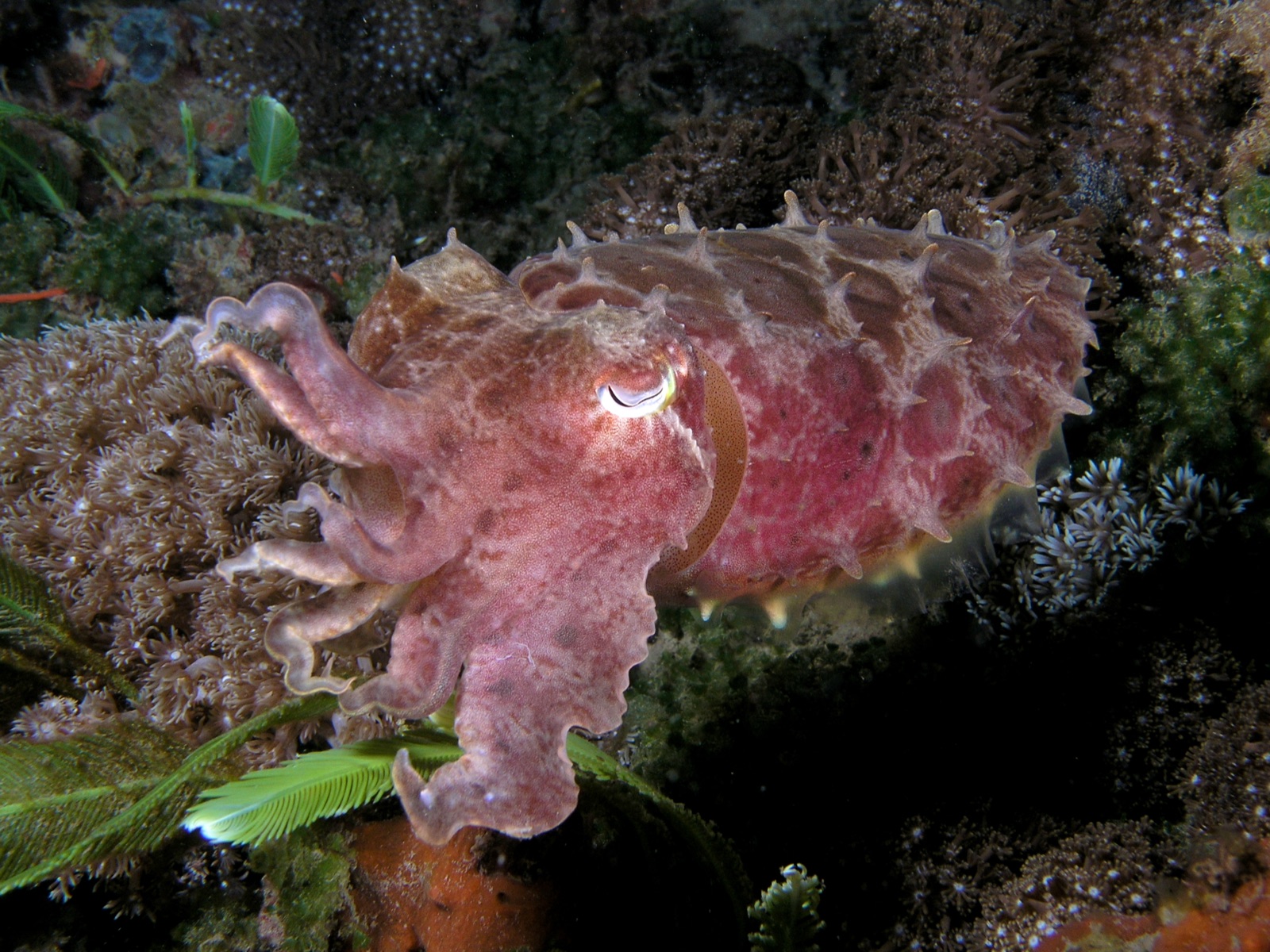
The broadclub cuttlefish is the big, watchable cuttlefish of tropical reefs, second in size only to Australia's giant, and the one most likely to meet a diver's gaze with its strange W-shaped pupil and simply hold position, hovering on the ripple of its fin skirt. Its party piece is the passing cloud: bands of dark color strobing forward across face and arms while it stalks a crab, apparently dazzling the prey into stillness before the twin feeding tentacles fire. Individuals often tolerate long, close observation, cycling camouflage and curiosity in equal measure. In breeding aggregations males guard females and flash zebra patterns at rivals, sometimes courting on one body half while warning on the other. Eggs go deep into branching coral like clusters of white grapes. Approach slowly; ink means the show is over.
Onde e quando ver um
"Residente" significa que a maioria dos mergulhos naquele destino os encontra; "sazonal" significa presença confiável nos meses listados; qualquer outra coisa é um bônus, não um plano.
| Destino | Fiabilidade | Meses | Notas |
|---|---|---|---|
| Sipadan & MabulMalaysia | Resident: seen on most dives | Todo o ano | |
| Raja AmpatIndonesia | Resident: seen on most dives | Todo o ano | |
| PalauPalau | Resident: seen on most dives | Todo o ano | |
| Cairns & the Ribbon ReefsAustralia | Resident: seen on most dives | Todo o ano | |
| Similan Islands & Richelieu RockThailand | Resident: seen on most dives | Todo o ano | |
| MoalboalPhilippines | Resident: seen on most dives | Todo o ano |
Melhor mês, em resumo
Entendendo-os
Habitat: Coral reefs and adjacent seagrass and rubble, hovering near branching coral where it hunts and breeds.
Distribuição: Indo-Pacific from the Andaman Sea through the Coral Triangle to northern Australia, Micronesia, and southern Japan.
Comportamento: Famous for the passing-cloud display: bands of dark color strobing forward over the face and arms to mesmerize prey; breeding males guard females and flash zebra patterns at rivals, sometimes displaying differently on each body half.
Dieta: Crabs, shrimp, and fishes struck with twin feeding tentacles after a slow stalk.
Tamanho: normalmente cerca de 0.3 m; documentado até 0.5 m (mantle length; heavyweights reach roughly 10 kg).
Como se comportar perto de um
Move gently and stay to one side; a relaxed animal will hold position and cycle displays for minutes, while a startled one inks and the audience is over. Leave egg clusters in branching coral untouched.
Conservação
Formally Data Deficient; taken in reef fisheries across parts of the range, and breeding-season animals are conspicuously easy targets.
Pontos mapeados conhecidos por eles
Os locais destacados foram cartografados para esta espécie pelos nossos editores; os números são registos de ocorrência do GBIF num raio de cerca de 5 km do local desde 1990.
Assista
Dos canais oficiais

Wildlife of Monterey | New film in our auditorium

Live Aviary Cam | Monterey Bay Aquarium

Live Aviary Cam | Monterey Bay Aquarium
Os vídeos são ligações incorporadas para os canais dos próprios criadores. Não alojamos nada e creditamos tudo.