Invertebrates
Christmas Tree Worm
Spirobranchus giganteus · Segmented worm, family Serpulidae (calcareous tube worms); the familiar reef animals form the Spirobranchus giganteus species complex
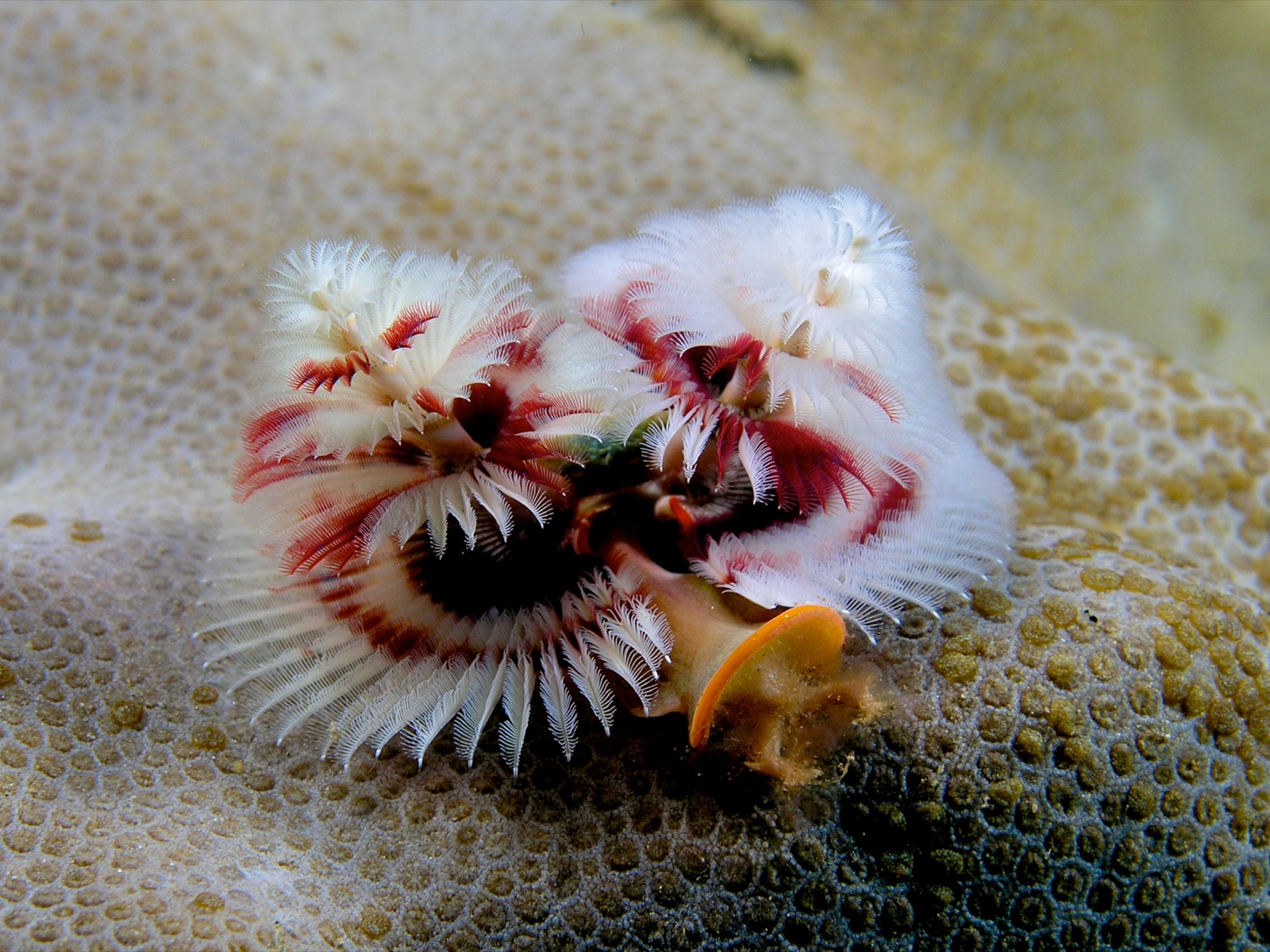
Christmas tree worms are the reef's pop-up decorations: twin spiral crowns, two or three centimeters tall, in blue, orange, yellow, white, and maroon, sprouting in constellations from heads of living coral. The crowns are the working end of a tube worm whose body stays sealed inside the coral skeleton, filtering plankton and breathing with the same feathery radioles. Startle one (a shadow, a pressure wave, an exhale too close) and it vanishes faster than the eye can track, capping its burrow with a spiked trapdoor. Then the game begins: hold position and count the seconds until the spirals unfurl again. Individuals can occupy the same coral head for decades, outliving most of the fish around them. They make superb practice subjects for breath control and slow approaches, grading your technique instantly and in public.
Where and when to see one
"Resident" means most dives at that destination encounter them; "seasonal" means reliably present in the listed months; anything else is a bonus, not a plan.
| Destination | Reliability | Months | Notes |
|---|---|---|---|
| Sharm El Sheikh & Ras MohammedEgypt | Resident: seen on most dives | Year-round | |
| North & South Malé AtollsMaldives | Resident: seen on most dives | Year-round | |
| BonaireBonaire | Resident: seen on most dives | Year-round | |
| CozumelMexico | Resident: seen on most dives | Year-round | |
| Cairns & the Ribbon ReefsAustralia | Resident: seen on most dives | Year-round | |
| RoatánHonduras | Resident: seen on most dives | Year-round |
Best month, at a glance
Understanding them
Habitat: Embedded in living coral heads (massive Porites especially) on sunlit reef flats and slopes.
Range: Circumtropical on coral reefs worldwide, from the Caribbean through the Indo-Pacific and Red Sea.
Behavior: Instantly withdraws at a shadow or pressure wave, sealing the tube with a spiked operculum, then re-emerges over seconds to minutes; individuals can hold the same spot for decades.
Diet: Suspended plankton and particles filtered by the feathery spiral crowns, which double as gills.
How to behave around one
Approach with slow exhalations and no touching. Triggering mass retractions for fun costs the worms feeding time, and the host coral does not appreciate braced fingers either.
Conservation
Not formally assessed; fortunes are welded to those of living coral, since the worm cannot outlive its host colony's surface.
Charted sites known for them
Highlighted sites were charted for this species by our editors; numbers are GBIF occurrence records logged within about 5 km of a site since 1990.
Watch
From the official channels

Wildlife of Monterey | New film in our auditorium

Live Aviary Cam | Monterey Bay Aquarium

Live Aviary Cam | Monterey Bay Aquarium
Videos are embedded links to their creators' own channels. We host nothing and credit everything.