Cephalopods
Flamboyant Cuttlefish
Metasepia pfefferi · Cephalopod mollusk, family Sepiidae; a dwarf cuttlefish with a reduced internal cuttlebone
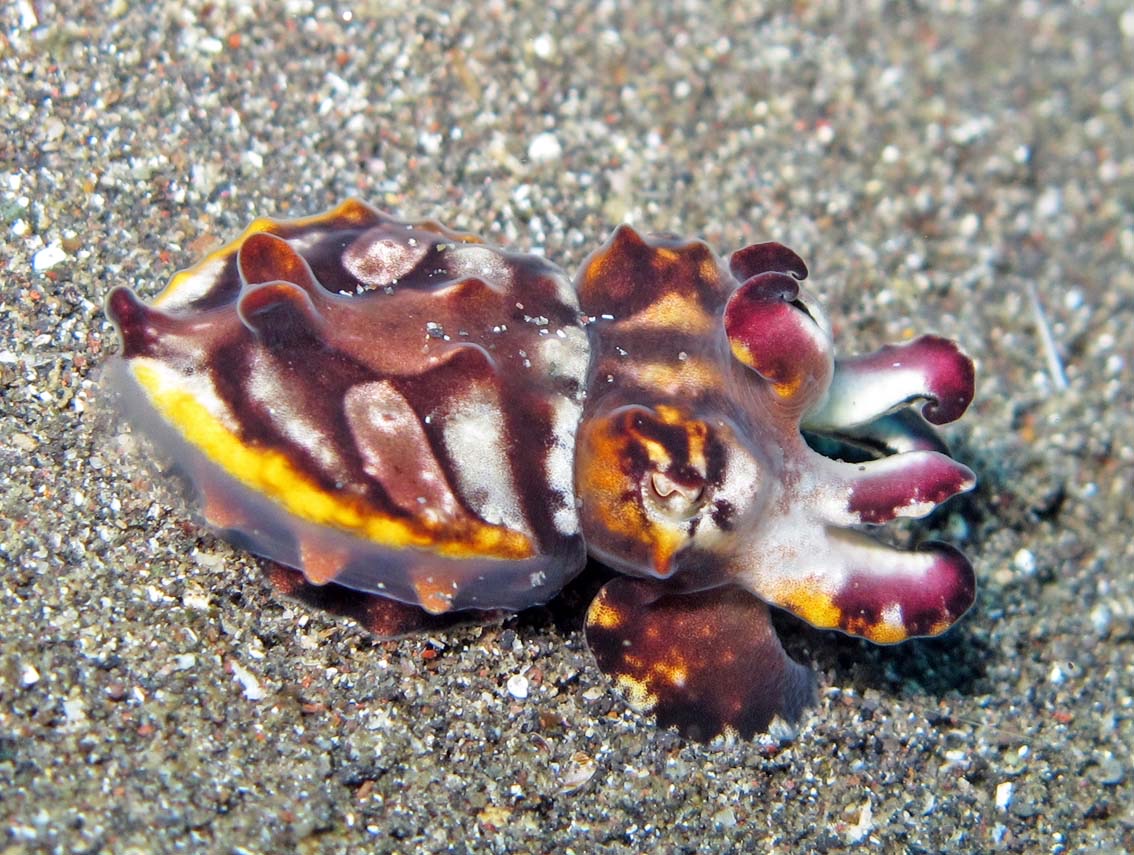
A flamboyant cuttlefish crossing a black-sand flat looks like a wind-up toy in ceremonial dress: a fist-sized animal ambling on two arm tips and skin flaps because its reduced internal cuttlebone barely floats it, pulsing waves of maroon, yellow, and white down its body as it goes. The pageant reads as warning coloration: laboratory work has reported significant toxins in its muscle, a rarity among cuttlefish, and the animal behaves like something with nothing to prove, hunting tiny shrimp and fish in open daylight with a deliberate tongue-flick strike of its feeding tentacles. At rest it fades to mud brown and simply disappears against the silt. Females glue eggs under coconut shells and rubble, and hatchlings emerge as perfect miniatures already flashing the family colors. It is a muck signature: ask the guides which slope has been producing.
Wo und wann man eines sieht
„Resident" bedeutet, dass die meisten Tauchgänge am jeweiligen Tauchziel eine Begegnung erwarten lassen; „saisonal" bedeutet, dass die Art in den genannten Monaten zuverlässig anzutreffen ist; alles andere ist ein Bonus, keine Planungsgrundlage.
| Ziel | Zuverlässigkeit | Monate | Hinweise |
|---|---|---|---|
| Lembeh StraitIndonesia | Occasional | Ganzjährig | |
| AnilaoPhilippines | Occasional | Ganzjährig | |
| Banda Sea & AmbonIndonesia | Occasional | Ganzjährig | |
| Dumaguete, Dauin & Apo IslandPhilippines | Occasional | Ganzjährig | |
| Milne BayPapua New Guinea | Occasional | Ganzjährig |
Bester Monat auf einen Blick
Sie verstehen
Lebensraum: Open sand, silt, and mud flats of sheltered bays and muck slopes, usually walking rather than swimming.
Verbreitung: Indo-Malayan region and northern Australia: Indonesia, Malaysia, the Philippines, and New Guinea.
Verhalten: Ambles across the bottom on two arm tips and skin flaps, pulsing waves of maroon, yellow, and white when hunting or alarmed; fades to mud brown at rest and vanishes.
Ernährung: Small shrimp and fishes taken with a slow-motion stalk and a lightning strike of the feeding tentacles.
Größe: typischerweise rund 0.06 m; dokumentiert bis zu 0.08 m (mantle length).
Wie man sich in ihrer Nähe verhält
Stay low and behind its line of travel, keep strobes reasonable, and never lift shells or coconut halves: females glue eggs beneath exactly that kind of cover.
Naturschutz
Formally Data Deficient; a bottom-bound lifestyle on developable coastal seabeds is its main exposure.
Bekannte Tauchplätze dafür
Hervorgehobene Tauchplätze wurden von unseren Redakteuren für diese Art kartiert; die Zahlen sind GBIF-Vorkommensdatensätze, die seit 1990 im Umkreis von etwa 5 km um einen Tauchplatz protokolliert wurden.
Ansehen
Aus den offiziellen Kanälen

Wildlife of Monterey | New film in our auditorium

Live Aviary Cam | Monterey Bay Aquarium

Live Aviary Cam | Monterey Bay Aquarium
Videos sind eingebettete Links zu den Kanälen der jeweiligen Ersteller – wir hosten nichts und geben für alles die Quelle an.