Cephalopods
Flamboyant Cuttlefish
Metasepia pfefferi · Cephalopod mollusk, family Sepiidae; a dwarf cuttlefish with a reduced internal cuttlebone
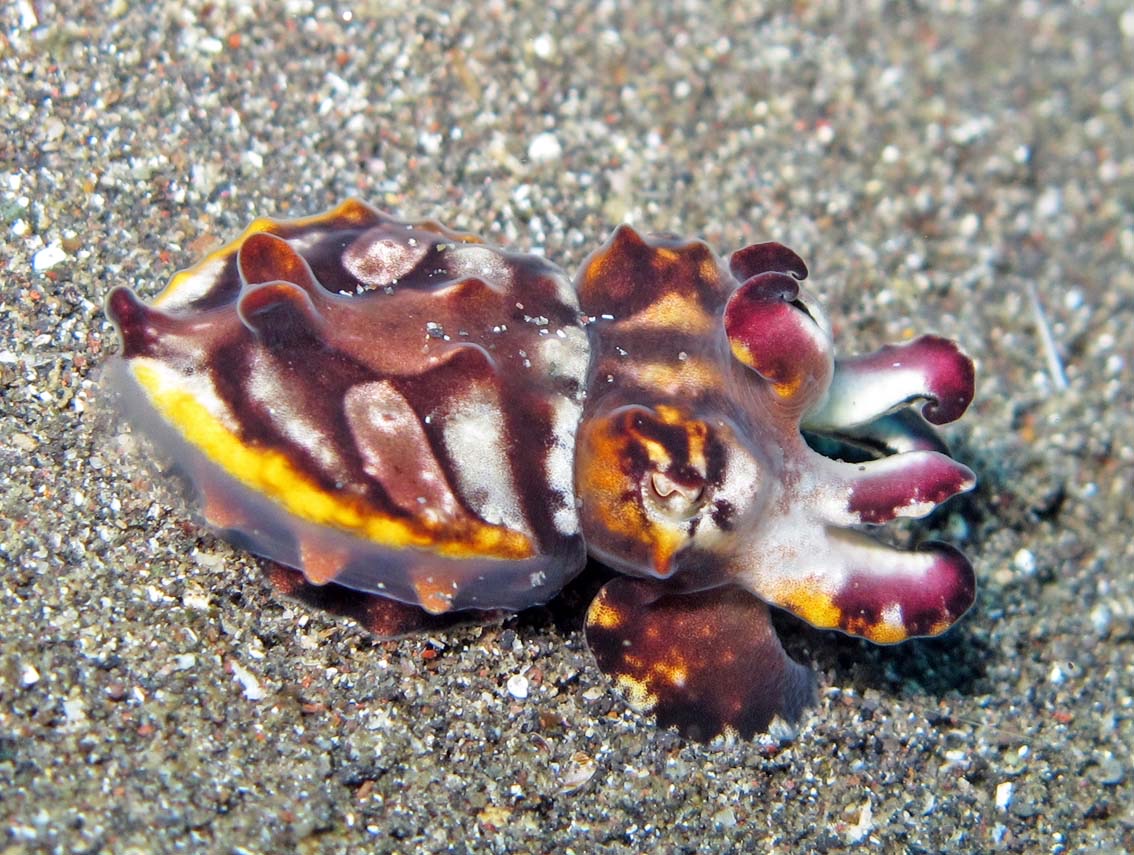
A flamboyant cuttlefish crossing a black-sand flat looks like a wind-up toy in ceremonial dress: a fist-sized animal ambling on two arm tips and skin flaps because its reduced internal cuttlebone barely floats it, pulsing waves of maroon, yellow, and white down its body as it goes. The pageant reads as warning coloration: laboratory work has reported significant toxins in its muscle, a rarity among cuttlefish, and the animal behaves like something with nothing to prove, hunting tiny shrimp and fish in open daylight with a deliberate tongue-flick strike of its feeding tentacles. At rest it fades to mud brown and simply disappears against the silt. Females glue eggs under coconut shells and rubble, and hatchlings emerge as perfect miniatures already flashing the family colors. It is a muck signature: ask the guides which slope has been producing.
Où et quand en observer un
« Résident » signifie que la plupart des plongées sur ce site permettent de les observer ; « saisonnier » signifie qu'ils sont présents de manière fiable durant les mois indiqués ; tout le reste est un bonus, pas une certitude.
| Destination | Fiabilité | Mois | Notes |
|---|---|---|---|
| Lembeh StraitIndonesia | Occasional | Toute l'année | |
| AnilaoPhilippines | Occasional | Toute l'année | |
| Banda Sea & AmbonIndonesia | Occasional | Toute l'année | |
| Dumaguete, Dauin & Apo IslandPhilippines | Occasional | Toute l'année | |
| Milne BayPapua New Guinea | Occasional | Toute l'année |
Meilleur mois, en un coup d'œil
Les comprendre
Habitat: Open sand, silt, and mud flats of sheltered bays and muck slopes, usually walking rather than swimming.
Aire de répartition: Indo-Malayan region and northern Australia: Indonesia, Malaysia, the Philippines, and New Guinea.
Comportement: Ambles across the bottom on two arm tips and skin flaps, pulsing waves of maroon, yellow, and white when hunting or alarmed; fades to mud brown at rest and vanishes.
Régime alimentaire: Small shrimp and fishes taken with a slow-motion stalk and a lightning strike of the feeding tentacles.
Taille: généralement autour de 0.06 m; documenté jusqu'à 0.08 m (mantle length).
Comment se comporter avec lui
Stay low and behind its line of travel, keep strobes reasonable, and never lift shells or coconut halves: females glue eggs beneath exactly that kind of cover.
Conservation
Formally Data Deficient; a bottom-bound lifestyle on developable coastal seabeds is its main exposure.
Sites répertoriés connus pour leur présence
Les sites mis en évidence ont été cartographiés pour cette espèce par nos éditeurs ; les chiffres correspondent aux occurrences GBIF enregistrées dans un rayon d'environ 5 km d'un site depuis 1990.
Regarder
Depuis les canaux officiels

Wildlife of Monterey | New film in our auditorium

Live Aviary Cam | Monterey Bay Aquarium

Live Aviary Cam | Monterey Bay Aquarium
Les vidéos sont des liens intégrés vers les chaînes de leurs créateurs. Nous n'hébergeons rien et créditons tout.