Cephalopods
Flamboyant Cuttlefish
Metasepia pfefferi · Cephalopod mollusk, family Sepiidae; a dwarf cuttlefish with a reduced internal cuttlebone
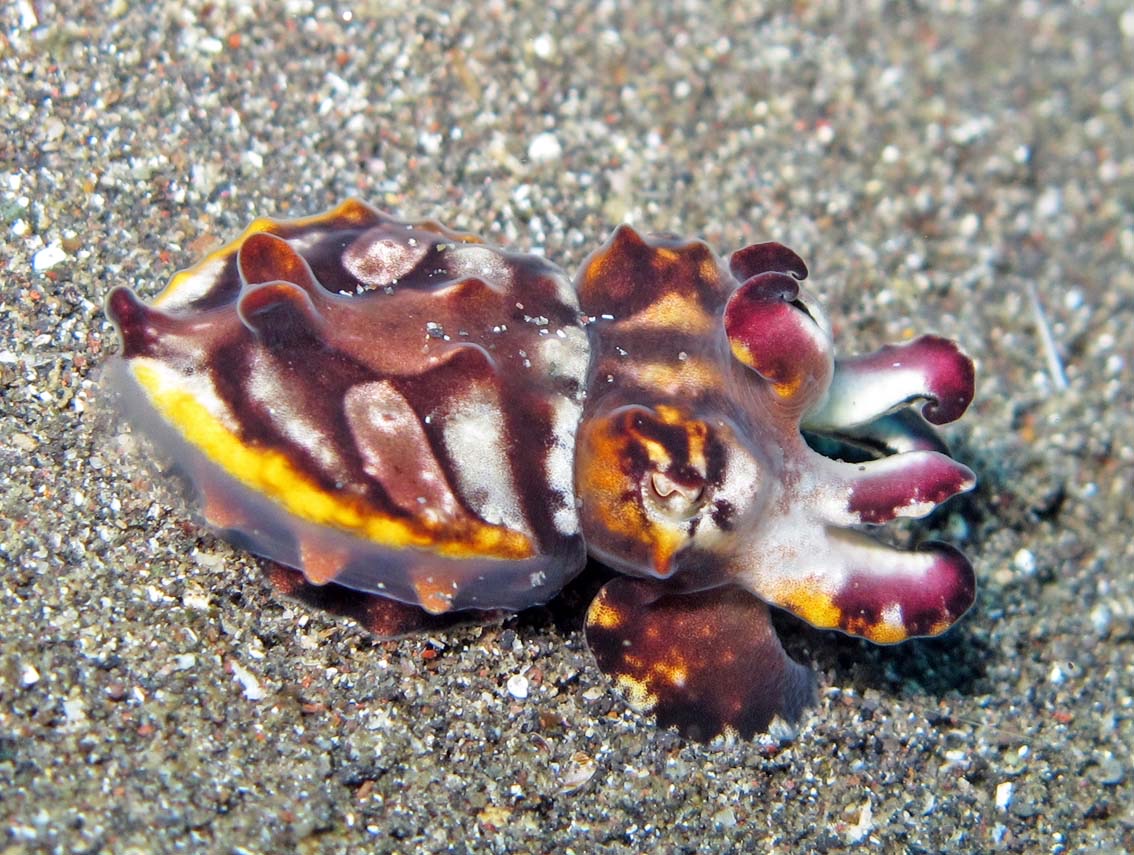
A flamboyant cuttlefish crossing a black-sand flat looks like a wind-up toy in ceremonial dress: a fist-sized animal ambling on two arm tips and skin flaps because its reduced internal cuttlebone barely floats it, pulsing waves of maroon, yellow, and white down its body as it goes. The pageant reads as warning coloration: laboratory work has reported significant toxins in its muscle, a rarity among cuttlefish, and the animal behaves like something with nothing to prove, hunting tiny shrimp and fish in open daylight with a deliberate tongue-flick strike of its feeding tentacles. At rest it fades to mud brown and simply disappears against the silt. Females glue eggs under coconut shells and rubble, and hatchlings emerge as perfect miniatures already flashing the family colors. It is a muck signature: ask the guides which slope has been producing.
Dove e quando avvistarne uno
"Residente" significa che la maggior parte delle immersioni in quella destinazione li incontra; "stagionale" significa che sono presenti in modo affidabile nei mesi indicati; qualsiasi altra cosa è un bonus, non un piano.
| Destinazione | Affidabilità | Mesi | Note |
|---|---|---|---|
| Lembeh StraitIndonesia | Occasional | Tutto l'anno | |
| AnilaoPhilippines | Occasional | Tutto l'anno | |
| Banda Sea & AmbonIndonesia | Occasional | Tutto l'anno | |
| Dumaguete, Dauin & Apo IslandPhilippines | Occasional | Tutto l'anno | |
| Milne BayPapua New Guinea | Occasional | Tutto l'anno |
Il mese migliore, a colpo d'occhio
Capirle
Habitat: Open sand, silt, and mud flats of sheltered bays and muck slopes, usually walking rather than swimming.
Distribuzione: Indo-Malayan region and northern Australia: Indonesia, Malaysia, the Philippines, and New Guinea.
Comportamento: Ambles across the bottom on two arm tips and skin flaps, pulsing waves of maroon, yellow, and white when hunting or alarmed; fades to mud brown at rest and vanishes.
Dieta: Small shrimp and fishes taken with a slow-motion stalk and a lightning strike of the feeding tentacles.
Dimensioni: tipicamente intorno a 0.06 m; documentato fino a 0.08 m (mantle length).
Come comportarsi in sua presenza
Stay low and behind its line of travel, keep strobes reasonable, and never lift shells or coconut halves: females glue eggs beneath exactly that kind of cover.
Conservazione
Formally Data Deficient; a bottom-bound lifestyle on developable coastal seabeds is its main exposure.
Siti mappati noti per avvistamenti
I siti evidenziati sono stati schedati per questa specie dai nostri redattori; i numeri sono record di occorrenza GBIF registrati entro circa 5 km dal sito a partire dal 1990.
Guarda
Dai canali ufficiali

Wildlife of Monterey | New film in our auditorium

Live Aviary Cam | Monterey Bay Aquarium

Live Aviary Cam | Monterey Bay Aquarium
I video sono link incorporati ai canali dei rispettivi autori. Non ospitiamo nulla e accreditiamo tutto.