Cephalopods
Flamboyant Cuttlefish
Metasepia pfefferi · Cephalopod mollusk, family Sepiidae; a dwarf cuttlefish with a reduced internal cuttlebone
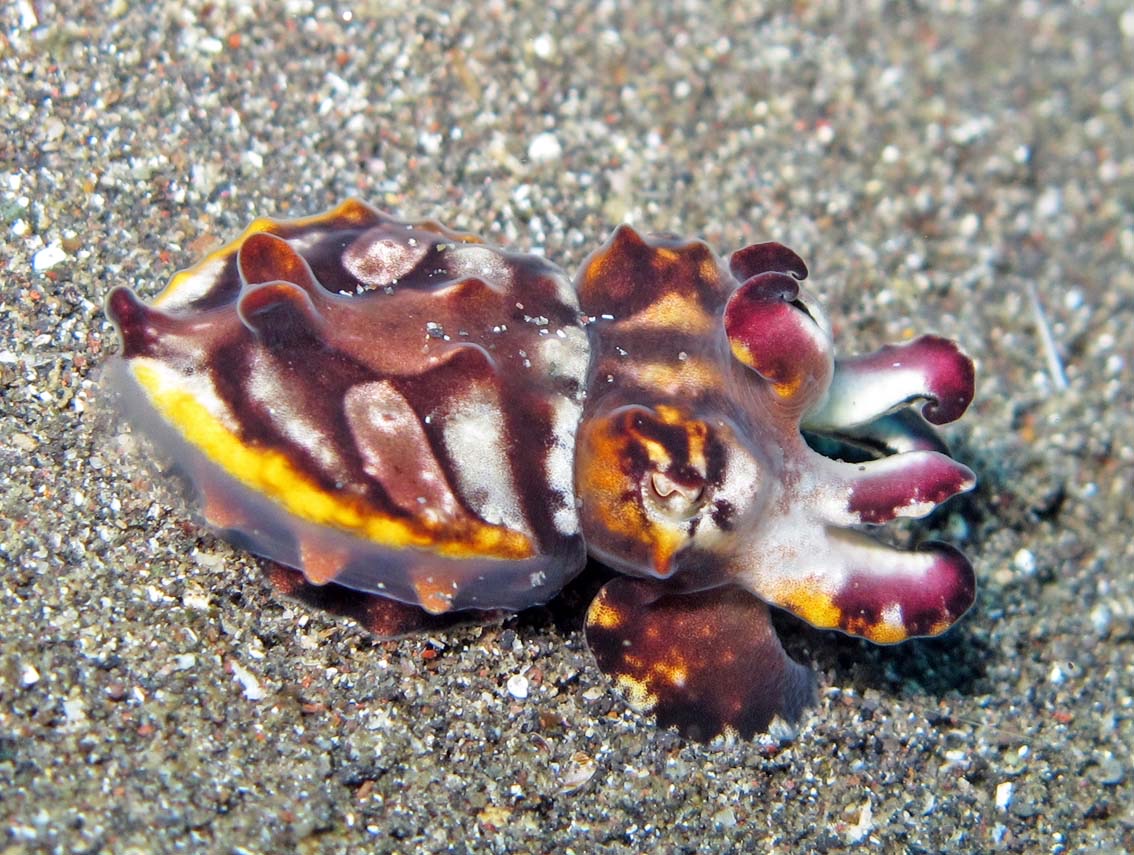
A flamboyant cuttlefish crossing a black-sand flat looks like a wind-up toy in ceremonial dress: a fist-sized animal ambling on two arm tips and skin flaps because its reduced internal cuttlebone barely floats it, pulsing waves of maroon, yellow, and white down its body as it goes. The pageant reads as warning coloration: laboratory work has reported significant toxins in its muscle, a rarity among cuttlefish, and the animal behaves like something with nothing to prove, hunting tiny shrimp and fish in open daylight with a deliberate tongue-flick strike of its feeding tentacles. At rest it fades to mud brown and simply disappears against the silt. Females glue eggs under coconut shells and rubble, and hatchlings emerge as perfect miniatures already flashing the family colors. It is a muck signature: ask the guides which slope has been producing.
Onde e quando ver um
"Residente" significa que a maioria dos mergulhos naquele destino os encontra; "sazonal" significa presença confiável nos meses listados; qualquer outra coisa é um bônus, não um plano.
| Destino | Fiabilidade | Meses | Notas |
|---|---|---|---|
| Lembeh StraitIndonesia | Occasional | Todo o ano | |
| AnilaoPhilippines | Occasional | Todo o ano | |
| Banda Sea & AmbonIndonesia | Occasional | Todo o ano | |
| Dumaguete, Dauin & Apo IslandPhilippines | Occasional | Todo o ano | |
| Milne BayPapua New Guinea | Occasional | Todo o ano |
Melhor mês, em resumo
Entendendo-os
Habitat: Open sand, silt, and mud flats of sheltered bays and muck slopes, usually walking rather than swimming.
Distribuição: Indo-Malayan region and northern Australia: Indonesia, Malaysia, the Philippines, and New Guinea.
Comportamento: Ambles across the bottom on two arm tips and skin flaps, pulsing waves of maroon, yellow, and white when hunting or alarmed; fades to mud brown at rest and vanishes.
Dieta: Small shrimp and fishes taken with a slow-motion stalk and a lightning strike of the feeding tentacles.
Tamanho: normalmente cerca de 0.06 m; documentado até 0.08 m (mantle length).
Como se comportar perto de um
Stay low and behind its line of travel, keep strobes reasonable, and never lift shells or coconut halves: females glue eggs beneath exactly that kind of cover.
Conservação
Formally Data Deficient; a bottom-bound lifestyle on developable coastal seabeds is its main exposure.
Pontos mapeados conhecidos por eles
Os locais destacados foram cartografados para esta espécie pelos nossos editores; os números são registos de ocorrência do GBIF num raio de cerca de 5 km do local desde 1990.
Assista
Dos canais oficiais

Wildlife of Monterey | New film in our auditorium

Live Aviary Cam | Monterey Bay Aquarium

Live Aviary Cam | Monterey Bay Aquarium
Os vídeos são ligações incorporadas para os canais dos próprios criadores. Não alojamos nada e creditamos tudo.