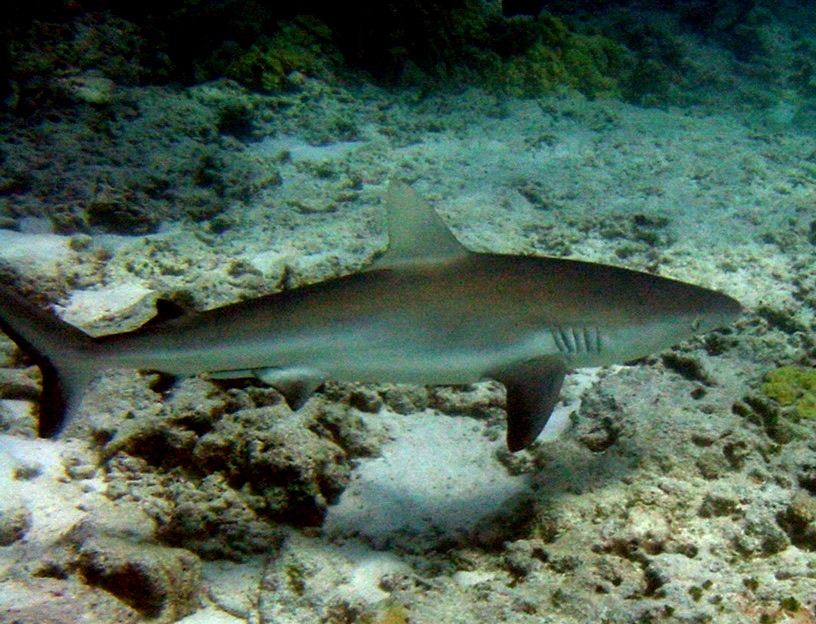
Sharks
Galápagos Shark
Carcharhinus galapagensis · Cartilaginous fish, family Carcharhinidae
The Galápagos shark is what most people picture when they hear the word shark: three meters of gunmetal muscle, tall dorsal, blunt round snout, cruising a boulder slope in gin-clear island water. It belongs to the remote places: the same species patrols Wolf and Darwin, Bermuda's outer banks, and the Revillagigedo seamounts, one of the odd distributions in the shark world, stitched between far-flung islands with deep ocean in between. Encounters are steady rather than dramatic; the shark holds its line, takes your measure on a slow pass, and resumes its rounds as though you were furniture.
Wo und wann man eines sieht
„Resident" bedeutet, dass die meisten Tauchgänge am jeweiligen Tauchziel eine Begegnung erwarten lassen; „saisonal" bedeutet, dass die Art in den genannten Monaten zuverlässig anzutreffen ist; alles andere ist ein Bonus, keine Planungsgrundlage.
| Ziel | Zuverlässigkeit | Monate | Hinweise |
|---|---|---|---|
| Galápagos IslandsEcuador | Resident: seen on most dives | Ganzjährig | |
| Socorro & the RevillagigedosMexico | Resident: seen on most dives | Ganzjährig | |
| BermudaBermuda | Occasional | Ganzjährig |
Bester Monat auf einen Blick
| Monat | Zuverlässige Reiseziele |
|---|---|
| January | Galápagos Islands · Socorro & the Revillagigedos · Bermuda |
| February | Galápagos Islands · Socorro & the Revillagigedos · Bermuda |
| March | Galápagos Islands · Socorro & the Revillagigedos · Bermuda |
| April | Galápagos Islands · Socorro & the Revillagigedos · Bermuda |
| May | Galápagos Islands · Socorro & the Revillagigedos · Bermuda |
| June | Galápagos Islands · Socorro & the Revillagigedos · Bermuda |
| July | Galápagos Islands · Socorro & the Revillagigedos · Bermuda |
| August | Galápagos Islands · Socorro & the Revillagigedos · Bermuda |
| September | Galápagos Islands · Socorro & the Revillagigedos · Bermuda |
| October | Galápagos Islands · Socorro & the Revillagigedos · Bermuda |
| November | Galápagos Islands · Socorro & the Revillagigedos · Bermuda |
| December | Galápagos Islands · Socorro & the Revillagigedos · Bermuda |
Sie verstehen
Lebensraum: Clear water around remote oceanic islands and seamounts: rocky drop-offs, boulder slopes, and adjacent blue water
Verbreitung: Scattered across the world's oceanic islands: the Galápagos and Revillagigedos, Hawaii, Bermuda, Lord Howe and the Kermadecs, Ascension, and similar isolated outposts
Verhalten: A big, classically shark-shaped carcharhinid that patrols island walls in twos and threes, often shadowing divers with steady, wide circuits. Around bait or in packs it grows bold and pushy; on an ordinary wall dive it reads as confident but unhurried company.
Ernährung: Bottom fish, octopus, and squid, with larger animals taking rays and small sharks
Größe: typischerweise rund 2.5 m; dokumentiert bis zu 3.7 m (total length).
Wie man sich in ihrer Nähe verhält
Stay off bait lines, keep the group together on blue-water exposures, and meet close passes with steady eye contact rather than retreat.
Naturschutz
Assessed Least Concern in aggregate, but individual island populations are small, isolated, and quick to deplete. Several of its strongholds are large marine reserves for good reason.
Bekannte Tauchplätze dafür
Hervorgehobene Tauchplätze wurden von unseren Redakteuren für diese Art kartiert; die Zahlen sind GBIF-Vorkommensdatensätze, die seit 1990 im Umkreis von etwa 5 km um einen Tauchplatz protokolliert wurden.
Ansehen
Aus den offiziellen Kanälen

Wildlife of Monterey | New film in our auditorium

Live Aviary Cam | Monterey Bay Aquarium

Live Aviary Cam | Monterey Bay Aquarium
Videos sind eingebettete Links zu den Kanälen der jeweiligen Ersteller – wir hosten nichts und geben für alles die Quelle an.