Reef Fish
Garden Eel
Heterocongrinae · Bony fish, subfamily Heterocongrinae, family Congridae (conger eels); family-level overview of the garden and spaghetti eels, roughly 35 species in two genera
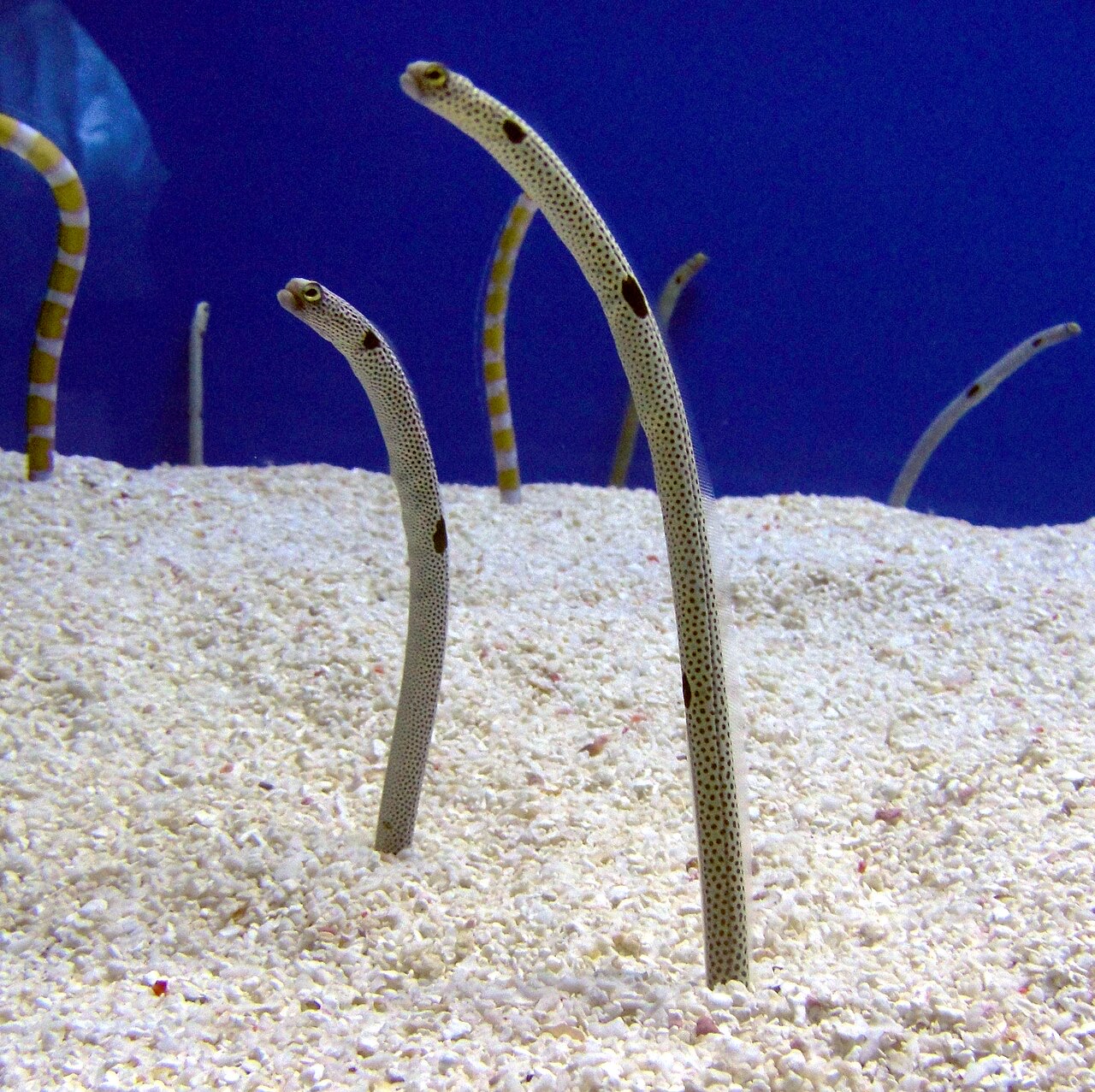
From a distance a garden eel colony looks like seagrass planted in ranks: hundreds or thousands of slender bodies rising from individual sand burrows, all curved the same way into the current to pick off drifting plankton. Get closer and the meadow shrinks: each eel sinks by degrees, and a careless approach mows the whole slope down into bare sand. The trick is to move like the tide, low and slow with controlled breathing, then settle and let the colony grow back around you. Species vary by ocean (spotted garden eels across the Indo-Pacific, brown garden eels on Caribbean sand flats), but the choreography is identical everywhere. They never fully leave home; tail anchored in a mucus-lined burrow, an eel stretches out two-thirds of its body at most.
Where and when to see one
"Resident" means most dives at that destination encounter them; "seasonal" means reliably present in the listed months; anything else is a bonus, not a plan.
| Destination | Reliability | Months | Notes |
|---|---|---|---|
| North & South Malé AtollsMaldives | Resident: seen on most dives | Year-round | |
| CozumelMexico | Resident: seen on most dives | Year-round | |
| BonaireBonaire | Resident: seen on most dives | Year-round | |
| Bali & Nusa PenidaIndonesia | Resident: seen on most dives | Year-round | |
| DahabEgypt | Resident: seen on most dives | Year-round | |
| Ari AtollMaldives | Resident: seen on most dives | Year-round |
Best month, at a glance
Understanding them
Habitat: Current-swept sand slopes and flats near reefs, in colonies from dozens to many thousands of burrows.
Range: Warm seas worldwide: spotted and splendid garden eels across the Indo-Pacific, brown garden eels in the tropical Atlantic and Caribbean.
Behavior: Colonies face into the current and sway while feeding, sinking underground in a wave ahead of any diver who approaches high or fast.
Diet: Zooplankton picked from the current while anchored tail-first in the burrow.
How to behave around one
Stay low, move at drift pace, then settle on bare sand and wait; the colony re-emerges around a motionless diver within minutes.
Conservation
No species is considered broadly threatened; colonies are vulnerable to anchor damage and repeated diver disturbance.
Charted sites known for them
Highlighted sites were charted for this species by our editors; numbers are GBIF occurrence records logged within about 5 km of a site since 1990.
Watch
From the official channels

Wildlife of Monterey | New film in our auditorium

Live Aviary Cam | Monterey Bay Aquarium

Live Aviary Cam | Monterey Bay Aquarium
Videos are embedded links to their creators' own channels. We host nothing and credit everything.