Reef Fish
Garden Eel
Heterocongrinae · Bony fish, subfamily Heterocongrinae, family Congridae (conger eels); family-level overview of the garden and spaghetti eels, roughly 35 species in two genera
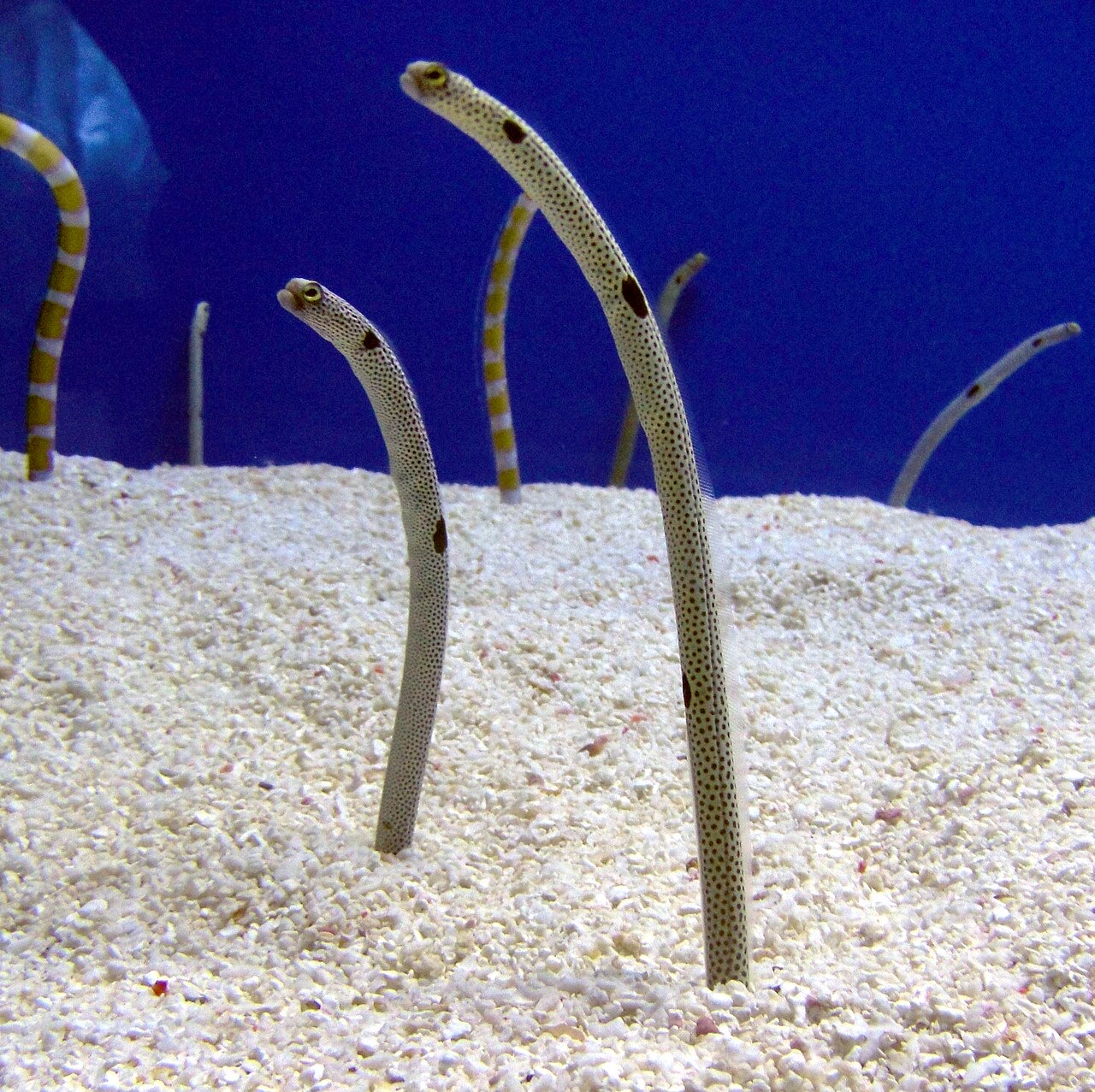
From a distance a garden eel colony looks like seagrass planted in ranks: hundreds or thousands of slender bodies rising from individual sand burrows, all curved the same way into the current to pick off drifting plankton. Get closer and the meadow shrinks: each eel sinks by degrees, and a careless approach mows the whole slope down into bare sand. The trick is to move like the tide, low and slow with controlled breathing, then settle and let the colony grow back around you. Species vary by ocean (spotted garden eels across the Indo-Pacific, brown garden eels on Caribbean sand flats), but the choreography is identical everywhere. They never fully leave home; tail anchored in a mucus-lined burrow, an eel stretches out two-thirds of its body at most.
Où et quand en observer un
« Résident » signifie que la plupart des plongées sur ce site permettent de les observer ; « saisonnier » signifie qu'ils sont présents de manière fiable durant les mois indiqués ; tout le reste est un bonus, pas une certitude.
| Destination | Fiabilité | Mois | Notes |
|---|---|---|---|
| North & South Malé AtollsMaldives | Resident: seen on most dives | Toute l'année | |
| CozumelMexico | Resident: seen on most dives | Toute l'année | |
| BonaireBonaire | Resident: seen on most dives | Toute l'année | |
| Bali & Nusa PenidaIndonesia | Resident: seen on most dives | Toute l'année | |
| DahabEgypt | Resident: seen on most dives | Toute l'année | |
| Ari AtollMaldives | Resident: seen on most dives | Toute l'année |
Meilleur mois, en un coup d'œil
Les comprendre
Habitat: Current-swept sand slopes and flats near reefs, in colonies from dozens to many thousands of burrows.
Aire de répartition: Warm seas worldwide: spotted and splendid garden eels across the Indo-Pacific, brown garden eels in the tropical Atlantic and Caribbean.
Comportement: Colonies face into the current and sway while feeding, sinking underground in a wave ahead of any diver who approaches high or fast.
Régime alimentaire: Zooplankton picked from the current while anchored tail-first in the burrow.
Comment se comporter avec lui
Stay low, move at drift pace, then settle on bare sand and wait; the colony re-emerges around a motionless diver within minutes.
Conservation
No species is considered broadly threatened; colonies are vulnerable to anchor damage and repeated diver disturbance.
Sites répertoriés connus pour leur présence
Les sites mis en évidence ont été cartographiés pour cette espèce par nos éditeurs ; les chiffres correspondent aux occurrences GBIF enregistrées dans un rayon d'environ 5 km d'un site depuis 1990.
Regarder
Depuis les canaux officiels

Wildlife of Monterey | New film in our auditorium

Live Aviary Cam | Monterey Bay Aquarium

Live Aviary Cam | Monterey Bay Aquarium
Les vidéos sont des liens intégrés vers les chaînes de leurs créateurs. Nous n'hébergeons rien et créditons tout.