Sharks
Great Hammerhead
Sphyrna mokarran · Cartilaginous fish, family Sphyrnidae
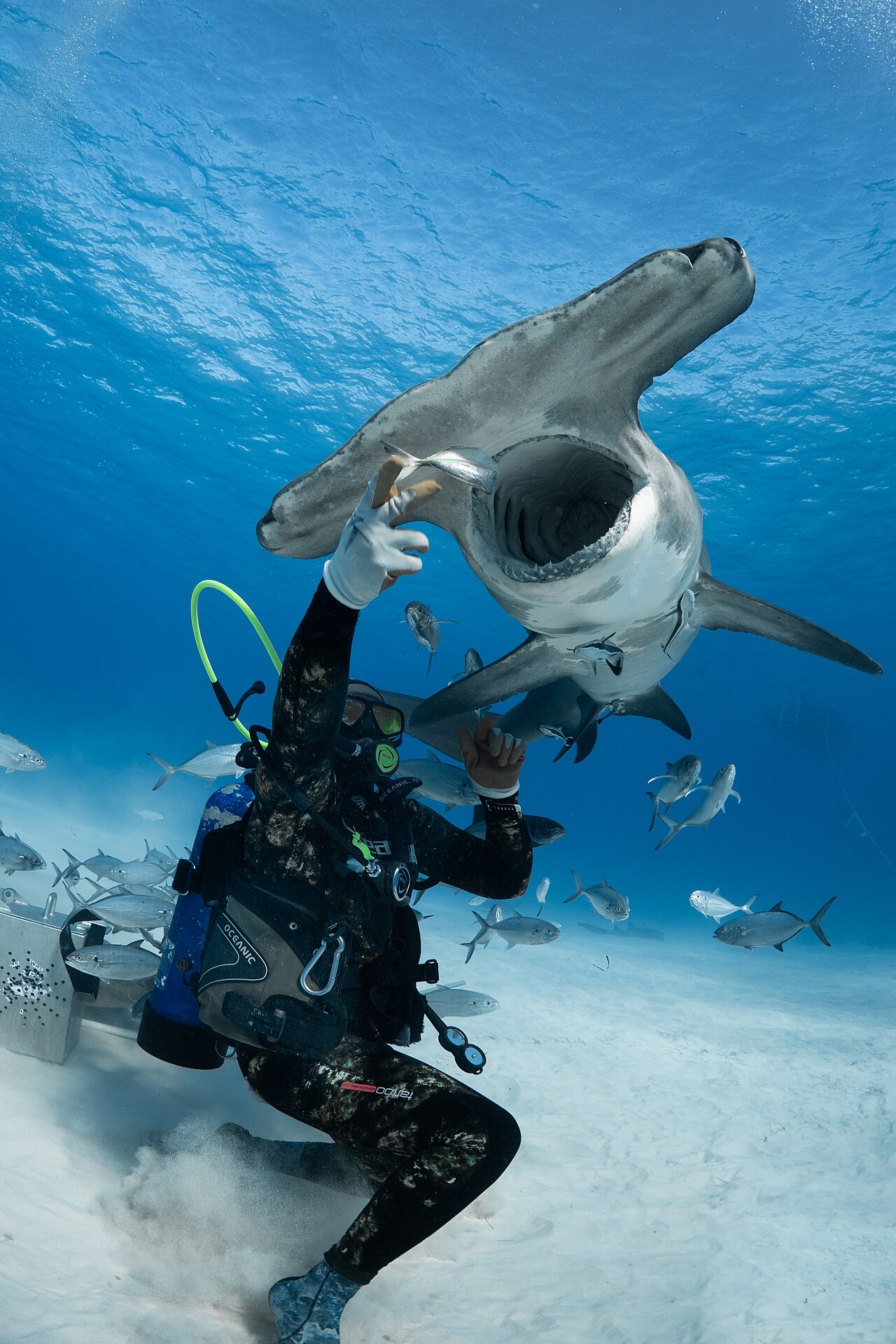
Seeing a great hammerhead approach across white sand is one of diving's great set pieces: a dorsal fin like a yacht sail, then the improbable meter-wide head swinging in slow arcs. This is the largest hammerhead, a specialist ray hunter that pins prey to the bottom with its cephalofoil before biting. It travels alone, which makes the reliable winter encounters in the Bahamas so unusual and so valuable. For all its presence in person, the species is in serious trouble: its fins command high prices, and it dies quickly on fishing gear even when released.
Wo und wann man eines sieht
„Resident" bedeutet, dass die meisten Tauchgänge am jeweiligen Tauchziel eine Begegnung erwarten lassen; „saisonal" bedeutet, dass die Art in den genannten Monaten zuverlässig anzutreffen ist; alles andere ist ein Bonus, keine Planungsgrundlage.
| Ziel | Zuverlässigkeit | Monate | Hinweise |
|---|---|---|---|
| Tiger Beach & Grand BahamaThe Bahamas | Seasonal: reliable in season | Dec–Mar | |
| RangiroaFrench Polynesia | Seasonal: reliable in season | Dec–Mar | |
| Brothers, Daedalus & St John'sEgypt | Occasional | May–Aug | |
| Florida KeysUnited States | Occasional | Dec–Apr | |
| Jardines de la ReinaCuba | Occasional | Ganzjährig |
Bester Monat auf einen Blick
| Monat | Zuverlässige Reiseziele |
|---|---|
| January | Tiger Beach & Grand Bahama · Rangiroa · Florida Keys · Jardines de la Reina |
| February | Tiger Beach & Grand Bahama · Rangiroa · Florida Keys · Jardines de la Reina |
| March | Tiger Beach & Grand Bahama · Rangiroa · Florida Keys · Jardines de la Reina |
| April | Florida Keys · Jardines de la Reina |
| May | Brothers, Daedalus & St John's · Jardines de la Reina |
| June | Brothers, Daedalus & St John's · Jardines de la Reina |
| July | Brothers, Daedalus & St John's · Jardines de la Reina |
| August | Brothers, Daedalus & St John's · Jardines de la Reina |
| September | Jardines de la Reina |
| October | Jardines de la Reina |
| November | Jardines de la Reina |
| December | Tiger Beach & Grand Bahama · Rangiroa · Florida Keys · Jardines de la Reina |
Sie verstehen
Lebensraum: Coastal shelves, reef edges, and sand flats; ranges into very shallow water when hunting rays
Verbreitung: Circumtropical in warm coastal seas: the wider Caribbean, Red Sea and Indian Ocean, northern Australia, and the central Pacific
Verhalten: A solitary, wide-roaming hunter, unlike its schooling scalloped cousin. The exaggerated cephalofoil is packed with electroreceptors and works like a metal detector swept over sand; the tall sickle of a first dorsal fin often shows before the animal itself. Around baited dives it moves with deliberate, unhurried confidence.
Ernährung: Rays and skates above all (stingray barbs are routinely found in their jaws), plus other sharks, groupers, and cephalopods
Größe: typischerweise rund 3.5 m; dokumentiert bis zu 6.1 m (total length; most animals on dive sites run 3–4.5 m).
Wie man sich in ihrer Nähe verhält
Stay low and settled on sand-bottom feed dives, avoid blocking its swim path, no touching as it passes, and never freelance with bait. In open water, hold your depth and let it choose the distance.
Naturschutz
Critically Endangered: overfishing for the fin trade and severe bycatch mortality have cut global numbers steeply. Encounter tourism in the Bahamas, where sharks are protected, is a genuine conservation asset.
Bekannte Tauchplätze dafür
Hervorgehobene Tauchplätze wurden von unseren Redakteuren für diese Art kartiert; die Zahlen sind GBIF-Vorkommensdatensätze, die seit 1990 im Umkreis von etwa 5 km um einen Tauchplatz protokolliert wurden.
Ansehen
Aus den offiziellen Kanälen

Wildlife of Monterey | New film in our auditorium

Live Aviary Cam | Monterey Bay Aquarium

Live Aviary Cam | Monterey Bay Aquarium
Videos sind eingebettete Links zu den Kanälen der jeweiligen Ersteller – wir hosten nichts und geben für alles die Quelle an.