Sharks
Great Hammerhead
Sphyrna mokarran · Cartilaginous fish, family Sphyrnidae
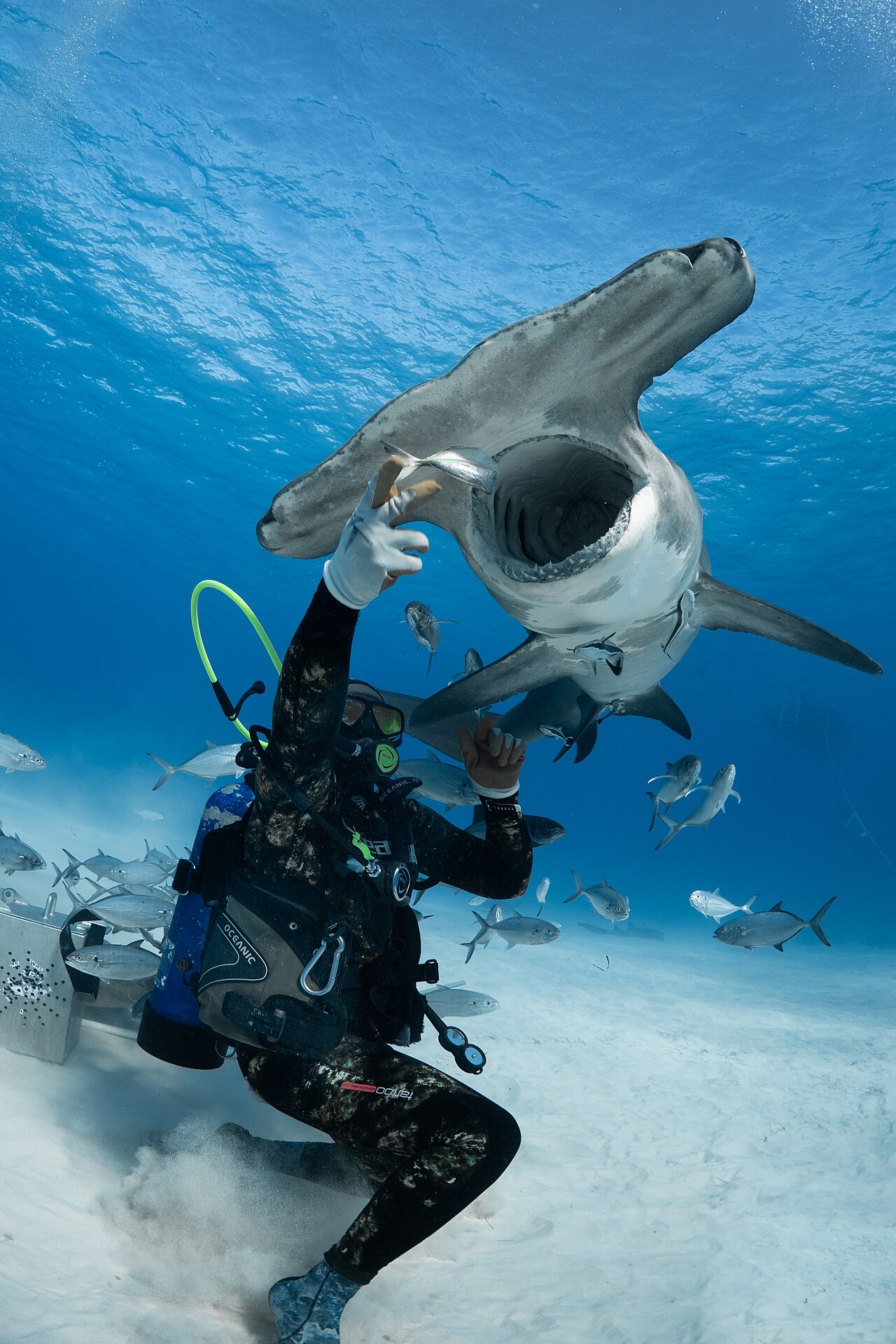
Seeing a great hammerhead approach across white sand is one of diving's great set pieces: a dorsal fin like a yacht sail, then the improbable meter-wide head swinging in slow arcs. This is the largest hammerhead, a specialist ray hunter that pins prey to the bottom with its cephalofoil before biting. It travels alone, which makes the reliable winter encounters in the Bahamas so unusual and so valuable. For all its presence in person, the species is in serious trouble: its fins command high prices, and it dies quickly on fishing gear even when released.
Où et quand en observer un
« Résident » signifie que la plupart des plongées sur ce site permettent de les observer ; « saisonnier » signifie qu'ils sont présents de manière fiable durant les mois indiqués ; tout le reste est un bonus, pas une certitude.
| Destination | Fiabilité | Mois | Notes |
|---|---|---|---|
| Tiger Beach & Grand BahamaThe Bahamas | Seasonal: reliable in season | Dec–Mar | |
| RangiroaFrench Polynesia | Seasonal: reliable in season | Dec–Mar | |
| Brothers, Daedalus & St John'sEgypt | Occasional | May–Aug | |
| Florida KeysUnited States | Occasional | Dec–Apr | |
| Jardines de la ReinaCuba | Occasional | Toute l'année |
Meilleur mois, en un coup d'œil
| Mois | Destinations fiables |
|---|---|
| January | Tiger Beach & Grand Bahama · Rangiroa · Florida Keys · Jardines de la Reina |
| February | Tiger Beach & Grand Bahama · Rangiroa · Florida Keys · Jardines de la Reina |
| March | Tiger Beach & Grand Bahama · Rangiroa · Florida Keys · Jardines de la Reina |
| April | Florida Keys · Jardines de la Reina |
| May | Brothers, Daedalus & St John's · Jardines de la Reina |
| June | Brothers, Daedalus & St John's · Jardines de la Reina |
| July | Brothers, Daedalus & St John's · Jardines de la Reina |
| August | Brothers, Daedalus & St John's · Jardines de la Reina |
| September | Jardines de la Reina |
| October | Jardines de la Reina |
| November | Jardines de la Reina |
| December | Tiger Beach & Grand Bahama · Rangiroa · Florida Keys · Jardines de la Reina |
Les comprendre
Habitat: Coastal shelves, reef edges, and sand flats; ranges into very shallow water when hunting rays
Aire de répartition: Circumtropical in warm coastal seas: the wider Caribbean, Red Sea and Indian Ocean, northern Australia, and the central Pacific
Comportement: A solitary, wide-roaming hunter, unlike its schooling scalloped cousin. The exaggerated cephalofoil is packed with electroreceptors and works like a metal detector swept over sand; the tall sickle of a first dorsal fin often shows before the animal itself. Around baited dives it moves with deliberate, unhurried confidence.
Régime alimentaire: Rays and skates above all (stingray barbs are routinely found in their jaws), plus other sharks, groupers, and cephalopods
Taille: généralement autour de 3.5 m; documenté jusqu'à 6.1 m (total length; most animals on dive sites run 3–4.5 m).
Comment se comporter avec lui
Stay low and settled on sand-bottom feed dives, avoid blocking its swim path, no touching as it passes, and never freelance with bait. In open water, hold your depth and let it choose the distance.
Conservation
Critically Endangered: overfishing for the fin trade and severe bycatch mortality have cut global numbers steeply. Encounter tourism in the Bahamas, where sharks are protected, is a genuine conservation asset.
Sites répertoriés connus pour leur présence
Les sites mis en évidence ont été cartographiés pour cette espèce par nos éditeurs ; les chiffres correspondent aux occurrences GBIF enregistrées dans un rayon d'environ 5 km d'un site depuis 1990.
Regarder
Depuis les canaux officiels

Wildlife of Monterey | New film in our auditorium

Live Aviary Cam | Monterey Bay Aquarium

Live Aviary Cam | Monterey Bay Aquarium
Les vidéos sont des liens intégrés vers les chaînes de leurs créateurs. Nous n'hébergeons rien et créditons tout.