Turtles
Green Sea Turtle
Chelonia mydas · Marine reptile, family Cheloniidae
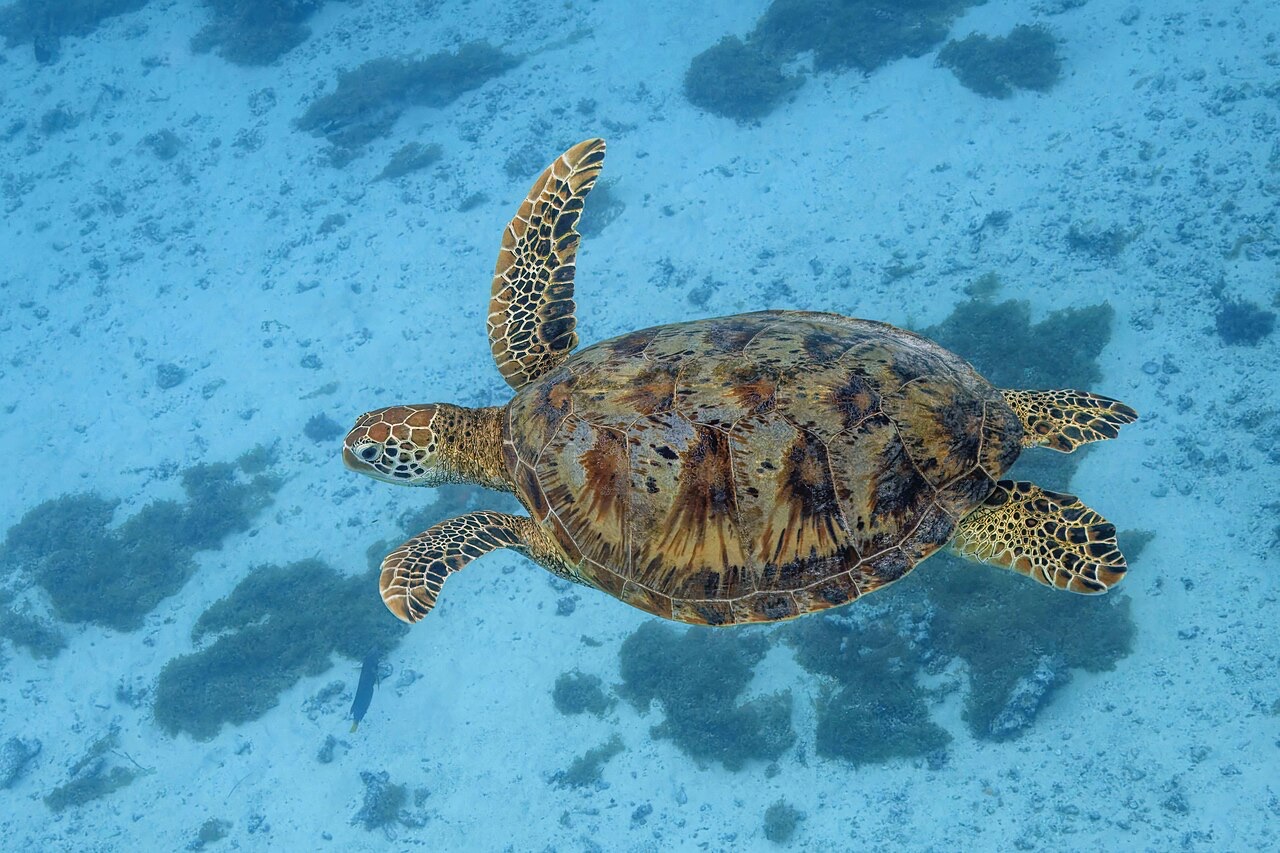
The green turtle is diving's great normalizer: on the right reef it becomes as ordinary as parrotfish, and never stops being wonderful. A big adult is a coffee-table of smooth olive shell topped by a small, gentle-jawed head built for mowing grass, trailing a wake of nibbled seagrass stubble across the lagoon floor. At Sipadan they stack along the wall like parked cars; at Marsa Alam's seagrass bays they graze beside snorkelers all day; Hawaiian greens haul out to bask on beaches, a habit almost unique to that population. Fifty years of protection have rebuilt many nesting populations: one of marine conservation's genuine success stories, still incomplete.
Où et quand en observer un
« Résident » signifie que la plupart des plongées sur ce site permettent de les observer ; « saisonnier » signifie qu'ils sont présents de manière fiable durant les mois indiqués ; tout le reste est un bonus, pas une certitude.
| Destination | Fiabilité | Mois | Notes |
|---|---|---|---|
| Riviera Maya & the CenotesMexico | Resident: seen on most dives | Toute l'année | |
| Galápagos IslandsEcuador | Resident: seen on most dives | Toute l'année | |
| Cairns & the Ribbon ReefsAustralia | Resident: seen on most dives | Toute l'année | |
| Sipadan & MabulMalaysia | Resident: seen on most dives | Toute l'année | |
| Kona, HawaiʻiUnited States | Resident: seen on most dives | Toute l'année | |
| Marsa Alam & the Deep SouthEgypt | Resident: seen on most dives | Toute l'année |
Meilleur mois, en un coup d'œil
Les comprendre
Habitat: Seagrass meadows, algae-covered reef flats, and lagoons; sleeps under reef ledges and migrates long distances to natal nesting beaches
Aire de répartition: Circumglobal in tropical and subtropical seas, with major populations in the Caribbean, Red Sea, Indian Ocean, Coral Triangle, Pacific islands, and Australia
Comportement: A placid grazer that crops seagrass in slow, methodical mouthfuls, surfaces in a leisurely arc to breathe, and wedges beneath the same ledges night after night. Where protected and habituated, as at Sipadan or Hawaii, it treats divers as scenery and continues feeding at arm's length.
Régime alimentaire: Adults graze seagrass and algae, the diet that greens their fat and names the species; juveniles are more omnivorous
Taille: généralement autour de 1.0 m; documenté jusqu'à 1.2 m (carapace length; large adults weigh 150–200 kg).
Comment se comporter avec lui
No touching or riding (illegal in most range states), keep hands off resting turtles, never block one's path to the surface to breathe, and give nesting beaches and mating pairs wide berth. Flash restrictions apply at many sites.
Conservation
Endangered globally, though many index nesting populations are climbing after decades of beach protection and harvest bans; boat strikes, net bycatch, and warming-skewed hatchling sex ratios are the live threats.
Sites répertoriés connus pour leur présence
Les sites mis en évidence ont été cartographiés pour cette espèce par nos éditeurs ; les chiffres correspondent aux occurrences GBIF enregistrées dans un rayon d'environ 5 km d'un site depuis 1990.
Regarder
Depuis les canaux officiels

Wildlife of Monterey | New film in our auditorium

Live Aviary Cam | Monterey Bay Aquarium

Live Aviary Cam | Monterey Bay Aquarium
Les vidéos sont des liens intégrés vers les chaînes de leurs créateurs. Nous n'hébergeons rien et créditons tout.