Sharks
Grey Nurse Shark
Carcharias taurus · Cartilaginous fish, family Odontaspididae
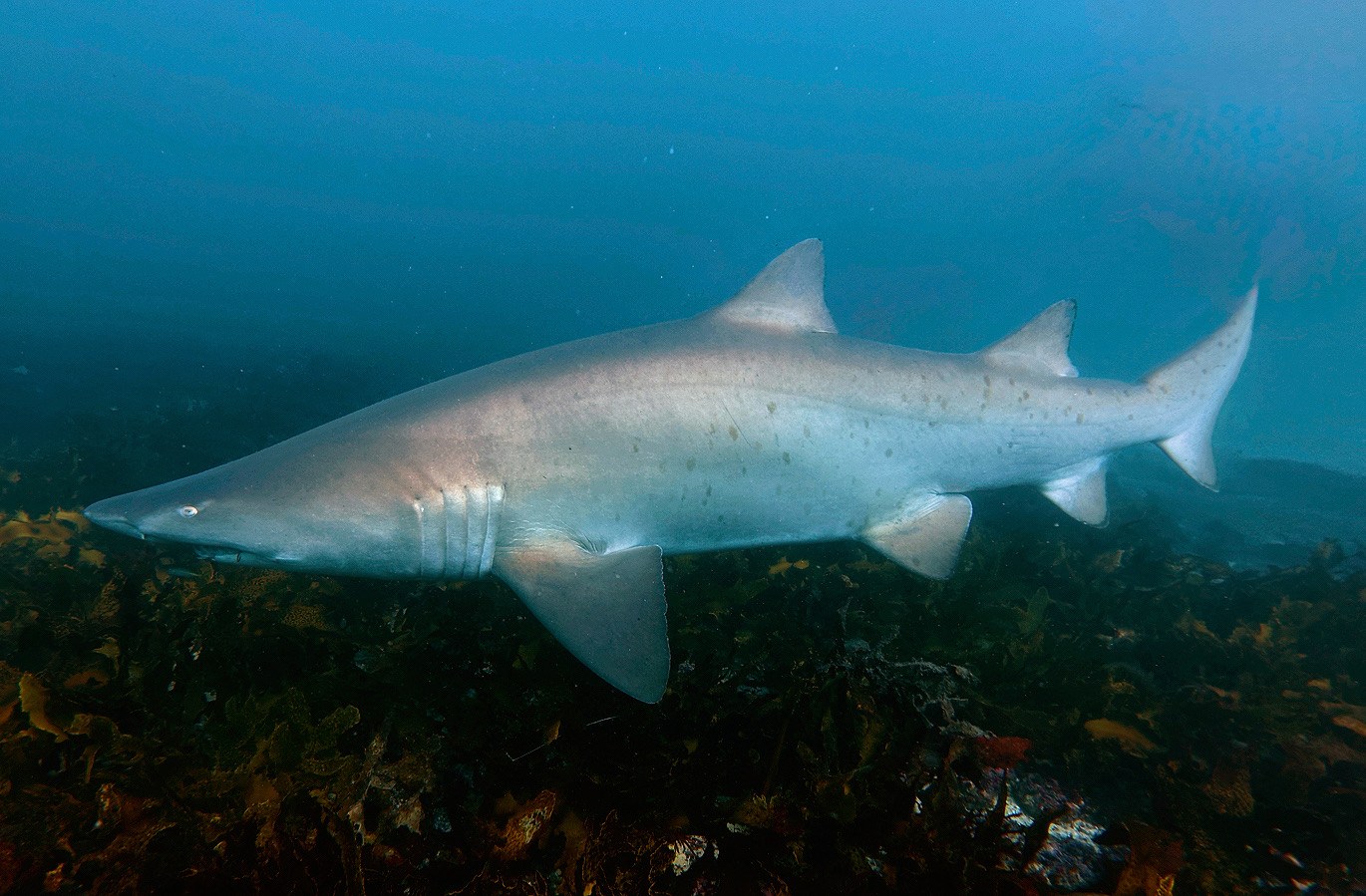
Australia's grey nurse is the same ragged-toothed species divers meet on North Carolina wrecks and Aliwal's caves, but its story here is distinct and cautionary. Labeled a killer on looks alone, it was speared toward oblivion by the 1970s before becoming one of the world's first protected sharks. Today small aggregations still trace slow ovals through gutters at a handful of east-coast sites, gliding among divers with prehistoric calm. The listed destinations in this atlas brush only the edges of its range (the celebrated aggregation reefs lie along the New South Wales and southern Queensland coast), so treat any sighting elsewhere in Australia as a bonus, not a plan.
Wo und wann man eines sieht
„Resident" bedeutet, dass die meisten Tauchgänge am jeweiligen Tauchziel eine Begegnung erwarten lassen; „saisonal" bedeutet, dass die Art in den genannten Monaten zuverlässig anzutreffen ist; alles andere ist ein Bonus, keine Planungsgrundlage.
Wir haben noch keine zuverlässigen Standorte für diese Art bestätigt – anstatt zu raten, lassen wir das Feld leer, bis eine Quelle vorliegt.
Sie verstehen
Lebensraum: Sandy gutters, bommies, and cave mouths along rocky reefs of the Australian coast; the same air-gulping hover as its overseas populations
Verbreitung: Australian name for the sand tiger shark, Carcharias taurus. Two Australian populations: a small east-coast population from southern Queensland through New South Wales, and a distinct, poorly known west-coast population
Verhalten: Days are spent circling slowly in traditional gutters and around pinnacles in loose aggregations, mouths bristling, bodies nearly still in the surge. Individuals return to the same handful of sites for years, which concentrates both divers and risk in the same places.
Ernährung: Reef and pelagic fish, rays, and small sharks, taken mostly at night
Größe: typischerweise rund 2.5 m; dokumentiert bis zu 3.2 m (total length).
Wie man sich in ihrer Nähe verhält
Australian critical-habitat rules are specific: no blocking gutters or cave entrances, no chasing or touching, approach along the side rather than head-on, keep group sizes modest, and no scooters or feeding at aggregation sites.
Naturschutz
The east Australian population is listed Critically Endangered nationally, numbering in the low thousands at best; protected since 1984 in NSW, with designated critical-habitat sites carrying enforceable approach rules.
Bekannte Tauchplätze dafür
Hervorgehobene Tauchplätze wurden von unseren Redakteuren für diese Art kartiert; die Zahlen sind GBIF-Vorkommensdatensätze, die seit 1990 im Umkreis von etwa 5 km um einen Tauchplatz protokolliert wurden.
Ansehen
Aus den offiziellen Kanälen

Wildlife of Monterey | New film in our auditorium

Live Aviary Cam | Monterey Bay Aquarium

Live Aviary Cam | Monterey Bay Aquarium
Videos sind eingebettete Links zu den Kanälen der jeweiligen Ersteller – wir hosten nichts und geben für alles die Quelle an.