Crustaceans
Harlequin Shrimp
Hymenocera picta · Crustacean, family Palaemonidae; a sea-star-eating specialist shrimp
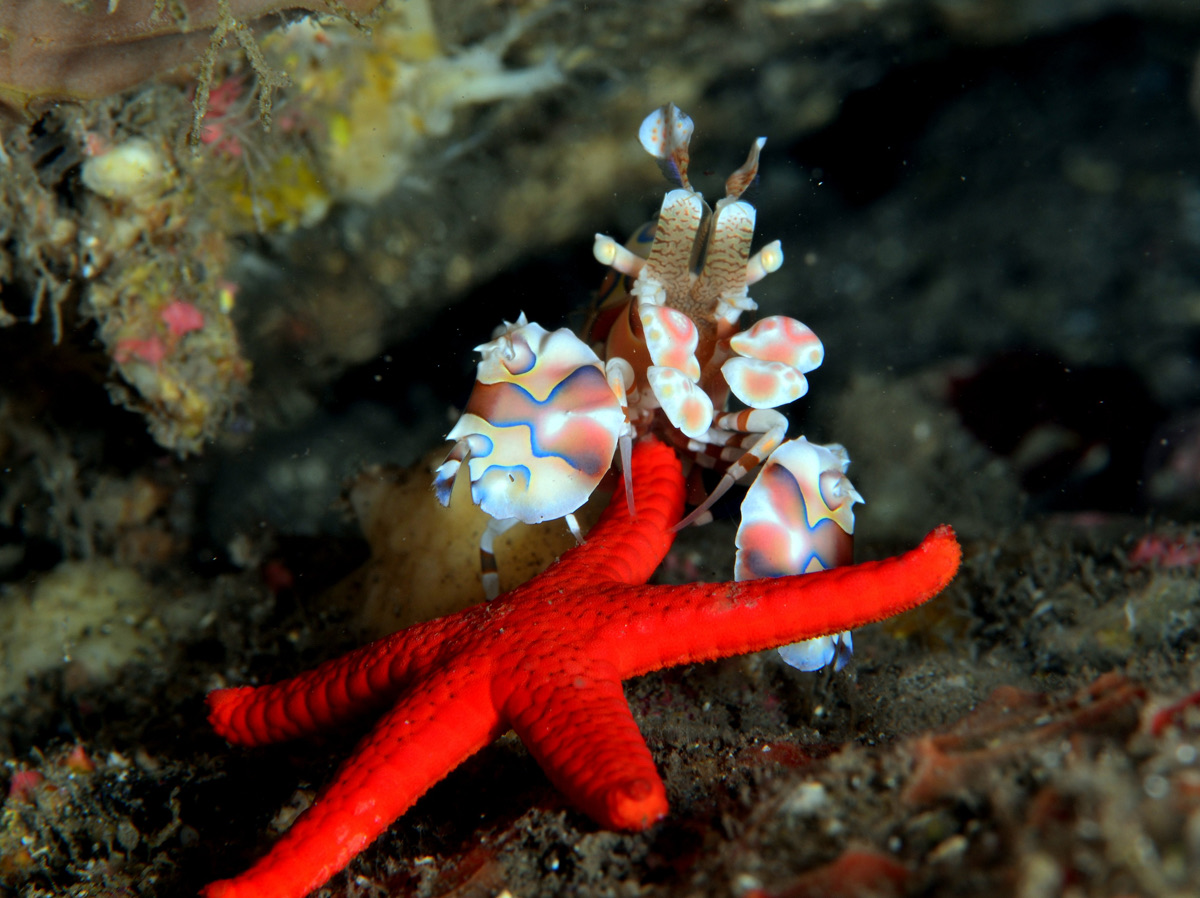
Harlequin shrimp look painted for a festival and live like specialists on a dare: they eat sea stars, only sea stars, and work in mated pairs to do it. A pair (porcelain white splashed with mauve-blue in the Pacific form) finds a star by scent, grips an arm, and levers the whole animal over to reach the tube feet, then walks it back toward the burrow. Feeding starts at the arm tips, and stars often survive long enough to regrow or escape; pairs have been seen keeping a Linckia alive as a larder. Territories are tiny and stable, so once a site's guides know a pair, sightings stay dependable for months. At two knuckles long they demand a slow search of rubble undercuts. Resist any urge to deliver a star for the camera: staged feedings are manipulation, not luck.
Waar en wanneer je er een kunt zien
"Resident" betekent dat je ze bij de meeste duiken op die bestemming tegenkomt; "seizoensgebonden" betekent betrouwbaar aanwezig in de vermelde maanden; al het andere is een bonus, geen garantie.
| Bestemming | Betrouwbaarheid | Maanden | Notities |
|---|---|---|---|
| Bali & Nusa PenidaIndonesia | Occasional | Het hele jaar door | |
| Kona, HawaiʻiUnited States | Occasional | Het hele jaar door | |
| Lembeh StraitIndonesia | Occasional | Het hele jaar door | |
| AnilaoPhilippines | Occasional | Het hele jaar door | |
| Dumaguete, Dauin & Apo IslandPhilippines | Occasional | Het hele jaar door |
Beste maand, in één oogopslag
Ze begrijpen
Habitat: Rubble undercuts, boulder gaps, and coral crevices on reefs and muck margins, in small, stable territories.
Verspreidingsgebied: Indo-Pacific from East Africa to Hawaii and the eastern Pacific fringe; Pacific animals wear mauve-blue blotches, Indian Ocean animals more purple-red.
Gedrag: Lives in monogamous pairs that locate stars by scent, lever them over to reach the tube feet, and feed from the arm tips over days; territories stay stable for months.
Dieet: Sea stars exclusively, from Linckia to juvenile crown-of-thorns; pairs sometimes keep a star as a living larder.
Grootte: doorgaans rond 0.04 m; gedocumenteerd tot 0.05 m (body length).
Hoe je je ertegenover gedraagt
Never collect a sea star and drop it in front of a pair to stage a feeding photo: moving animals to bait behavior is manipulation, and known pairs get enough attention as it is.
Behoud
Not formally assessed; aquarium collection is the main direct pressure, and its prey-specialist lifestyle ties it to healthy sea-star populations.
Gekende duiksites waar je ze tegenkomt
Gemarkeerde locaties zijn voor deze soort in kaart gebracht door onze redacteurs; de getallen zijn GBIF-waarnemingsrecords vastgelegd binnen ongeveer 5 km van een locatie sinds 1990.
Bekijk
Via de officiële kanalen

Wildlife of Monterey | New film in our auditorium

Live Aviary Cam | Monterey Bay Aquarium

Live Aviary Cam | Monterey Bay Aquarium
Video's zijn ingesloten links naar de eigen kanalen van de makers. We hosten niets en vermelden altijd de bron.