Cold Water
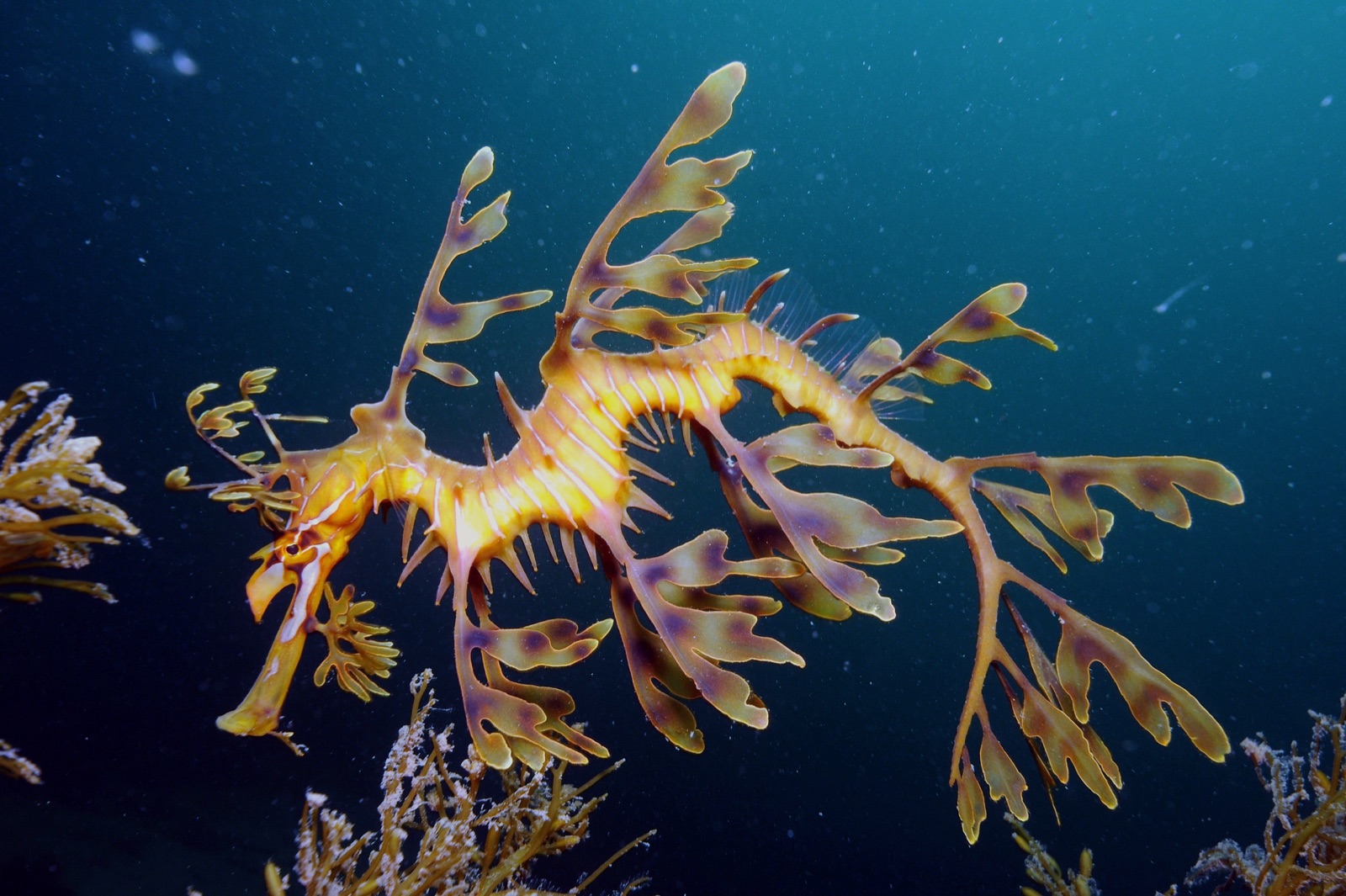
Leafy Seadragon
Phycodurus eques · Bony fish, family Syngnathidae; an Australian endemic seadragon and South Australia's marine emblem
The leafy seadragon does not look like a fish even while you watch it swim. Leaf-shaped skin lobes sprout from head, trunk, and tail until the animal reads as drifting kelp; propulsion comes from small, nearly transparent fins, so it hangs and pivots like weed obeying a private current. Leafies live only along Australia's southern coast, working kelp lines, seagrass edges, and jetty piles for mysid shrimp taken through a pipette snout. Males carry the brood, eggs pressed onto a patch beneath the tail for six to eight weeks. South Australian jetty and bay dives made the species a pilgrimage animal, and the rules reflect its status: fully protected, never touched, never herded into open water for a photograph. Move with the swell, keep the lights low and brief, and let the kelp keep pretending.
Où et quand en observer un
« Résident » signifie que la plupart des plongées sur ce site permettent de les observer ; « saisonnier » signifie qu'ils sont présents de manière fiable durant les mois indiqués ; tout le reste est un bonus, pas une certitude.
| Destination | Fiabilité | Mois | Notes |
|---|---|---|---|
| South AustraliaAustralia | Resident: seen on most dives | Toute l'année |
Meilleur mois, en un coup d'œil
| Mois | Destinations fiables |
|---|---|
| January | South Australia |
| February | South Australia |
| March | South Australia |
| April | South Australia |
| May | South Australia |
| June | South Australia |
| July | South Australia |
| August | South Australia |
| September | South Australia |
| October | South Australia |
| November | South Australia |
| December | South Australia |
Les comprendre
Habitat: Kelp and macroalgae beds, seagrass edges, and jetty piles over sand in cool southern Australian water.
Aire de répartition: Southern Australian coast only, roughly from South Australia's gulfs west into southern Western Australia.
Comportement: Drifts among weed on nearly transparent fins, relying wholly on its leafy costume; males brood the eggs, carried on a patch under the tail for roughly six to eight weeks.
Régime alimentaire: Mysid shrimp and other small crustaceans sucked through the pipette snout in vast numbers.
Taille: généralement autour de 0.24 m; documenté jusqu'à 0.35 m (total length).
Comment se comporter avec lui
Fully protected: never touch, herd into open water, or crowd for a cleaner backdrop; move with the swell, keep lights brief, and stay at the animal's level rather than above it.
Conservation
Least Concern under its current assessment and fully protected in Australian waters; habitat loss along the southern coast and past curio collection drove the protections.
Sites répertoriés connus pour leur présence
Les sites mis en évidence ont été cartographiés pour cette espèce par nos éditeurs ; les chiffres correspondent aux occurrences GBIF enregistrées dans un rayon d'environ 5 km d'un site depuis 1990.
Regarder
Depuis les canaux officiels

Wildlife of Monterey | New film in our auditorium

Live Aviary Cam | Monterey Bay Aquarium

Live Aviary Cam | Monterey Bay Aquarium
Les vidéos sont des liens intégrés vers les chaînes de leurs créateurs. Nous n'hébergeons rien et créditons tout.