Cold Water
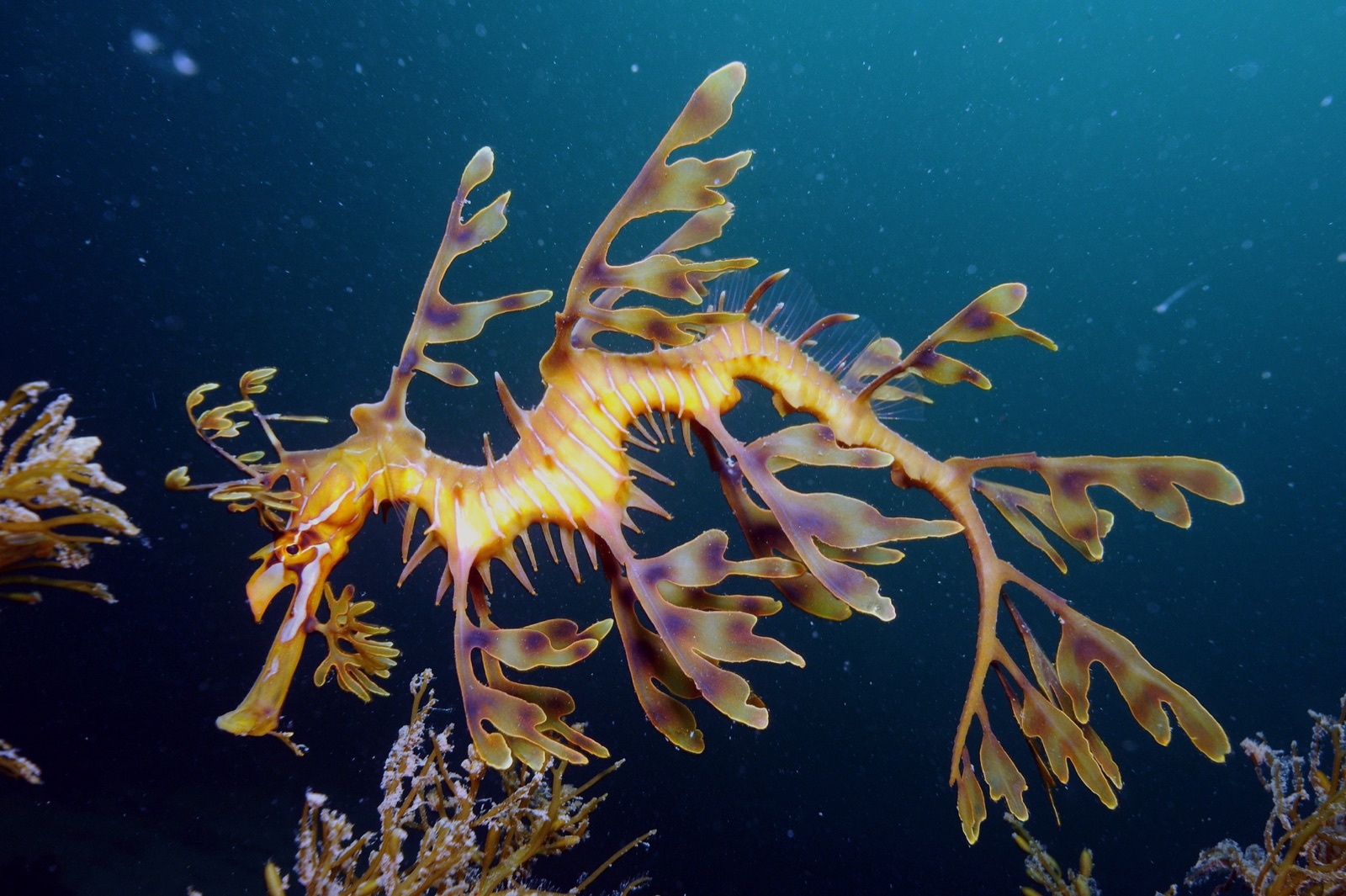
Leafy Seadragon
Phycodurus eques · Bony fish, family Syngnathidae; an Australian endemic seadragon and South Australia's marine emblem
The leafy seadragon does not look like a fish even while you watch it swim. Leaf-shaped skin lobes sprout from head, trunk, and tail until the animal reads as drifting kelp; propulsion comes from small, nearly transparent fins, so it hangs and pivots like weed obeying a private current. Leafies live only along Australia's southern coast, working kelp lines, seagrass edges, and jetty piles for mysid shrimp taken through a pipette snout. Males carry the brood, eggs pressed onto a patch beneath the tail for six to eight weeks. South Australian jetty and bay dives made the species a pilgrimage animal, and the rules reflect its status: fully protected, never touched, never herded into open water for a photograph. Move with the swell, keep the lights low and brief, and let the kelp keep pretending.
Waar en wanneer je er een kunt zien
"Resident" betekent dat je ze bij de meeste duiken op die bestemming tegenkomt; "seizoensgebonden" betekent betrouwbaar aanwezig in de vermelde maanden; al het andere is een bonus, geen garantie.
| Bestemming | Betrouwbaarheid | Maanden | Notities |
|---|---|---|---|
| South AustraliaAustralia | Resident: seen on most dives | Het hele jaar door |
Beste maand, in één oogopslag
| Maand | Betrouwbare bestemmingen |
|---|---|
| January | South Australia |
| February | South Australia |
| March | South Australia |
| April | South Australia |
| May | South Australia |
| June | South Australia |
| July | South Australia |
| August | South Australia |
| September | South Australia |
| October | South Australia |
| November | South Australia |
| December | South Australia |
Ze begrijpen
Habitat: Kelp and macroalgae beds, seagrass edges, and jetty piles over sand in cool southern Australian water.
Verspreidingsgebied: Southern Australian coast only, roughly from South Australia's gulfs west into southern Western Australia.
Gedrag: Drifts among weed on nearly transparent fins, relying wholly on its leafy costume; males brood the eggs, carried on a patch under the tail for roughly six to eight weeks.
Dieet: Mysid shrimp and other small crustaceans sucked through the pipette snout in vast numbers.
Grootte: doorgaans rond 0.24 m; gedocumenteerd tot 0.35 m (total length).
Hoe je je ertegenover gedraagt
Fully protected: never touch, herd into open water, or crowd for a cleaner backdrop; move with the swell, keep lights brief, and stay at the animal's level rather than above it.
Behoud
Least Concern under its current assessment and fully protected in Australian waters; habitat loss along the southern coast and past curio collection drove the protections.
Gekende duiksites waar je ze tegenkomt
Gemarkeerde locaties zijn voor deze soort in kaart gebracht door onze redacteurs; de getallen zijn GBIF-waarnemingsrecords vastgelegd binnen ongeveer 5 km van een locatie sinds 1990.
Bekijk
Via de officiële kanalen

Wildlife of Monterey | New film in our auditorium

Live Aviary Cam | Monterey Bay Aquarium

Live Aviary Cam | Monterey Bay Aquarium
Video's zijn ingesloten links naar de eigen kanalen van de makers. We hosten niets en vermelden altijd de bron.