Cold Water
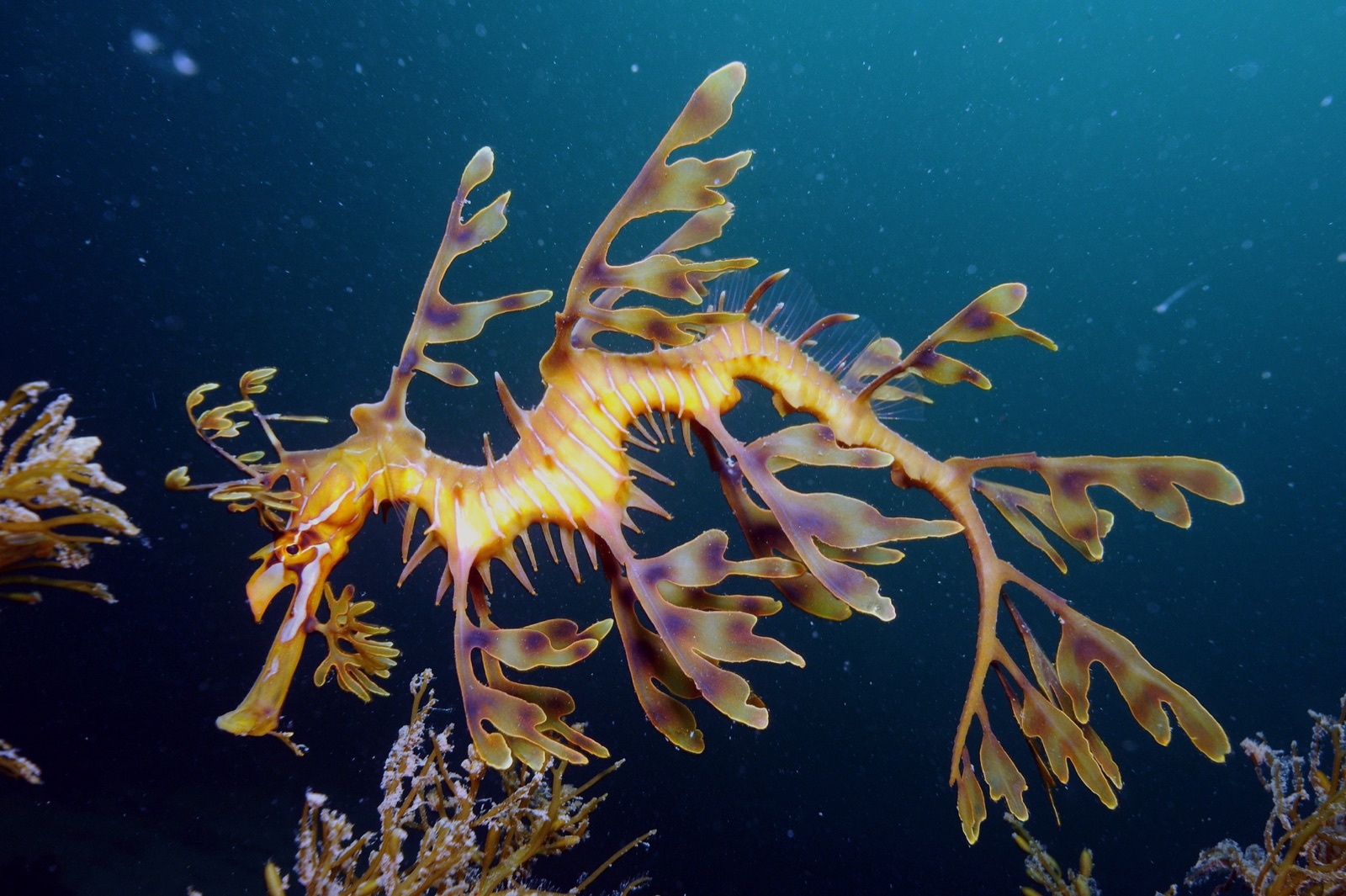
Leafy Seadragon
Phycodurus eques · Bony fish, family Syngnathidae; an Australian endemic seadragon and South Australia's marine emblem
The leafy seadragon does not look like a fish even while you watch it swim. Leaf-shaped skin lobes sprout from head, trunk, and tail until the animal reads as drifting kelp; propulsion comes from small, nearly transparent fins, so it hangs and pivots like weed obeying a private current. Leafies live only along Australia's southern coast, working kelp lines, seagrass edges, and jetty piles for mysid shrimp taken through a pipette snout. Males carry the brood, eggs pressed onto a patch beneath the tail for six to eight weeks. South Australian jetty and bay dives made the species a pilgrimage animal, and the rules reflect its status: fully protected, never touched, never herded into open water for a photograph. Move with the swell, keep the lights low and brief, and let the kelp keep pretending.
Onde e quando ver um
"Residente" significa que a maioria dos mergulhos naquele destino os encontra; "sazonal" significa presença confiável nos meses listados; qualquer outra coisa é um bônus, não um plano.
| Destino | Fiabilidade | Meses | Notas |
|---|---|---|---|
| South AustraliaAustralia | Resident: seen on most dives | Todo o ano |
Melhor mês, em resumo
| Mês | Destinos fiáveis |
|---|---|
| January | South Australia |
| February | South Australia |
| March | South Australia |
| April | South Australia |
| May | South Australia |
| June | South Australia |
| July | South Australia |
| August | South Australia |
| September | South Australia |
| October | South Australia |
| November | South Australia |
| December | South Australia |
Entendendo-os
Habitat: Kelp and macroalgae beds, seagrass edges, and jetty piles over sand in cool southern Australian water.
Distribuição: Southern Australian coast only, roughly from South Australia's gulfs west into southern Western Australia.
Comportamento: Drifts among weed on nearly transparent fins, relying wholly on its leafy costume; males brood the eggs, carried on a patch under the tail for roughly six to eight weeks.
Dieta: Mysid shrimp and other small crustaceans sucked through the pipette snout in vast numbers.
Tamanho: normalmente cerca de 0.24 m; documentado até 0.35 m (total length).
Como se comportar perto de um
Fully protected: never touch, herd into open water, or crowd for a cleaner backdrop; move with the swell, keep lights brief, and stay at the animal's level rather than above it.
Conservação
Least Concern under its current assessment and fully protected in Australian waters; habitat loss along the southern coast and past curio collection drove the protections.
Pontos mapeados conhecidos por eles
Os locais destacados foram cartografados para esta espécie pelos nossos editores; os números são registos de ocorrência do GBIF num raio de cerca de 5 km do local desde 1990.
Assista
Dos canais oficiais

Wildlife of Monterey | New film in our auditorium

Live Aviary Cam | Monterey Bay Aquarium

Live Aviary Cam | Monterey Bay Aquarium
Os vídeos são ligações incorporadas para os canais dos próprios criadores. Não alojamos nada e creditamos tudo.