Cold Water
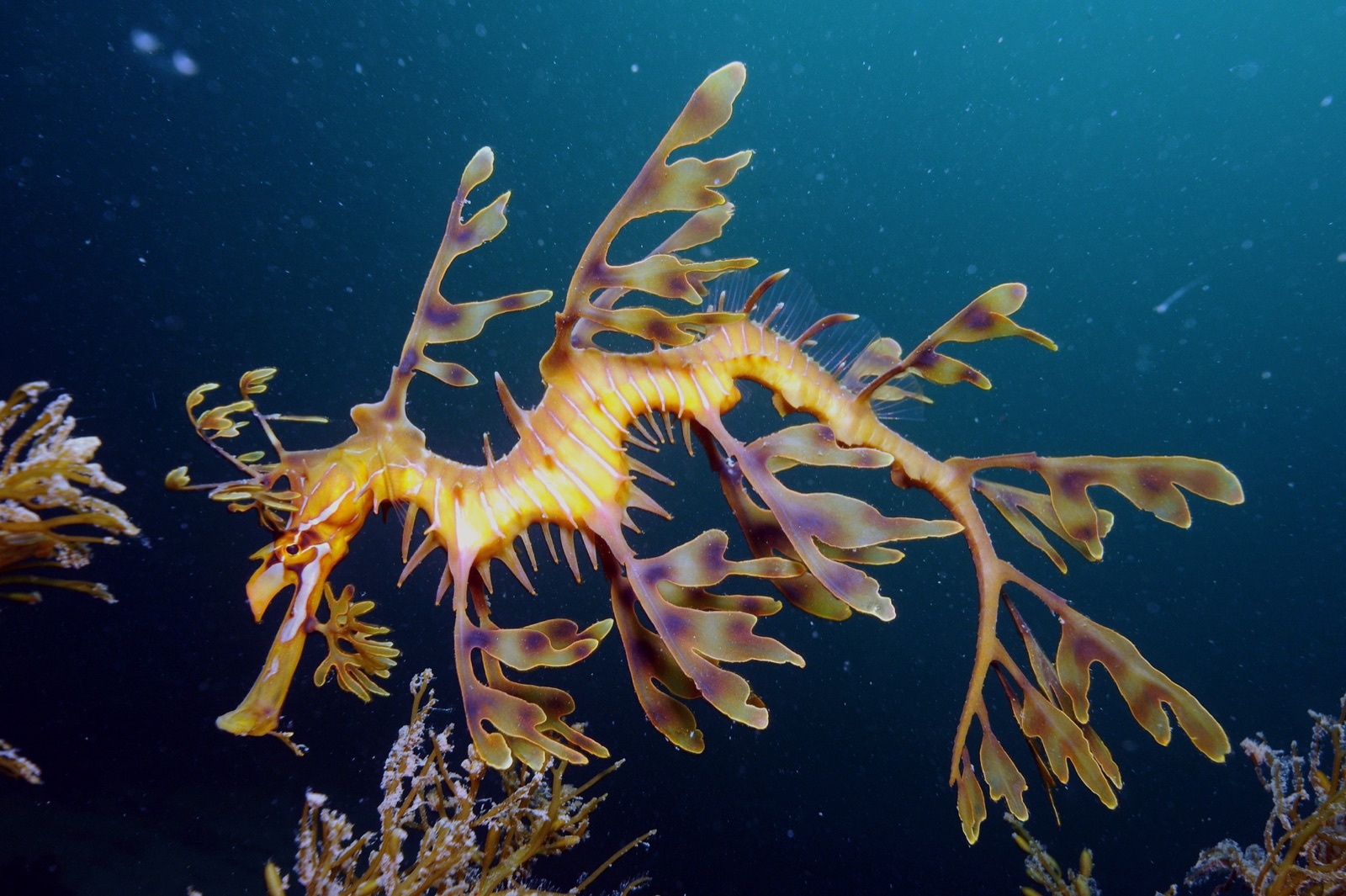
Leafy Seadragon
Phycodurus eques · Bony fish, family Syngnathidae; an Australian endemic seadragon and South Australia's marine emblem
The leafy seadragon does not look like a fish even while you watch it swim. Leaf-shaped skin lobes sprout from head, trunk, and tail until the animal reads as drifting kelp; propulsion comes from small, nearly transparent fins, so it hangs and pivots like weed obeying a private current. Leafies live only along Australia's southern coast, working kelp lines, seagrass edges, and jetty piles for mysid shrimp taken through a pipette snout. Males carry the brood, eggs pressed onto a patch beneath the tail for six to eight weeks. South Australian jetty and bay dives made the species a pilgrimage animal, and the rules reflect its status: fully protected, never touched, never herded into open water for a photograph. Move with the swell, keep the lights low and brief, and let the kelp keep pretending.
Nơi và thời điểm có thể gặp
"Thường trú" nghĩa là hầu hết các lần lặn tại điểm đó đều gặp được chúng; "theo mùa" nghĩa là chúng xuất hiện đáng tin cậy trong các tháng được liệt kê; bất kỳ điều gì ngoài ra là điểm thưởng, không phải kế hoạch.
| Điểm đến | Độ tin cậy | Các tháng | Ghi chú |
|---|---|---|---|
| South AustraliaAustralia | Resident: seen on most dives | Quanh năm |
Tháng tốt nhất, nhìn tổng quan
| Tháng | Điểm đến đáng tin cậy |
|---|---|
| January | South Australia |
| February | South Australia |
| March | South Australia |
| April | South Australia |
| May | South Australia |
| June | South Australia |
| July | South Australia |
| August | South Australia |
| September | South Australia |
| October | South Australia |
| November | South Australia |
| December | South Australia |
Tìm hiểu về chúng
Môi trường sống: Kelp and macroalgae beds, seagrass edges, and jetty piles over sand in cool southern Australian water.
Phạm vi phân bố: Southern Australian coast only, roughly from South Australia's gulfs west into southern Western Australia.
Hành vi: Drifts among weed on nearly transparent fins, relying wholly on its leafy costume; males brood the eggs, carried on a patch under the tail for roughly six to eight weeks.
Chế độ ăn: Mysid shrimp and other small crustaceans sucked through the pipette snout in vast numbers.
Kích thước: thường vào khoảng 0.24 m; ghi nhận đến độ sâu 0.35 m (total length).
Cách ứng xử khi ở gần loài này
Fully protected: never touch, herd into open water, or crowd for a cleaner backdrop; move with the swell, keep lights brief, and stay at the animal's level rather than above it.
Bảo tồn
Least Concern under its current assessment and fully protected in Australian waters; habitat loss along the southern coast and past curio collection drove the protections.
Các điểm lặn đã ghi nhận có loài này
Các điểm được làm nổi bật là những điểm đã được ban biên tập ghi chép cho loài này; các con số là bản ghi xuất hiện từ GBIF được ghi nhận trong phạm vi khoảng 5 km của điểm lặn kể từ năm 1990.
Xem
Từ kênh chính thức

Wildlife of Monterey | New film in our auditorium

Live Aviary Cam | Monterey Bay Aquarium

Live Aviary Cam | Monterey Bay Aquarium
Video là các liên kết nhúng dẫn đến kênh của chính tác giả. Chúng tôi không lưu trữ gì và ghi công đầy đủ.