Sharks
Oceanic Whitetip Shark
Carcharhinus longimanus · Cartilaginous fish, family Carcharhinidae
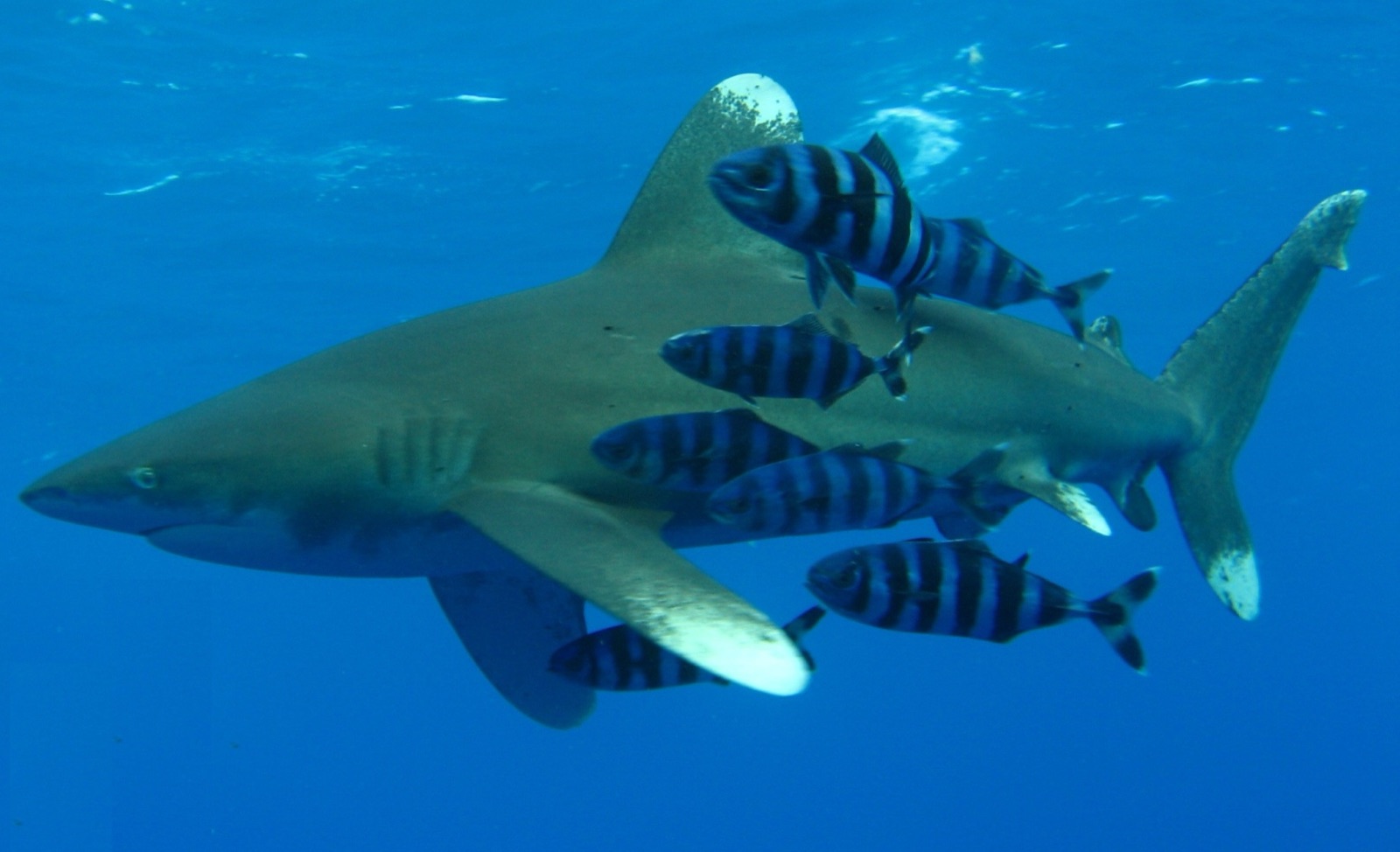
Meeting an oceanic whitetip rearranges your understanding of shark encounters. Most species keep a polite perimeter; this one crosses it immediately, gliding in at eye level on pectoral fins like white-tipped wings, close enough to count the scars. It is not aggression so much as an economy of curiosity from an animal that lives where meals are weeks apart. Around Daedalus, the Brothers, and Elphinstone in autumn, divers hang in blue water while one or several whitetips run their patient circuits. Once among the most abundant large animals on Earth, longimanus has been fished to Critically Endangered. The Red Sea encounters are a privilege of geography and protection.
Where and when to see one
"Resident" means most dives at that destination encounter them; "seasonal" means reliably present in the listed months; anything else is a bonus, not a plan.
| Destination | Reliability | Months | Notes |
|---|---|---|---|
| Brothers, Daedalus & St John'sEgypt | Seasonal: reliable in season | Oct–Jan | |
| Marsa Alam & the Deep SouthEgypt | Seasonal: reliable in season | Oct–Dec | |
| Socorro & the RevillagigedosMexico | Occasional | Year-round |
Best month, at a glance
| Month | Reliable destinations |
|---|---|
| January | Brothers, Daedalus & St John's · Socorro & the Revillagigedos |
| February | Socorro & the Revillagigedos |
| March | Socorro & the Revillagigedos |
| April | Socorro & the Revillagigedos |
| May | Socorro & the Revillagigedos |
| June | Socorro & the Revillagigedos |
| July | Socorro & the Revillagigedos |
| August | Socorro & the Revillagigedos |
| September | Socorro & the Revillagigedos |
| October | Brothers, Daedalus & St John's · Marsa Alam & the Deep South · Socorro & the Revillagigedos |
| November | Brothers, Daedalus & St John's · Marsa Alam & the Deep South · Socorro & the Revillagigedos |
| December | Brothers, Daedalus & St John's · Marsa Alam & the Deep South · Socorro & the Revillagigedos |
Understanding them
Habitat: The open-ocean surface layer, far from land; approaches offshore reefs and seamounts, and famously shadows boats
Range: Circumtropical in deep, warm offshore water worldwide; for divers the reliable overlap is Egypt's offshore Red Sea reefs
Behavior: The defining trait is persistence. In an ocean of scarcity, longimanus investigates everything: it approaches divers directly, circles close, and returns again and again, often with a pilot-fish escort. The huge, white-mottled, paddle-shaped pectorals make it unmistakable at a glance.
Diet: Squid and pelagic fish such as tuna; an opportunist adapted to a food-poor environment where nothing edible can be ignored
Size: typically around 2.0 m; documented up to 3.5 m (total length; most Red Sea animals run 1.8–2.5 m).
How to behave around one
Descend and ascend as a tight group, avoid lingering at the surface, keep your camera between you and a closing shark, turn to face every pass, and end the dive if an animal escalates. Follow Egyptian park briefings: no feeding, no swimming off alone.
Conservation
Critically Endangered after catastrophic bycatch and finning losses across all oceans, among the steepest declines documented for any wide-ranging shark. Retention is banned by most tuna fishery bodies, and the species is on CITES Appendix II.
Charted sites known for them
Highlighted sites were charted for this species by our editors; numbers are GBIF occurrence records logged within about 5 km of a site since 1990.
Watch
From the official channels

Wildlife of Monterey | New film in our auditorium

Live Aviary Cam | Monterey Bay Aquarium

Live Aviary Cam | Monterey Bay Aquarium
Videos are embedded links to their creators' own channels. We host nothing and credit everything.