Crustaceans
Peacock Mantis Shrimp
Odontodactylus scyllarus · Crustacean, order Stomatopoda (mantis shrimps), a smasher-type stomatopod; not a true shrimp
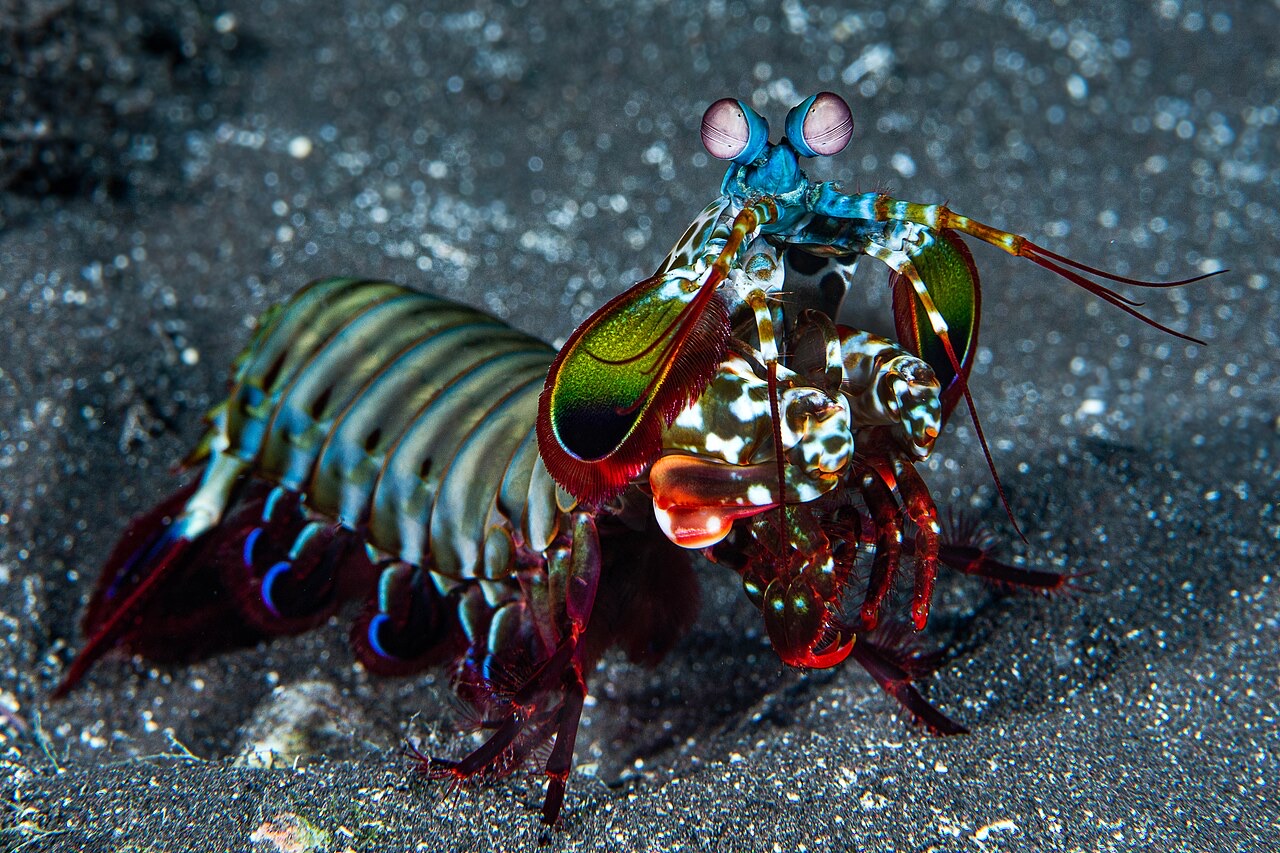
The peacock mantis shrimp carries the fastest punch a diver will ever share water with: spring-loaded raptorial clubs that accelerate through water hard enough to crack crab armor, with a collapsing cavitation bubble striking a second time behind the blow. Aquarists call them thumb splitters; divers mostly meet flashes of emerald, scarlet, and turquoise scuttling between rubble burrows. The eyes may be stranger than the weapons: mounted on independent stalks, packed with more photoreceptor classes than almost any animal studied, and sensitive to polarized light, they track a passing diver like gun turrets. Females brood egg masses in the burrow, and monogamous pairs hold the same territory for years at some sites. Watch from a respectful half meter, and keep fingers, pointers, and dome ports away from the front door. The clubs answer for the shrimp.
Wo und wann man eines sieht
„Resident" bedeutet, dass die meisten Tauchgänge am jeweiligen Tauchziel eine Begegnung erwarten lassen; „saisonal" bedeutet, dass die Art in den genannten Monaten zuverlässig anzutreffen ist; alles andere ist ein Bonus, keine Planungsgrundlage.
| Ziel | Zuverlässigkeit | Monate | Hinweise |
|---|---|---|---|
| Bali & Nusa PenidaIndonesia | Resident: seen on most dives | Ganzjährig | |
| AnilaoPhilippines | Resident: seen on most dives | Ganzjährig | |
| Similan Islands & Richelieu RockThailand | Resident: seen on most dives | Ganzjährig | |
| Lembeh StraitIndonesia | Resident: seen on most dives | Ganzjährig | |
| Dumaguete, Dauin & Apo IslandPhilippines | Resident: seen on most dives | Ganzjährig | |
| MoalboalPhilippines | Resident: seen on most dives | Ganzjährig |
Bester Monat auf einen Blick
Sie verstehen
Lebensraum: Rubble and sand near reefs, in U-shaped burrows the animal maintains and defends for long periods.
Verbreitung: Indo-Pacific from East Africa and the Andaman Sea through the Coral Triangle to northern Australia and Japan.
Verhalten: Patrols near the burrow in bursts, tracking divers with independently swiveling eyes; females brood egg masses in the burrow, and pairs at some sites hold territories for years.
Ernährung: Hard-shelled prey (crabs, snails, clams) cracked open with hammer-like raptorial clubs.
Größe: typischerweise rund 0.12 m; dokumentiert bis zu 0.18 m (body length).
Wie man sich in ihrer Nähe verhält
Observe from half a meter, never tease a burrow mouth with fingers or a pointer, and keep camera ports out of striking range of a displaying animal.
Naturschutz
Not formally assessed and locally common; collected for aquaria despite being a famously destructive tank resident.
Bekannte Tauchplätze dafür
Hervorgehobene Tauchplätze wurden von unseren Redakteuren für diese Art kartiert; die Zahlen sind GBIF-Vorkommensdatensätze, die seit 1990 im Umkreis von etwa 5 km um einen Tauchplatz protokolliert wurden.
Ansehen
Aus den offiziellen Kanälen

Wildlife of Monterey | New film in our auditorium

Live Aviary Cam | Monterey Bay Aquarium

Live Aviary Cam | Monterey Bay Aquarium
Videos sind eingebettete Links zu den Kanälen der jeweiligen Ersteller – wir hosten nichts und geben für alles die Quelle an.