Dive sites, seasons and marine life — researched, mapped, planned.
Menu
Destinations Dive Sites Marine Life Wrecks News
Plan a trip Trip planner When to dive Cost calculator Comparisons Marine-life calendar Water temperature Liveaboards Operators & resorts Marine parks Hyperbaric chambers World map
Regions Australia, New Zealand & East AsiaCaribbean & Western AtlanticEurope, Atlantic & MediterraneanIndian Ocean & East AfricaPacific Islands & MicronesiaRed Sea & Middle EastSoutheast Asia & Coral TriangleThe Americas & Eastern Pacific Countries
Learn & Tools All guides Certifications Gear guides Videos Ask the Data AI Agents API
About About us Methodology Disclaimer Contact
Your view
★ Saved

Your starred destinations, sites and species — stored in this browser.

API GATEWAY

Free read-only JSON access to the atlas's cached data.

Dark mode

🧭 Guided View
New to diving — depths, currents, certification levels? We explain every term as you browse, in plain English. Same data, with the help built in.

⚡ Expert View
You already know the difference between a wall and a drift. Just the data — clean, fast and compact. This is the default view.

Interface language
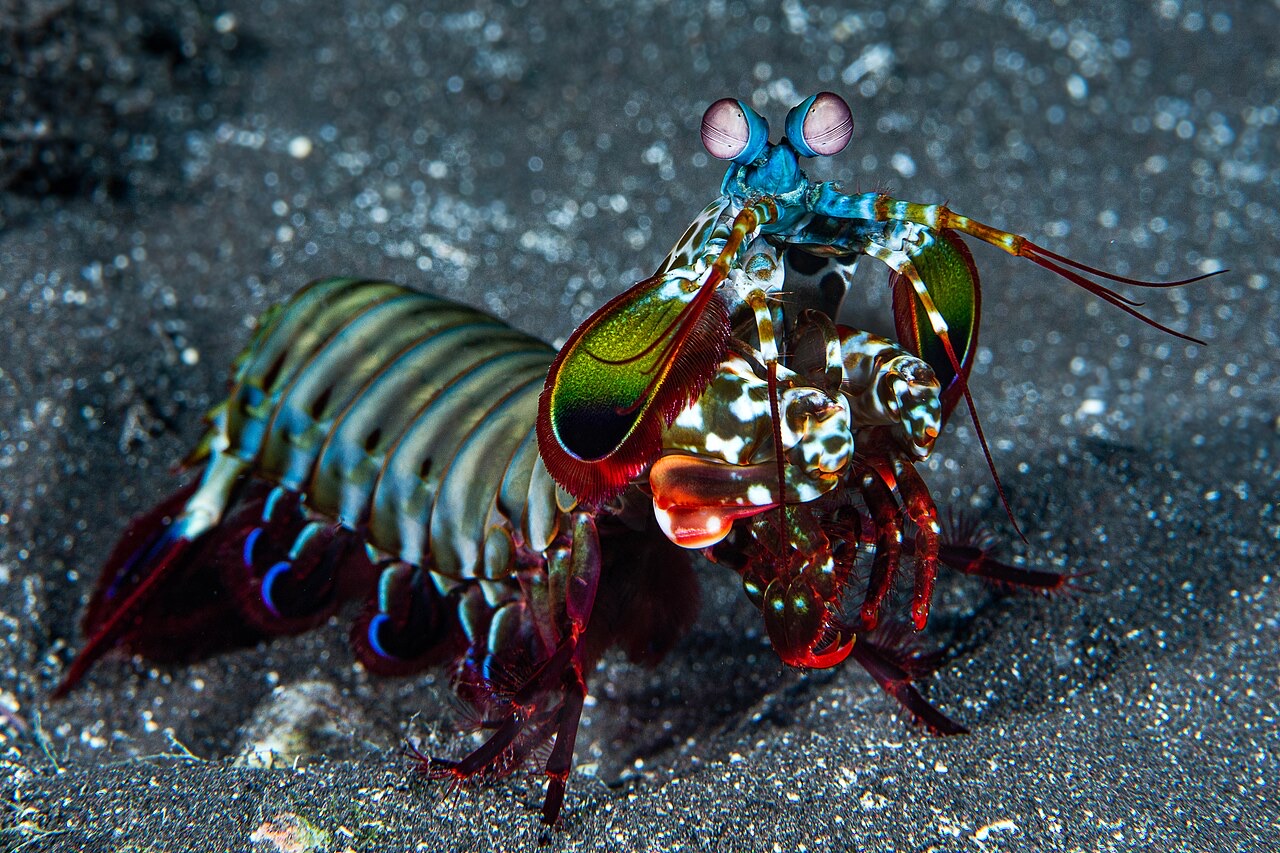
Peacock Mantis Shrimp — illustration
AI-generated illustration for The Scuba Atlas — illustrative, not a documentary photograph.

Crustaceans

Peacock Mantis Shrimp

Odontodactylus scyllarus · Crustacean — order Stomatopoda (mantis shrimps), a smasher-type stomatopod; not a true shrimp

~0.12 m body length 3–40 m depth band Well documented

The peacock mantis shrimp carries the fastest punch a diver will ever share water with — spring-loaded raptorial clubs that accelerate through water hard enough to crack crab armor, with a collapsing cavitation bubble striking a second time behind the blow. Aquarists call them thumb splitters; divers mostly meet flashes of emerald, scarlet, and turquoise scuttling between rubble burrows. The eyes may be stranger than the weapons: mounted on independent stalks, packed with more photoreceptor classes than almost any animal studied, and sensitive to polarized light, they track a passing diver like gun turrets. Females brood egg masses in the burrow, and monogamous pairs hold the same territory for years at some sites. Watch from a respectful half meter, and keep fingers, pointers, and dome ports away from the front door. The clubs answer for the shrimp.

Respect factor: Treat With RespectA defensive strike can lacerate skin through gloves — injuries come from provoking, cornering, or trying to handle one. Left alone it is harmless and mostly shy.

Where and when to see one

"Resident" means most dives at that destination encounter them; "seasonal" means reliably present in the listed months; anything else is a bonus, not a plan.

DestinationReliabilityMonthsNotes
Bali & Nusa PenidaIndonesia Resident — seen on most dives Year-round
AnilaoPhilippines Resident — seen on most dives Year-round
Similan Islands & Richelieu RockThailand Resident — seen on most dives Year-round
Lembeh StraitIndonesia Resident — seen on most dives Year-round
Dumaguete, Dauin & Apo IslandPhilippines Resident — seen on most dives Year-round
MoalboalPhilippines Resident — seen on most dives Year-round

Best month, at a glance

MonthReliable destinations
January Bali & Nusa Penida · Anilao · Similan Islands & Richelieu Rock · Lembeh Strait · Dumaguete, Dauin & Apo Island · Moalboal
February Bali & Nusa Penida · Anilao · Similan Islands & Richelieu Rock · Lembeh Strait · Dumaguete, Dauin & Apo Island · Moalboal
March Bali & Nusa Penida · Anilao · Similan Islands & Richelieu Rock · Lembeh Strait · Dumaguete, Dauin & Apo Island · Moalboal
April Bali & Nusa Penida · Anilao · Similan Islands & Richelieu Rock · Lembeh Strait · Dumaguete, Dauin & Apo Island · Moalboal
May Bali & Nusa Penida · Anilao · Similan Islands & Richelieu Rock · Lembeh Strait · Dumaguete, Dauin & Apo Island · Moalboal
June Bali & Nusa Penida · Anilao · Similan Islands & Richelieu Rock · Lembeh Strait · Dumaguete, Dauin & Apo Island · Moalboal
July Bali & Nusa Penida · Anilao · Similan Islands & Richelieu Rock · Lembeh Strait · Dumaguete, Dauin & Apo Island · Moalboal
August Bali & Nusa Penida · Anilao · Similan Islands & Richelieu Rock · Lembeh Strait · Dumaguete, Dauin & Apo Island · Moalboal
September Bali & Nusa Penida · Anilao · Similan Islands & Richelieu Rock · Lembeh Strait · Dumaguete, Dauin & Apo Island · Moalboal
October Bali & Nusa Penida · Anilao · Similan Islands & Richelieu Rock · Lembeh Strait · Dumaguete, Dauin & Apo Island · Moalboal
November Bali & Nusa Penida · Anilao · Similan Islands & Richelieu Rock · Lembeh Strait · Dumaguete, Dauin & Apo Island · Moalboal
December Bali & Nusa Penida · Anilao · Similan Islands & Richelieu Rock · Lembeh Strait · Dumaguete, Dauin & Apo Island · Moalboal

Understanding them

Habitat: Rubble and sand near reefs, in U-shaped burrows the animal maintains and defends for long periods.

Range: Indo-Pacific from East Africa and the Andaman Sea through the Coral Triangle to northern Australia and Japan.

Behavior: Patrols near the burrow in bursts, tracking divers with independently swiveling eyes; females brood egg masses in the burrow, and pairs at some sites hold territories for years.

Diet: Hard-shelled prey — crabs, snails, clams — cracked open with hammer-like raptorial clubs.

Size: typically around 0.12 m; documented up to 0.18 m (body length).

How to behave around one

Observe from half a meter, never tease a burrow mouth with fingers or a pointer, and keep camera ports out of striking range of a displaying animal.

Conservation

Not formally assessed and locally common; collected for aquaria despite being a famously destructive tank resident.

Charted sites known for them

Watch

From the official channels

All videos →

Videos are embedded links to their creators' own channels — we host nothing and credit everything.

Sources: Wikipedia ↗SeaLifeBase ↗ · Facts verified against the sources above; fields without support are labeled not yet verified.

Australia, New Zealand & East Asia

Cairns & the Ribbon ReefsNingaloo ReefCoral Sea & Osprey ReefOkinawa & the Kerama IslandsPoor Knights IslandsTownsville & the YongalaGreen IslandIzu Peninsula

Caribbean & Western Atlantic

BonaireCozumelRiviera Maya & the CenotesBelize Barrier ReefGrand CaymanIsla Mujeres & CancúnRoatánTiger Beach & Grand Bahama

Europe, Atlantic & Mediterranean

Malta & GozoSilfra & IcelandThe AzoresCanary IslandsLarnaca & the ZenobiaScapa FlowArctic NorwayMadeira

Indian Ocean & East Africa

North & South Malé AtollsAri AtollBaa Atoll & Hanifaru BayAliwal Shoal & UmkomaasMafia IslandMauritiusSeychellesSodwana Bay

Pacific Islands & Micronesia

PalauChuuk (Truk) LagoonFakaravaKona, HawaiʻiRangiroaTaveuni & Rainbow ReefBeqa Lagoon & Pacific HarbourEspiritu Santo

Red Sea & Middle East

Sharm El Sheikh & Ras MohammedBrothers, Daedalus & St John'sDahabHurghada & El GounaMarsa Alam & the Deep SouthAqabaDaymaniyat IslandsMusandam Peninsula

Southeast Asia & Coral Triangle

Bali & Nusa PenidaKomodoRaja AmpatSipadan & MabulAnilaoCoronKoh TaoLembeh Strait

The Americas & Eastern Pacific

Galápagos IslandsCocos IslandFlorida KeysSea of Cortez & Cabo PulmoSocorro & the RevillagigedosBritish ColumbiaCalifornia Channel IslandsCosta Rica Pacific Coast