Crustaceans
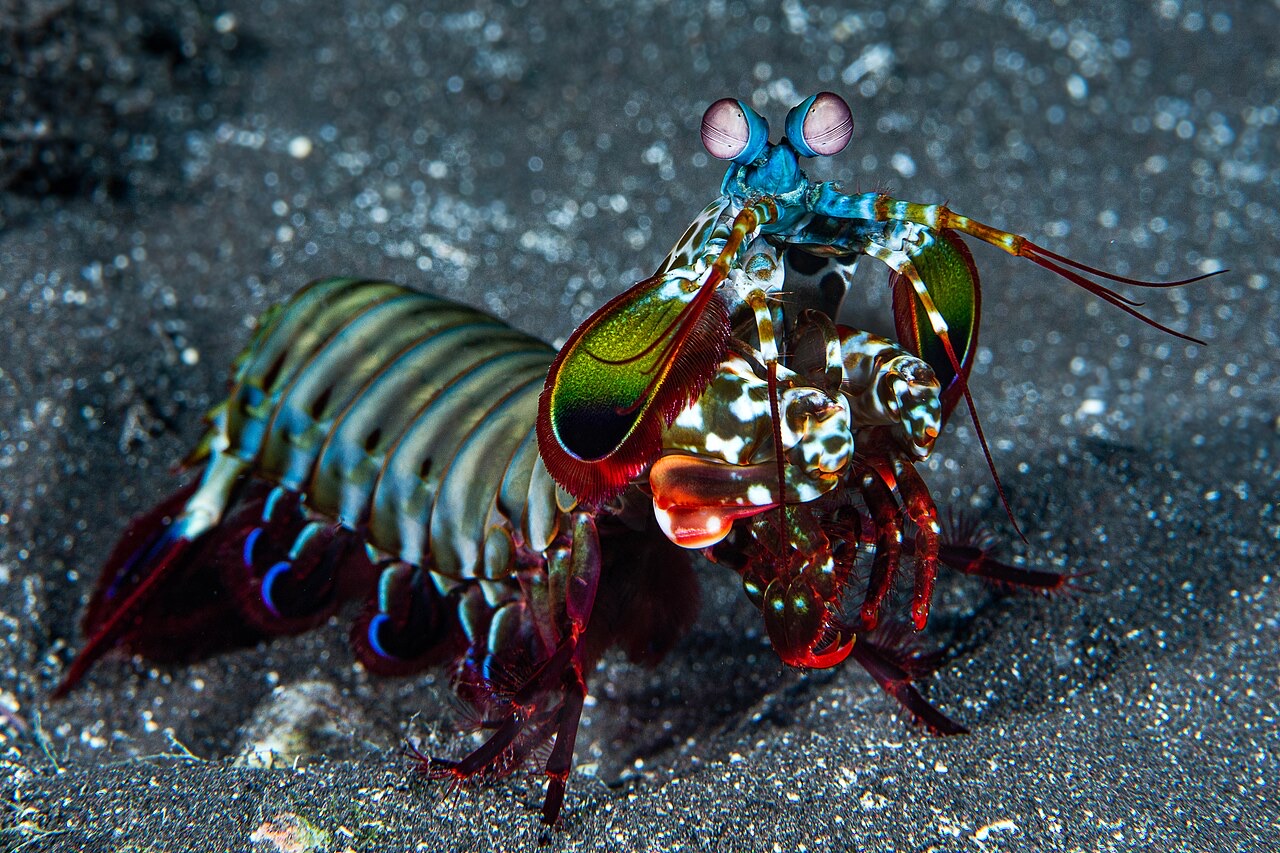
Peacock Mantis Shrimp
Odontodactylus scyllarus · Crustacean, order Stomatopoda (mantis shrimps), a smasher-type stomatopod; not a true shrimp
The peacock mantis shrimp carries the fastest punch a diver will ever share water with: spring-loaded raptorial clubs that accelerate through water hard enough to crack crab armor, with a collapsing cavitation bubble striking a second time behind the blow. Aquarists call them thumb splitters; divers mostly meet flashes of emerald, scarlet, and turquoise scuttling between rubble burrows. The eyes may be stranger than the weapons: mounted on independent stalks, packed with more photoreceptor classes than almost any animal studied, and sensitive to polarized light, they track a passing diver like gun turrets. Females brood egg masses in the burrow, and monogamous pairs hold the same territory for years at some sites. Watch from a respectful half meter, and keep fingers, pointers, and dome ports away from the front door. The clubs answer for the shrimp.
Dónde y cuándo ver uno
"Residente" significa que la mayoría de las inmersiones en ese destino tienen encuentros con ellos; "estacional" significa que su presencia es fiable en los meses indicados; cualquier otra cosa es un extra, no algo con lo que contar.
| Destino | Fiabilidad | Meses | Notas |
|---|---|---|---|
| Bali & Nusa PenidaIndonesia | Resident: seen on most dives | Todo el año | |
| AnilaoPhilippines | Resident: seen on most dives | Todo el año | |
| Similan Islands & Richelieu RockThailand | Resident: seen on most dives | Todo el año | |
| Lembeh StraitIndonesia | Resident: seen on most dives | Todo el año | |
| Dumaguete, Dauin & Apo IslandPhilippines | Resident: seen on most dives | Todo el año | |
| MoalboalPhilippines | Resident: seen on most dives | Todo el año |
El mejor mes, de un vistazo
Comprendiéndolos
Hábitat: Rubble and sand near reefs, in U-shaped burrows the animal maintains and defends for long periods.
Rango: Indo-Pacific from East Africa and the Andaman Sea through the Coral Triangle to northern Australia and Japan.
Comportamiento: Patrols near the burrow in bursts, tracking divers with independently swiveling eyes; females brood egg masses in the burrow, and pairs at some sites hold territories for years.
Dieta: Hard-shelled prey (crabs, snails, clams) cracked open with hammer-like raptorial clubs.
Tamaño: normalmente alrededor de 0.12 m; documentado hasta 0.18 m (body length).
Cómo comportarse cerca de uno
Observe from half a meter, never tease a burrow mouth with fingers or a pointer, and keep camera ports out of striking range of a displaying animal.
Conservación
Not formally assessed and locally common; collected for aquaria despite being a famously destructive tank resident.
Puntos conocidos por avistamientos
Los puntos destacados fueron registrados para esta especie por nuestros editores; los números son registros de ocurrencia de GBIF anotados en un radio de unos 5 km de un punto desde 1990.
Ver
Desde los canales oficiales

Wildlife of Monterey | New film in our auditorium

Live Aviary Cam | Monterey Bay Aquarium

Live Aviary Cam | Monterey Bay Aquarium
Los vídeos son enlaces insertados a los canales de sus propios creadores. No alojamos nada y acreditamos todo.