Crustaceans
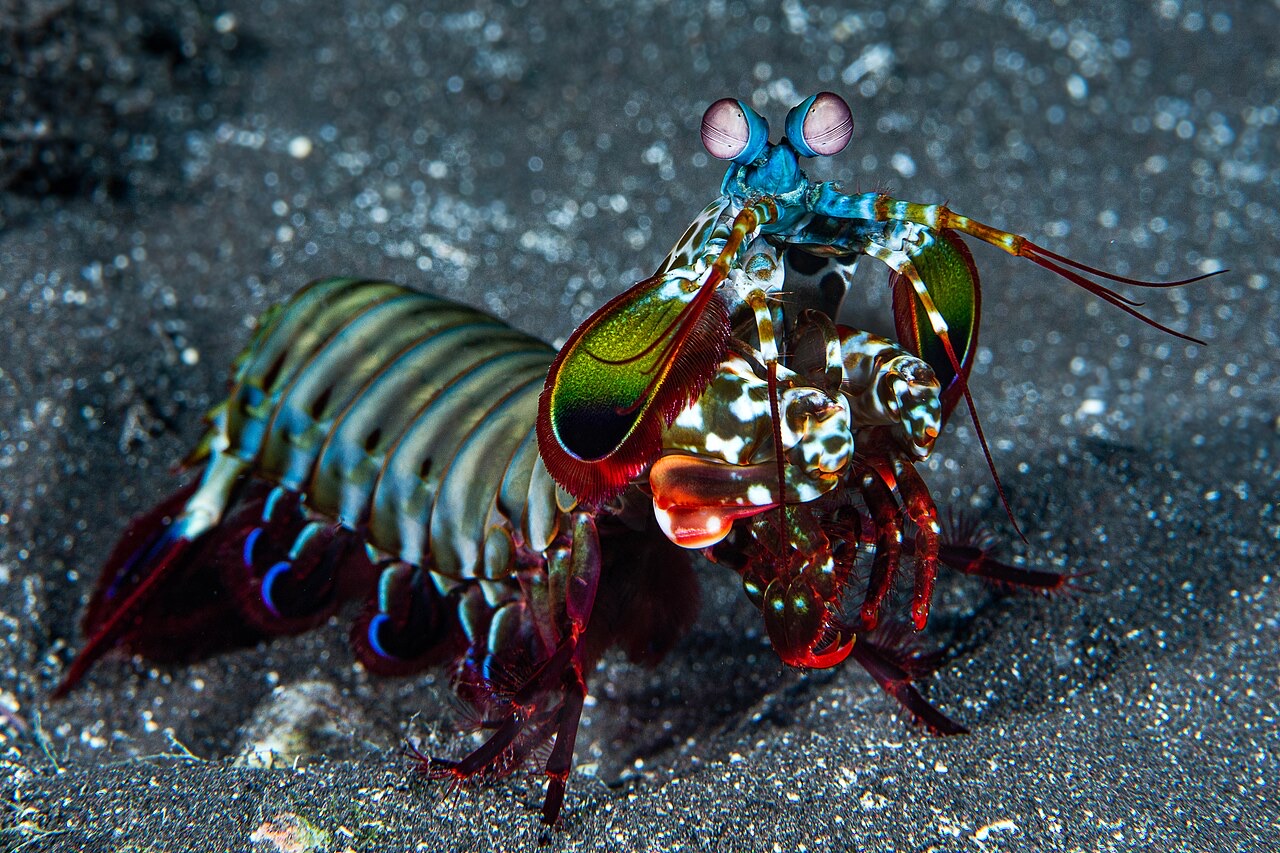
Peacock Mantis Shrimp
Odontodactylus scyllarus · Crustacean, order Stomatopoda (mantis shrimps), a smasher-type stomatopod; not a true shrimp
The peacock mantis shrimp carries the fastest punch a diver will ever share water with: spring-loaded raptorial clubs that accelerate through water hard enough to crack crab armor, with a collapsing cavitation bubble striking a second time behind the blow. Aquarists call them thumb splitters; divers mostly meet flashes of emerald, scarlet, and turquoise scuttling between rubble burrows. The eyes may be stranger than the weapons: mounted on independent stalks, packed with more photoreceptor classes than almost any animal studied, and sensitive to polarized light, they track a passing diver like gun turrets. Females brood egg masses in the burrow, and monogamous pairs hold the same territory for years at some sites. Watch from a respectful half meter, and keep fingers, pointers, and dome ports away from the front door. The clubs answer for the shrimp.
Dove e quando avvistarne uno
"Residente" significa che la maggior parte delle immersioni in quella destinazione li incontra; "stagionale" significa che sono presenti in modo affidabile nei mesi indicati; qualsiasi altra cosa è un bonus, non un piano.
| Destinazione | Affidabilità | Mesi | Note |
|---|---|---|---|
| Bali & Nusa PenidaIndonesia | Resident: seen on most dives | Tutto l'anno | |
| AnilaoPhilippines | Resident: seen on most dives | Tutto l'anno | |
| Similan Islands & Richelieu RockThailand | Resident: seen on most dives | Tutto l'anno | |
| Lembeh StraitIndonesia | Resident: seen on most dives | Tutto l'anno | |
| Dumaguete, Dauin & Apo IslandPhilippines | Resident: seen on most dives | Tutto l'anno | |
| MoalboalPhilippines | Resident: seen on most dives | Tutto l'anno |
Il mese migliore, a colpo d'occhio
Capirle
Habitat: Rubble and sand near reefs, in U-shaped burrows the animal maintains and defends for long periods.
Distribuzione: Indo-Pacific from East Africa and the Andaman Sea through the Coral Triangle to northern Australia and Japan.
Comportamento: Patrols near the burrow in bursts, tracking divers with independently swiveling eyes; females brood egg masses in the burrow, and pairs at some sites hold territories for years.
Dieta: Hard-shelled prey (crabs, snails, clams) cracked open with hammer-like raptorial clubs.
Dimensioni: tipicamente intorno a 0.12 m; documentato fino a 0.18 m (body length).
Come comportarsi in sua presenza
Observe from half a meter, never tease a burrow mouth with fingers or a pointer, and keep camera ports out of striking range of a displaying animal.
Conservazione
Not formally assessed and locally common; collected for aquaria despite being a famously destructive tank resident.
Siti mappati noti per avvistamenti
I siti evidenziati sono stati schedati per questa specie dai nostri redattori; i numeri sono record di occorrenza GBIF registrati entro circa 5 km dal sito a partire dal 1990.
Guarda
Dai canali ufficiali

Wildlife of Monterey | New film in our auditorium

Live Aviary Cam | Monterey Bay Aquarium

Live Aviary Cam | Monterey Bay Aquarium
I video sono link incorporati ai canali dei rispettivi autori. Non ospitiamo nulla e accreditiamo tutto.