Crustaceans
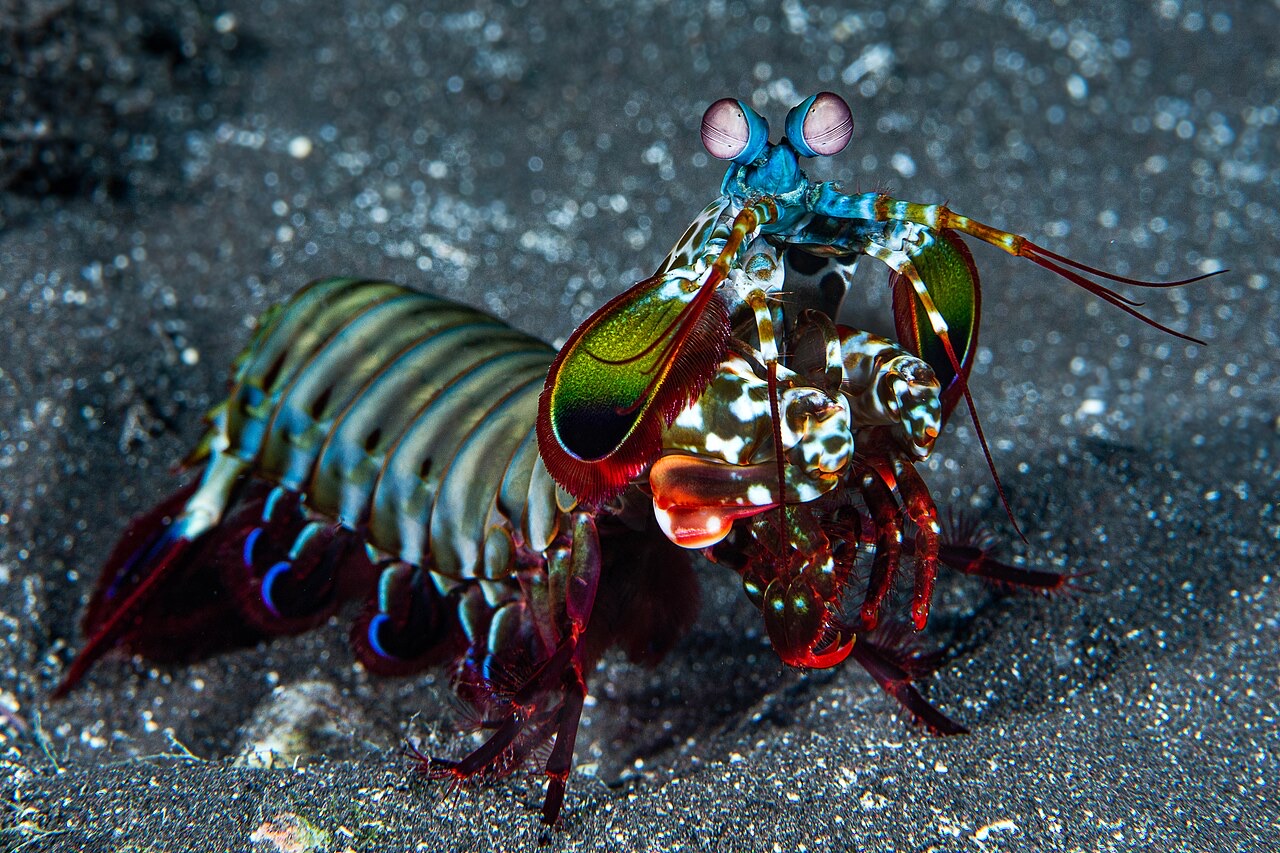
Peacock Mantis Shrimp
Odontodactylus scyllarus · Crustacean, order Stomatopoda (mantis shrimps), a smasher-type stomatopod; not a true shrimp
The peacock mantis shrimp carries the fastest punch a diver will ever share water with: spring-loaded raptorial clubs that accelerate through water hard enough to crack crab armor, with a collapsing cavitation bubble striking a second time behind the blow. Aquarists call them thumb splitters; divers mostly meet flashes of emerald, scarlet, and turquoise scuttling between rubble burrows. The eyes may be stranger than the weapons: mounted on independent stalks, packed with more photoreceptor classes than almost any animal studied, and sensitive to polarized light, they track a passing diver like gun turrets. Females brood egg masses in the burrow, and monogamous pairs hold the same territory for years at some sites. Watch from a respectful half meter, and keep fingers, pointers, and dome ports away from the front door. The clubs answer for the shrimp.
Waar en wanneer je er een kunt zien
"Resident" betekent dat je ze bij de meeste duiken op die bestemming tegenkomt; "seizoensgebonden" betekent betrouwbaar aanwezig in de vermelde maanden; al het andere is een bonus, geen garantie.
| Bestemming | Betrouwbaarheid | Maanden | Notities |
|---|---|---|---|
| Bali & Nusa PenidaIndonesia | Resident: seen on most dives | Het hele jaar door | |
| AnilaoPhilippines | Resident: seen on most dives | Het hele jaar door | |
| Similan Islands & Richelieu RockThailand | Resident: seen on most dives | Het hele jaar door | |
| Lembeh StraitIndonesia | Resident: seen on most dives | Het hele jaar door | |
| Dumaguete, Dauin & Apo IslandPhilippines | Resident: seen on most dives | Het hele jaar door | |
| MoalboalPhilippines | Resident: seen on most dives | Het hele jaar door |
Beste maand, in één oogopslag
Ze begrijpen
Habitat: Rubble and sand near reefs, in U-shaped burrows the animal maintains and defends for long periods.
Verspreidingsgebied: Indo-Pacific from East Africa and the Andaman Sea through the Coral Triangle to northern Australia and Japan.
Gedrag: Patrols near the burrow in bursts, tracking divers with independently swiveling eyes; females brood egg masses in the burrow, and pairs at some sites hold territories for years.
Dieet: Hard-shelled prey (crabs, snails, clams) cracked open with hammer-like raptorial clubs.
Grootte: doorgaans rond 0.12 m; gedocumenteerd tot 0.18 m (body length).
Hoe je je ertegenover gedraagt
Observe from half a meter, never tease a burrow mouth with fingers or a pointer, and keep camera ports out of striking range of a displaying animal.
Behoud
Not formally assessed and locally common; collected for aquaria despite being a famously destructive tank resident.
Gekende duiksites waar je ze tegenkomt
Gemarkeerde locaties zijn voor deze soort in kaart gebracht door onze redacteurs; de getallen zijn GBIF-waarnemingsrecords vastgelegd binnen ongeveer 5 km van een locatie sinds 1990.
Bekijk
Via de officiële kanalen

Wildlife of Monterey | New film in our auditorium

Live Aviary Cam | Monterey Bay Aquarium

Live Aviary Cam | Monterey Bay Aquarium
Video's zijn ingesloten links naar de eigen kanalen van de makers. We hosten niets en vermelden altijd de bron.