Pontos de mergulho, épocas e vida marinha — pesquisados, mapeados, planeados.
Menu
Destinos Pontos de Mergulho Vida Marinha Naufrágios Notícias
Planejar uma viagem Planejador de viagem Quando mergulhar Calculadora de custos Comparações Calendário de vida marinha Temperatura da água Liveaboards Operadores & resorts Parques marinhos Câmaras hiperbáricas Mapa mundial
Regiões Austrália, Nova Zelândia e Ásia OrientalCaribe e Atlântico OcidentalEuropa, Atlântico & MediterrâneoOceano Índico e África OrientalIlhas do Pacífico & MicronésiaMar Vermelho & Médio OrienteSudeste Asiático e Triângulo de CoralAs Américas e o Pacífico Oriental Países
Aprender e Ferramentas Todos os guias Certificações Guias de equipamento Vídeos Consulte os Dados Agentes de IA API
Sobre Sobre nós Metodologia Aviso legal Contato
A sua vista
★ Guardado

Os seus destinos, sítios de mergulho e espécies favoritos — guardados neste browser.

API GATEWAY

Acesso JSON gratuito e só de leitura aos dados em cache do atlas.

Modo escuro

🧭 Vista Guiada
Novo no mergulho — profundidades, correntes, níveis de certificação? Explicamos cada termo enquanto navega, em linguagem simples. Os mesmos dados, com a ajuda integrada.

⚡ Vista de Especialista
Já sabe a diferença entre uma parede e um drift dive. Apenas os dados — claros, rápidos e compactos. Esta é a vista predefinida.

Idioma da interface
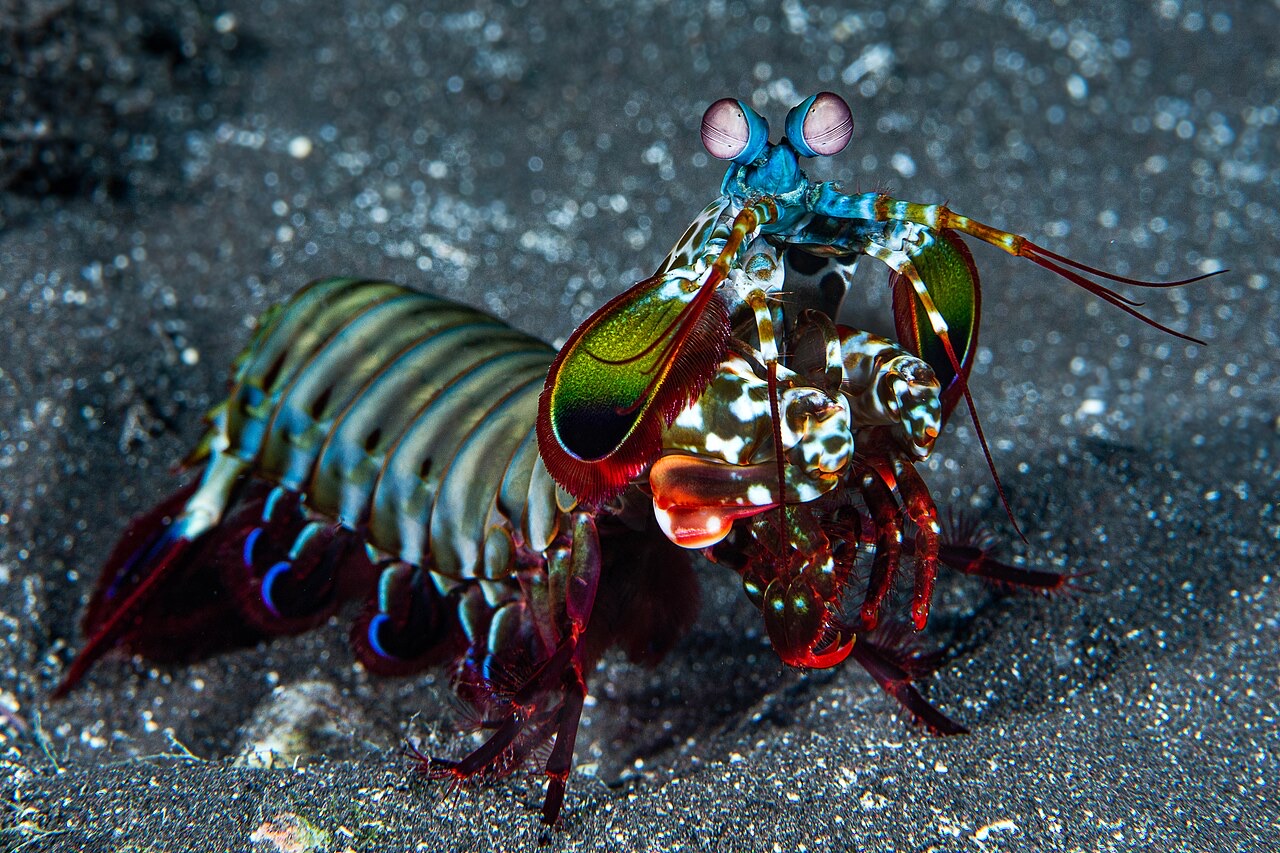
Peacock Mantis Shrimp — illustration
Ilustração gerada por IA para The Scuba Atlas — ilustrativa, não uma fotografia documental.

Crustaceans

Peacock Mantis Shrimp

Odontodactylus scyllarus · Crustacean — order Stomatopoda (mantis shrimps), a smasher-type stomatopod; not a true shrimp

~0.12 m body length 3–40 m intervalo de profundidade Bem documentado

The peacock mantis shrimp carries the fastest punch a diver will ever share water with — spring-loaded raptorial clubs that accelerate through water hard enough to crack crab armor, with a collapsing cavitation bubble striking a second time behind the blow. Aquarists call them thumb splitters; divers mostly meet flashes of emerald, scarlet, and turquoise scuttling between rubble burrows. The eyes may be stranger than the weapons: mounted on independent stalks, packed with more photoreceptor classes than almost any animal studied, and sensitive to polarized light, they track a passing diver like gun turrets. Females brood egg masses in the burrow, and monogamous pairs hold the same territory for years at some sites. Watch from a respectful half meter, and keep fingers, pointers, and dome ports away from the front door. The clubs answer for the shrimp.

Fator de respeito: Treat With RespectA defensive strike can lacerate skin through gloves — injuries come from provoking, cornering, or trying to handle one. Left alone it is harmless and mostly shy.

Onde e quando ver um

"Residente" significa que a maioria dos mergulhos naquele destino os encontra; "sazonal" significa presença confiável nos meses listados; qualquer outra coisa é um bônus, não um plano.

DestinoFiabilidadeMesesNotas
Bali & Nusa PenidaIndonesia Resident — seen on most dives Todo o ano
AnilaoPhilippines Resident — seen on most dives Todo o ano
Similan Islands & Richelieu RockThailand Resident — seen on most dives Todo o ano
Lembeh StraitIndonesia Resident — seen on most dives Todo o ano
Dumaguete, Dauin & Apo IslandPhilippines Resident — seen on most dives Todo o ano
MoalboalPhilippines Resident — seen on most dives Todo o ano

Melhor mês, em resumo

MêsDestinos fiáveis
January Bali & Nusa Penida · Anilao · Similan Islands & Richelieu Rock · Lembeh Strait · Dumaguete, Dauin & Apo Island · Moalboal
February Bali & Nusa Penida · Anilao · Similan Islands & Richelieu Rock · Lembeh Strait · Dumaguete, Dauin & Apo Island · Moalboal
March Bali & Nusa Penida · Anilao · Similan Islands & Richelieu Rock · Lembeh Strait · Dumaguete, Dauin & Apo Island · Moalboal
April Bali & Nusa Penida · Anilao · Similan Islands & Richelieu Rock · Lembeh Strait · Dumaguete, Dauin & Apo Island · Moalboal
May Bali & Nusa Penida · Anilao · Similan Islands & Richelieu Rock · Lembeh Strait · Dumaguete, Dauin & Apo Island · Moalboal
June Bali & Nusa Penida · Anilao · Similan Islands & Richelieu Rock · Lembeh Strait · Dumaguete, Dauin & Apo Island · Moalboal
July Bali & Nusa Penida · Anilao · Similan Islands & Richelieu Rock · Lembeh Strait · Dumaguete, Dauin & Apo Island · Moalboal
August Bali & Nusa Penida · Anilao · Similan Islands & Richelieu Rock · Lembeh Strait · Dumaguete, Dauin & Apo Island · Moalboal
September Bali & Nusa Penida · Anilao · Similan Islands & Richelieu Rock · Lembeh Strait · Dumaguete, Dauin & Apo Island · Moalboal
October Bali & Nusa Penida · Anilao · Similan Islands & Richelieu Rock · Lembeh Strait · Dumaguete, Dauin & Apo Island · Moalboal
November Bali & Nusa Penida · Anilao · Similan Islands & Richelieu Rock · Lembeh Strait · Dumaguete, Dauin & Apo Island · Moalboal
December Bali & Nusa Penida · Anilao · Similan Islands & Richelieu Rock · Lembeh Strait · Dumaguete, Dauin & Apo Island · Moalboal

Entendendo-os

Habitat: Rubble and sand near reefs, in U-shaped burrows the animal maintains and defends for long periods.

Distribuição: Indo-Pacific from East Africa and the Andaman Sea through the Coral Triangle to northern Australia and Japan.

Comportamento: Patrols near the burrow in bursts, tracking divers with independently swiveling eyes; females brood egg masses in the burrow, and pairs at some sites hold territories for years.

Dieta: Hard-shelled prey — crabs, snails, clams — cracked open with hammer-like raptorial clubs.

Tamanho: normalmente cerca de 0.12 m; documentado até 0.18 m (body length).

Como se comportar perto de um

Observe from half a meter, never tease a burrow mouth with fingers or a pointer, and keep camera ports out of striking range of a displaying animal.

Conservação

Not formally assessed and locally common; collected for aquaria despite being a famously destructive tank resident.

Pontos mapeados conhecidos por eles

Assista

Dos canais oficiais

Todos os vídeos →

Os vídeos são links incorporados dos próprios canais dos criadores — não hospedamos nada e creditamos tudo.

Fontes: Wikipedia ↗SeaLifeBase ↗ · Factos verificados em relação às fontes acima; os campos sem suporte estão assinalados como não verificado ainda.

Austrália, Nova Zelândia e Ásia Oriental

Cairns & the Ribbon ReefsNingaloo ReefCoral Sea & Osprey ReefOkinawa & the Kerama IslandsPoor Knights IslandsTownsville & the YongalaGreen IslandIzu Peninsula

Caribe e Atlântico Ocidental

BonaireCozumelRiviera Maya & the CenotesBelize Barrier ReefGrand CaymanIsla Mujeres & CancúnRoatánTiger Beach & Grand Bahama

Europa, Atlântico & Mediterrâneo

Malta & GozoSilfra & IcelandThe AzoresCanary IslandsLarnaca & the ZenobiaScapa FlowArctic NorwayMadeira

Oceano Índico e África Oriental

North & South Malé AtollsAri AtollBaa Atoll & Hanifaru BayAliwal Shoal & UmkomaasMafia IslandMauritiusSeychellesSodwana Bay

Ilhas do Pacífico & Micronésia

PalauChuuk (Truk) LagoonFakaravaKona, HawaiʻiRangiroaTaveuni & Rainbow ReefBeqa Lagoon & Pacific HarbourEspiritu Santo

Mar Vermelho & Médio Oriente

Sharm El Sheikh & Ras MohammedBrothers, Daedalus & St John'sDahabHurghada & El GounaMarsa Alam & the Deep SouthAqabaDaymaniyat IslandsMusandam Peninsula

Sudeste Asiático e Triângulo de Coral

Bali & Nusa PenidaKomodoRaja AmpatSipadan & MabulAnilaoCoronKoh TaoLembeh Strait

As Américas e o Pacífico Oriental

Galápagos IslandsCocos IslandFlorida KeysSea of Cortez & Cabo PulmoSocorro & the RevillagigedosBritish ColumbiaCalifornia Channel IslandsCosta Rica Pacific Coast