Crustaceans
Peacock Mantis Shrimp
Odontodactylus scyllarus · Crustacean, order Stomatopoda (mantis shrimps), a smasher-type stomatopod; not a true shrimp
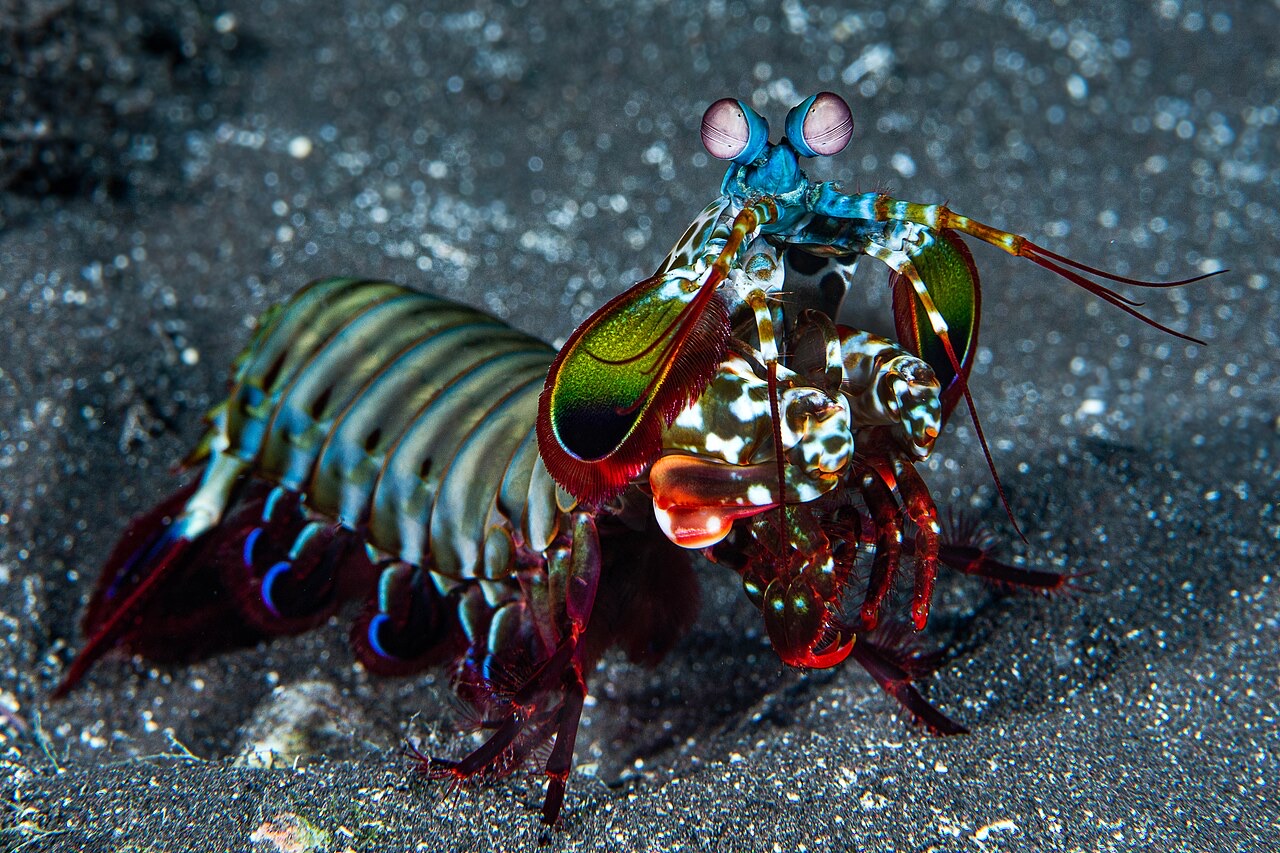
The peacock mantis shrimp carries the fastest punch a diver will ever share water with: spring-loaded raptorial clubs that accelerate through water hard enough to crack crab armor, with a collapsing cavitation bubble striking a second time behind the blow. Aquarists call them thumb splitters; divers mostly meet flashes of emerald, scarlet, and turquoise scuttling between rubble burrows. The eyes may be stranger than the weapons: mounted on independent stalks, packed with more photoreceptor classes than almost any animal studied, and sensitive to polarized light, they track a passing diver like gun turrets. Females brood egg masses in the burrow, and monogamous pairs hold the same territory for years at some sites. Watch from a respectful half meter, and keep fingers, pointers, and dome ports away from the front door. The clubs answer for the shrimp.
Nơi và thời điểm có thể gặp
"Thường trú" nghĩa là hầu hết các lần lặn tại điểm đó đều gặp được chúng; "theo mùa" nghĩa là chúng xuất hiện đáng tin cậy trong các tháng được liệt kê; bất kỳ điều gì ngoài ra là điểm thưởng, không phải kế hoạch.
| Điểm đến | Độ tin cậy | Các tháng | Ghi chú |
|---|---|---|---|
| Bali & Nusa PenidaIndonesia | Resident: seen on most dives | Quanh năm | |
| AnilaoPhilippines | Resident: seen on most dives | Quanh năm | |
| Similan Islands & Richelieu RockThailand | Resident: seen on most dives | Quanh năm | |
| Lembeh StraitIndonesia | Resident: seen on most dives | Quanh năm | |
| Dumaguete, Dauin & Apo IslandPhilippines | Resident: seen on most dives | Quanh năm | |
| MoalboalPhilippines | Resident: seen on most dives | Quanh năm |
Tháng tốt nhất, nhìn tổng quan
Tìm hiểu về chúng
Môi trường sống: Rubble and sand near reefs, in U-shaped burrows the animal maintains and defends for long periods.
Phạm vi phân bố: Indo-Pacific from East Africa and the Andaman Sea through the Coral Triangle to northern Australia and Japan.
Hành vi: Patrols near the burrow in bursts, tracking divers with independently swiveling eyes; females brood egg masses in the burrow, and pairs at some sites hold territories for years.
Chế độ ăn: Hard-shelled prey (crabs, snails, clams) cracked open with hammer-like raptorial clubs.
Kích thước: thường vào khoảng 0.12 m; ghi nhận đến độ sâu 0.18 m (body length).
Cách ứng xử khi ở gần loài này
Observe from half a meter, never tease a burrow mouth with fingers or a pointer, and keep camera ports out of striking range of a displaying animal.
Bảo tồn
Not formally assessed and locally common; collected for aquaria despite being a famously destructive tank resident.
Các điểm lặn đã ghi nhận có loài này
Các điểm được làm nổi bật là những điểm đã được ban biên tập ghi chép cho loài này; các con số là bản ghi xuất hiện từ GBIF được ghi nhận trong phạm vi khoảng 5 km của điểm lặn kể từ năm 1990.
Xem
Từ kênh chính thức

Wildlife of Monterey | New film in our auditorium

Live Aviary Cam | Monterey Bay Aquarium

Live Aviary Cam | Monterey Bay Aquarium
Video là các liên kết nhúng dẫn đến kênh của chính tác giả. Chúng tôi không lưu trữ gì và ghi công đầy đủ.