Reef Fish
Ribbon Eel
Rhinomuraena quaesita · Bony fish, family Muraenidae (moray eels); the only member of its genus
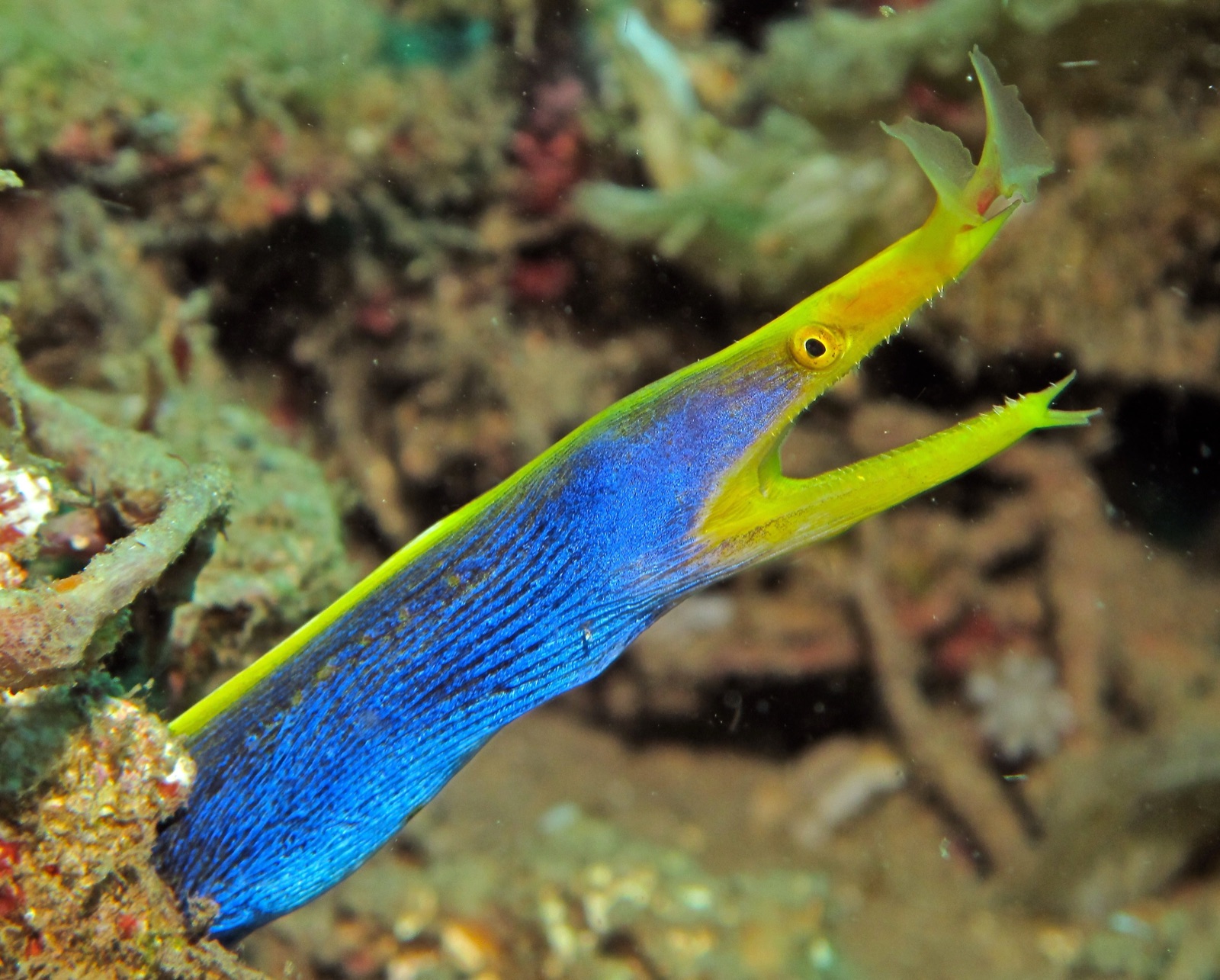
A ribbon eel in full display looks less like a fish than a ribbon caught in current: a pencil-thin body anchored in a sand burrow, front third waving, jaws flared beneath trumpet-shaped nostrils. The species wears three costumes: juveniles jet black with a yellow dorsal stripe, mature males electric blue and yellow, and late-stage animals yellow overall, widely described as females in a male-to-female sequence. Most encounters are jack-in-the-box moments on rubble slopes and muck flats, the eel striking at passing silversides or simply tasting the water. Individuals reuse the same burrow for months, which is why good guides find them on demand. Come in low and unhurried from the front; a burst of exhaust bubbles overhead sends the whole animal underground until tomorrow.
Où et quand en observer un
« Résident » signifie que la plupart des plongées sur ce site permettent de les observer ; « saisonnier » signifie qu'ils sont présents de manière fiable durant les mois indiqués ; tout le reste est un bonus, pas une certitude.
| Destination | Fiabilité | Mois | Notes |
|---|---|---|---|
| Bali & Nusa PenidaIndonesia | Resident: seen on most dives | Toute l'année | |
| Lembeh StraitIndonesia | Resident: seen on most dives | Toute l'année | |
| AnilaoPhilippines | Resident: seen on most dives | Toute l'année | |
| Dumaguete, Dauin & Apo IslandPhilippines | Resident: seen on most dives | Toute l'année | |
| MoalboalPhilippines | Occasional | Toute l'année |
Meilleur mois, en un coup d'œil
Les comprendre
Habitat: Sand and rubble burrows on reef margins, slopes, and muck flats, usually with just the head and front third showing.
Aire de répartition: Indo-Pacific from East Africa to French Polynesia, north to southern Japan, south to Australia.
Comportement: Anchors in a burrow and waves the forebody in the current; individuals reuse the same hole for months. Flared nostrils and constant open-mouth posture are sensory and respiratory, not aggression.
Régime alimentaire: Small fishes snatched from the water column above the burrow.
Taille: généralement autour de 1.0 m; documenté jusqu'à 1.3 m (total length; the body is only a few centimeters deep).
Comment se comporter avec lui
Approach low and slow from the front and keep bubbles off the burrow; a startled eel withdraws for the rest of the dive. Divers should never pull or bait one out.
Conservation
Common across a vast range; collected for aquaria despite surviving poorly in captivity, a trade worth declining to support.
Sites répertoriés connus pour leur présence
Les sites mis en évidence ont été cartographiés pour cette espèce par nos éditeurs ; les chiffres correspondent aux occurrences GBIF enregistrées dans un rayon d'environ 5 km d'un site depuis 1990.
Regarder
Depuis les canaux officiels

Wildlife of Monterey | New film in our auditorium

Live Aviary Cam | Monterey Bay Aquarium

Live Aviary Cam | Monterey Bay Aquarium
Les vidéos sont des liens intégrés vers les chaînes de leurs créateurs. Nous n'hébergeons rien et créditons tout.