Reef Fish
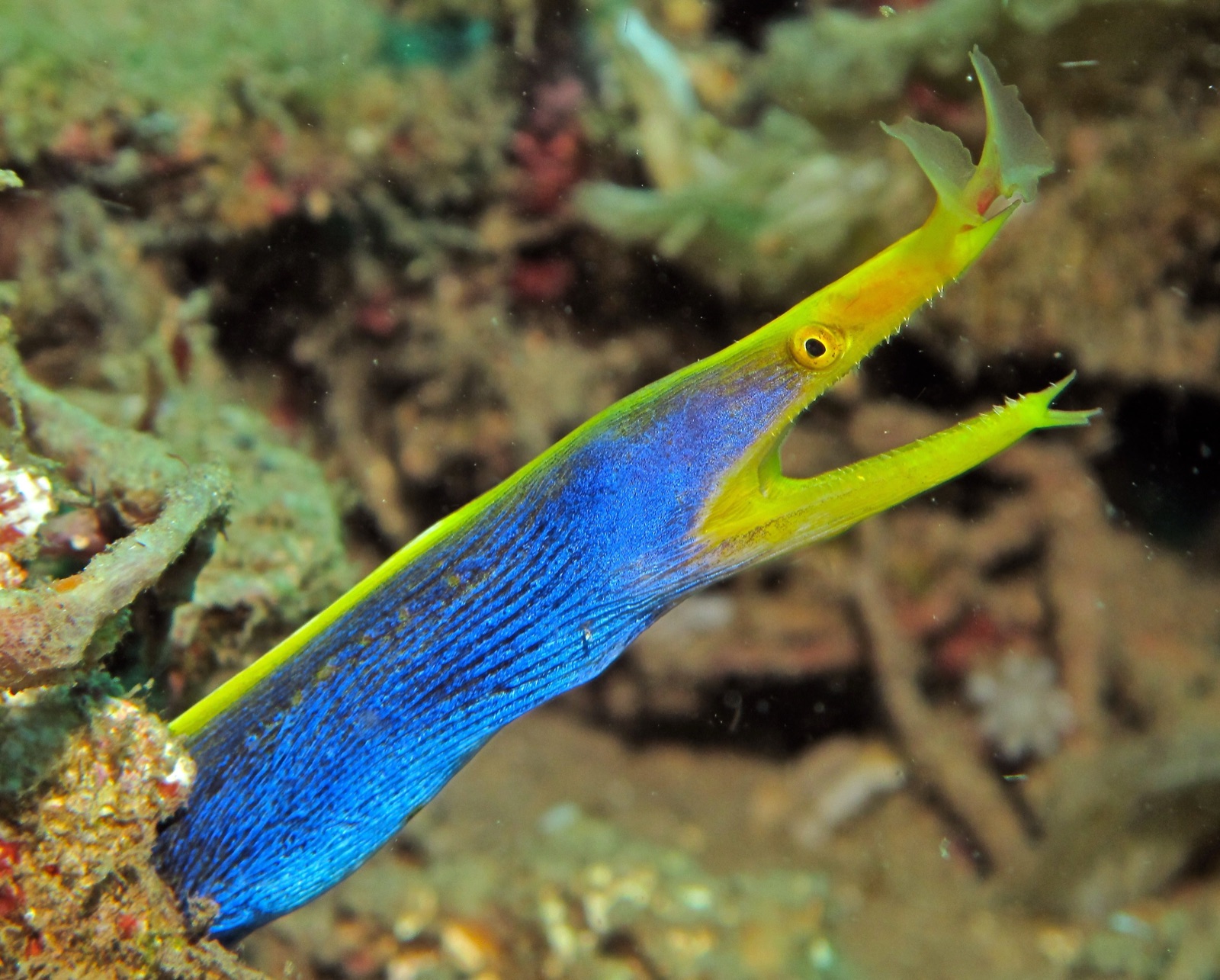
Ribbon Eel
Rhinomuraena quaesita · Bony fish, family Muraenidae (moray eels); the only member of its genus
A ribbon eel in full display looks less like a fish than a ribbon caught in current: a pencil-thin body anchored in a sand burrow, front third waving, jaws flared beneath trumpet-shaped nostrils. The species wears three costumes: juveniles jet black with a yellow dorsal stripe, mature males electric blue and yellow, and late-stage animals yellow overall, widely described as females in a male-to-female sequence. Most encounters are jack-in-the-box moments on rubble slopes and muck flats, the eel striking at passing silversides or simply tasting the water. Individuals reuse the same burrow for months, which is why good guides find them on demand. Come in low and unhurried from the front; a burst of exhaust bubbles overhead sends the whole animal underground until tomorrow.
Dove e quando avvistarne uno
"Residente" significa che la maggior parte delle immersioni in quella destinazione li incontra; "stagionale" significa che sono presenti in modo affidabile nei mesi indicati; qualsiasi altra cosa è un bonus, non un piano.
| Destinazione | Affidabilità | Mesi | Note |
|---|---|---|---|
| Bali & Nusa PenidaIndonesia | Resident: seen on most dives | Tutto l'anno | |
| Lembeh StraitIndonesia | Resident: seen on most dives | Tutto l'anno | |
| AnilaoPhilippines | Resident: seen on most dives | Tutto l'anno | |
| Dumaguete, Dauin & Apo IslandPhilippines | Resident: seen on most dives | Tutto l'anno | |
| MoalboalPhilippines | Occasional | Tutto l'anno |
Il mese migliore, a colpo d'occhio
Capirle
Habitat: Sand and rubble burrows on reef margins, slopes, and muck flats, usually with just the head and front third showing.
Distribuzione: Indo-Pacific from East Africa to French Polynesia, north to southern Japan, south to Australia.
Comportamento: Anchors in a burrow and waves the forebody in the current; individuals reuse the same hole for months. Flared nostrils and constant open-mouth posture are sensory and respiratory, not aggression.
Dieta: Small fishes snatched from the water column above the burrow.
Dimensioni: tipicamente intorno a 1.0 m; documentato fino a 1.3 m (total length; the body is only a few centimeters deep).
Come comportarsi in sua presenza
Approach low and slow from the front and keep bubbles off the burrow; a startled eel withdraws for the rest of the dive. Divers should never pull or bait one out.
Conservazione
Common across a vast range; collected for aquaria despite surviving poorly in captivity, a trade worth declining to support.
Siti mappati noti per avvistamenti
I siti evidenziati sono stati schedati per questa specie dai nostri redattori; i numeri sono record di occorrenza GBIF registrati entro circa 5 km dal sito a partire dal 1990.
Guarda
Dai canali ufficiali

Wildlife of Monterey | New film in our auditorium

Live Aviary Cam | Monterey Bay Aquarium

Live Aviary Cam | Monterey Bay Aquarium
I video sono link incorporati ai canali dei rispettivi autori. Non ospitiamo nulla e accreditiamo tutto.