Reef Fish
Ribbon Eel
Rhinomuraena quaesita · Bony fish, family Muraenidae (moray eels); the only member of its genus
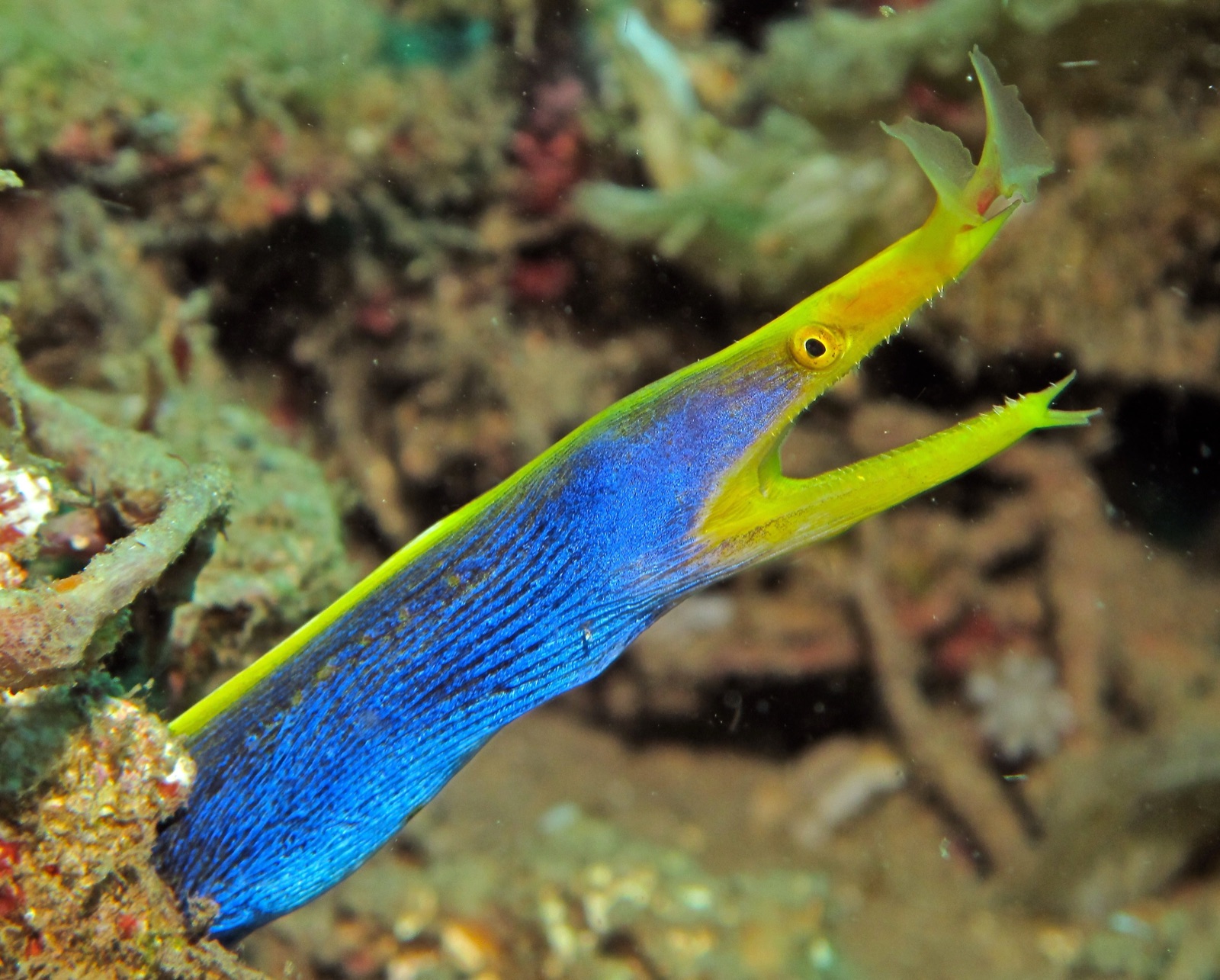
A ribbon eel in full display looks less like a fish than a ribbon caught in current: a pencil-thin body anchored in a sand burrow, front third waving, jaws flared beneath trumpet-shaped nostrils. The species wears three costumes: juveniles jet black with a yellow dorsal stripe, mature males electric blue and yellow, and late-stage animals yellow overall, widely described as females in a male-to-female sequence. Most encounters are jack-in-the-box moments on rubble slopes and muck flats, the eel striking at passing silversides or simply tasting the water. Individuals reuse the same burrow for months, which is why good guides find them on demand. Come in low and unhurried from the front; a burst of exhaust bubbles overhead sends the whole animal underground until tomorrow.
Waar en wanneer je er een kunt zien
"Resident" betekent dat je ze bij de meeste duiken op die bestemming tegenkomt; "seizoensgebonden" betekent betrouwbaar aanwezig in de vermelde maanden; al het andere is een bonus, geen garantie.
| Bestemming | Betrouwbaarheid | Maanden | Notities |
|---|---|---|---|
| Bali & Nusa PenidaIndonesia | Resident: seen on most dives | Het hele jaar door | |
| Lembeh StraitIndonesia | Resident: seen on most dives | Het hele jaar door | |
| AnilaoPhilippines | Resident: seen on most dives | Het hele jaar door | |
| Dumaguete, Dauin & Apo IslandPhilippines | Resident: seen on most dives | Het hele jaar door | |
| MoalboalPhilippines | Occasional | Het hele jaar door |
Beste maand, in één oogopslag
Ze begrijpen
Habitat: Sand and rubble burrows on reef margins, slopes, and muck flats, usually with just the head and front third showing.
Verspreidingsgebied: Indo-Pacific from East Africa to French Polynesia, north to southern Japan, south to Australia.
Gedrag: Anchors in a burrow and waves the forebody in the current; individuals reuse the same hole for months. Flared nostrils and constant open-mouth posture are sensory and respiratory, not aggression.
Dieet: Small fishes snatched from the water column above the burrow.
Grootte: doorgaans rond 1.0 m; gedocumenteerd tot 1.3 m (total length; the body is only a few centimeters deep).
Hoe je je ertegenover gedraagt
Approach low and slow from the front and keep bubbles off the burrow; a startled eel withdraws for the rest of the dive. Divers should never pull or bait one out.
Behoud
Common across a vast range; collected for aquaria despite surviving poorly in captivity, a trade worth declining to support.
Gekende duiksites waar je ze tegenkomt
Gemarkeerde locaties zijn voor deze soort in kaart gebracht door onze redacteurs; de getallen zijn GBIF-waarnemingsrecords vastgelegd binnen ongeveer 5 km van een locatie sinds 1990.
Bekijk
Via de officiële kanalen

Wildlife of Monterey | New film in our auditorium

Live Aviary Cam | Monterey Bay Aquarium

Live Aviary Cam | Monterey Bay Aquarium
Video's zijn ingesloten links naar de eigen kanalen van de makers. We hosten niets en vermelden altijd de bron.