Dive sites, seasons and marine life — researched, mapped, planned.
Menu
Destinations Dive Sites Marine Life Wrecks News
Plan a trip Trip planner When to dive Cost calculator Comparisons Marine-life calendar Water temperature Liveaboards Operators & resorts Marine parks Hyperbaric chambers World map
Regions Australia, New Zealand & East AsiaCaribbean & Western AtlanticEurope, Atlantic & MediterraneanIndian Ocean & East AfricaPacific Islands & MicronesiaRed Sea & Middle EastSoutheast Asia & Coral TriangleThe Americas & Eastern Pacific Countries
Learn & Tools All guides Certifications Gear guides Videos Ask the Data AI Agents API
About About us Methodology Disclaimer Contact
Your view
★ Saved

Your starred destinations, sites and species — stored in this browser.

API GATEWAY

Free read-only JSON access to the atlas's cached data.

Dark mode

🧭 Guided View
New to diving — depths, currents, certification levels? We explain every term as you browse, in plain English. Same data, with the help built in.

⚡ Expert View
You already know the difference between a wall and a drift. Just the data — clean, fast and compact. This is the default view.

Interface language
Reef Stonefish — illustration
AI-generated illustration for The Scuba Atlas — illustrative, not a documentary photograph.

Reef Fish

Reef Stonefish

Synanceia verrucosa · Bony fish — family Synanceiidae (stonefishes), often treated within the scorpionfish lineage

~0.3 m total length 0–40 m depth band Well documented

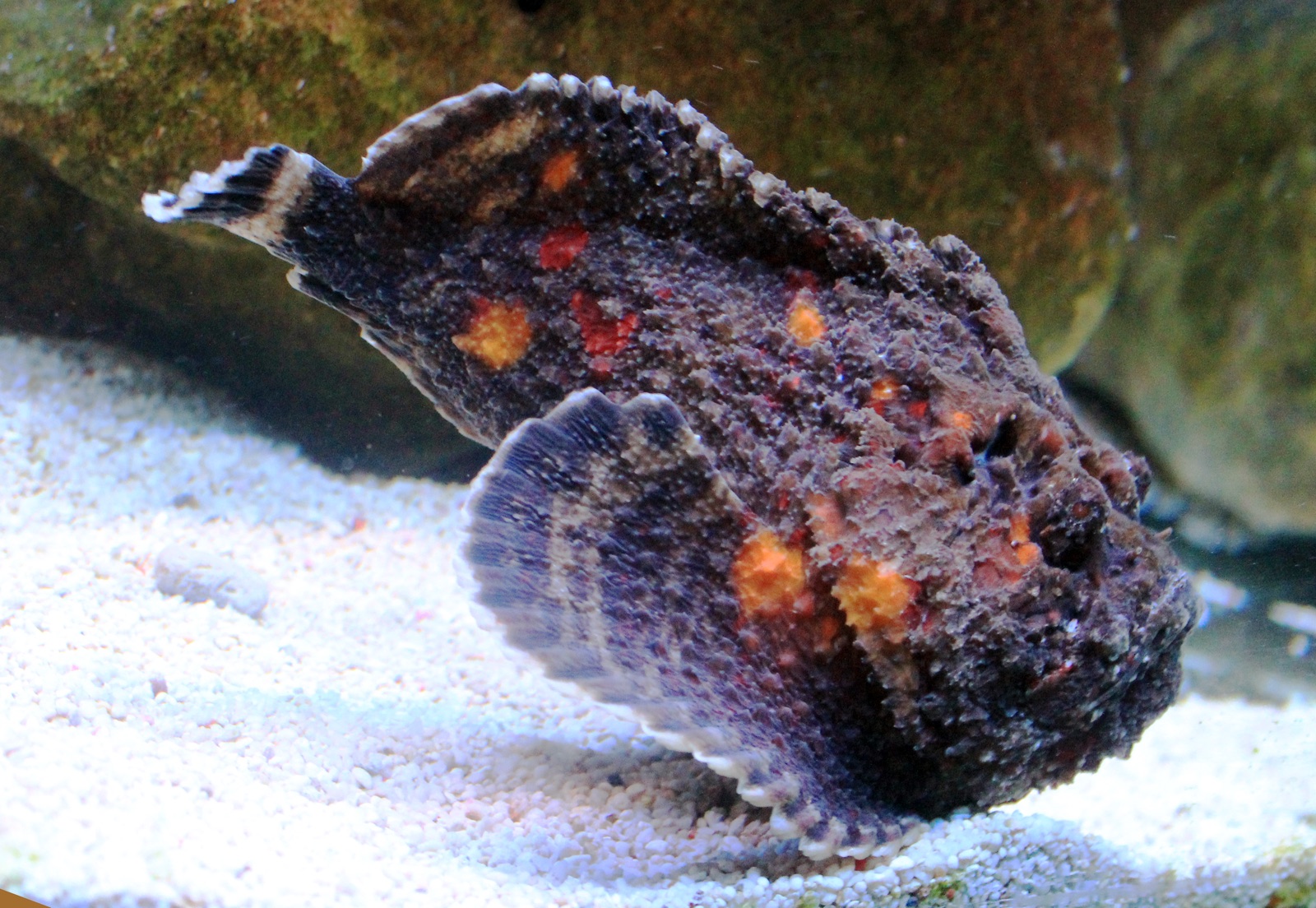
Nothing on the reef rewards good buoyancy like the reef stonefish, because the price of touching the bottom carelessly is written into its anatomy: thirteen dorsal spines, each seated over venom glands that inject under pressure when pressed. It is the most dangerous venomous fish a diver routinely shares water with — envenomation means immediate, severe pain and a trip to hospital, though deaths are very rare and an antivenom exists in Australia. The animal itself is a masterpiece of not being there, a warty, algae-crusted lump that buries into sand or molds against coral for weeks at a stretch, lunging only when prey passes. Divers almost never spot one unaided. Treat every unexamined rock as spoken for: stay off the bottom, never brace a hand blind, and save the close inspection for after the guide points.

Respect factor: Medically SignificantThirteen dorsal spines inject venom under pressure when pressed. Envenomation causes immediate severe pain and needs hospital care — hot (not scalding) water immersion helps en route, and an antivenom exists in Australia. Deaths are very rare.

Where and when to see one

"Resident" means most dives at that destination encounter them; "seasonal" means reliably present in the listed months; anything else is a bonus, not a plan.

DestinationReliabilityMonthsNotes
Bali & Nusa PenidaIndonesia Resident — seen on most dives Year-round
Cairns & the Ribbon ReefsAustralia Resident — seen on most dives Year-round
Sharm El Sheikh & Ras MohammedEgypt Resident — seen on most dives Year-round
Hurghada & El GounaEgypt Resident — seen on most dives Year-round
Lembeh StraitIndonesia Resident — seen on most dives Year-round
Similan Islands & Richelieu RockThailand Occasional Year-round

Best month, at a glance

MonthReliable destinations
January Bali & Nusa Penida · Cairns & the Ribbon Reefs · Sharm El Sheikh & Ras Mohammed · Hurghada & El Gouna · Lembeh Strait · Similan Islands & Richelieu Rock
February Bali & Nusa Penida · Cairns & the Ribbon Reefs · Sharm El Sheikh & Ras Mohammed · Hurghada & El Gouna · Lembeh Strait · Similan Islands & Richelieu Rock
March Bali & Nusa Penida · Cairns & the Ribbon Reefs · Sharm El Sheikh & Ras Mohammed · Hurghada & El Gouna · Lembeh Strait · Similan Islands & Richelieu Rock
April Bali & Nusa Penida · Cairns & the Ribbon Reefs · Sharm El Sheikh & Ras Mohammed · Hurghada & El Gouna · Lembeh Strait · Similan Islands & Richelieu Rock
May Bali & Nusa Penida · Cairns & the Ribbon Reefs · Sharm El Sheikh & Ras Mohammed · Hurghada & El Gouna · Lembeh Strait · Similan Islands & Richelieu Rock
June Bali & Nusa Penida · Cairns & the Ribbon Reefs · Sharm El Sheikh & Ras Mohammed · Hurghada & El Gouna · Lembeh Strait · Similan Islands & Richelieu Rock
July Bali & Nusa Penida · Cairns & the Ribbon Reefs · Sharm El Sheikh & Ras Mohammed · Hurghada & El Gouna · Lembeh Strait · Similan Islands & Richelieu Rock
August Bali & Nusa Penida · Cairns & the Ribbon Reefs · Sharm El Sheikh & Ras Mohammed · Hurghada & El Gouna · Lembeh Strait · Similan Islands & Richelieu Rock
September Bali & Nusa Penida · Cairns & the Ribbon Reefs · Sharm El Sheikh & Ras Mohammed · Hurghada & El Gouna · Lembeh Strait · Similan Islands & Richelieu Rock
October Bali & Nusa Penida · Cairns & the Ribbon Reefs · Sharm El Sheikh & Ras Mohammed · Hurghada & El Gouna · Lembeh Strait · Similan Islands & Richelieu Rock
November Bali & Nusa Penida · Cairns & the Ribbon Reefs · Sharm El Sheikh & Ras Mohammed · Hurghada & El Gouna · Lembeh Strait · Similan Islands & Richelieu Rock
December Bali & Nusa Penida · Cairns & the Ribbon Reefs · Sharm El Sheikh & Ras Mohammed · Hurghada & El Gouna · Lembeh Strait · Similan Islands & Richelieu Rock

Understanding them

Habitat: Sand, rubble, and coral where it half-buries or molds against the bottom, including knee-deep shore entries and reef tops.

Range: Indo-Pacific and Red Sea, from East Africa to French Polynesia, north to southern Japan.

Behavior: May hold one ambush spot for weeks, accumulating algae and silt until it reads as rock; relies so completely on camouflage that it rarely moves even for an approaching diver.

Diet: Fishes and crustaceans taken in a single explosive lunge from ambush.

Size: typically around 0.3 m; documented up to 0.4 m (total length).

How to behave around one

Perfect buoyancy is the protection: stay off the bottom, never brace a hand where you have not looked, and wear solid-soled boots on shore entries.

Conservation

Widespread and not considered threatened; the management story is human safety education rather than protection.

Charted sites known for them

Watch

From the official channels

All videos →

Videos are embedded links to their creators' own channels — we host nothing and credit everything.

Sources: Divers Alert Network ↗Australian Museum ↗ · Facts verified against the sources above; fields without support are labeled not yet verified.

Australia, New Zealand & East Asia

Cairns & the Ribbon ReefsNingaloo ReefCoral Sea & Osprey ReefOkinawa & the Kerama IslandsPoor Knights IslandsTownsville & the YongalaGreen IslandIzu Peninsula

Caribbean & Western Atlantic

BonaireCozumelRiviera Maya & the CenotesBelize Barrier ReefGrand CaymanIsla Mujeres & CancúnRoatánTiger Beach & Grand Bahama

Europe, Atlantic & Mediterranean

Malta & GozoSilfra & IcelandThe AzoresCanary IslandsLarnaca & the ZenobiaScapa FlowArctic NorwayMadeira

Indian Ocean & East Africa

North & South Malé AtollsAri AtollBaa Atoll & Hanifaru BayAliwal Shoal & UmkomaasMafia IslandMauritiusSeychellesSodwana Bay

Pacific Islands & Micronesia

PalauChuuk (Truk) LagoonFakaravaKona, HawaiʻiRangiroaTaveuni & Rainbow ReefBeqa Lagoon & Pacific HarbourEspiritu Santo

Red Sea & Middle East

Sharm El Sheikh & Ras MohammedBrothers, Daedalus & St John'sDahabHurghada & El GounaMarsa Alam & the Deep SouthAqabaDaymaniyat IslandsMusandam Peninsula

Southeast Asia & Coral Triangle

Bali & Nusa PenidaKomodoRaja AmpatSipadan & MabulAnilaoCoronKoh TaoLembeh Strait

The Americas & Eastern Pacific

Galápagos IslandsCocos IslandFlorida KeysSea of Cortez & Cabo PulmoSocorro & the RevillagigedosBritish ColumbiaCalifornia Channel IslandsCosta Rica Pacific Coast