Reef Fish
Reef Stonefish
Synanceia verrucosa · Bony fish, family Synanceiidae (stonefishes), often treated within the scorpionfish lineage
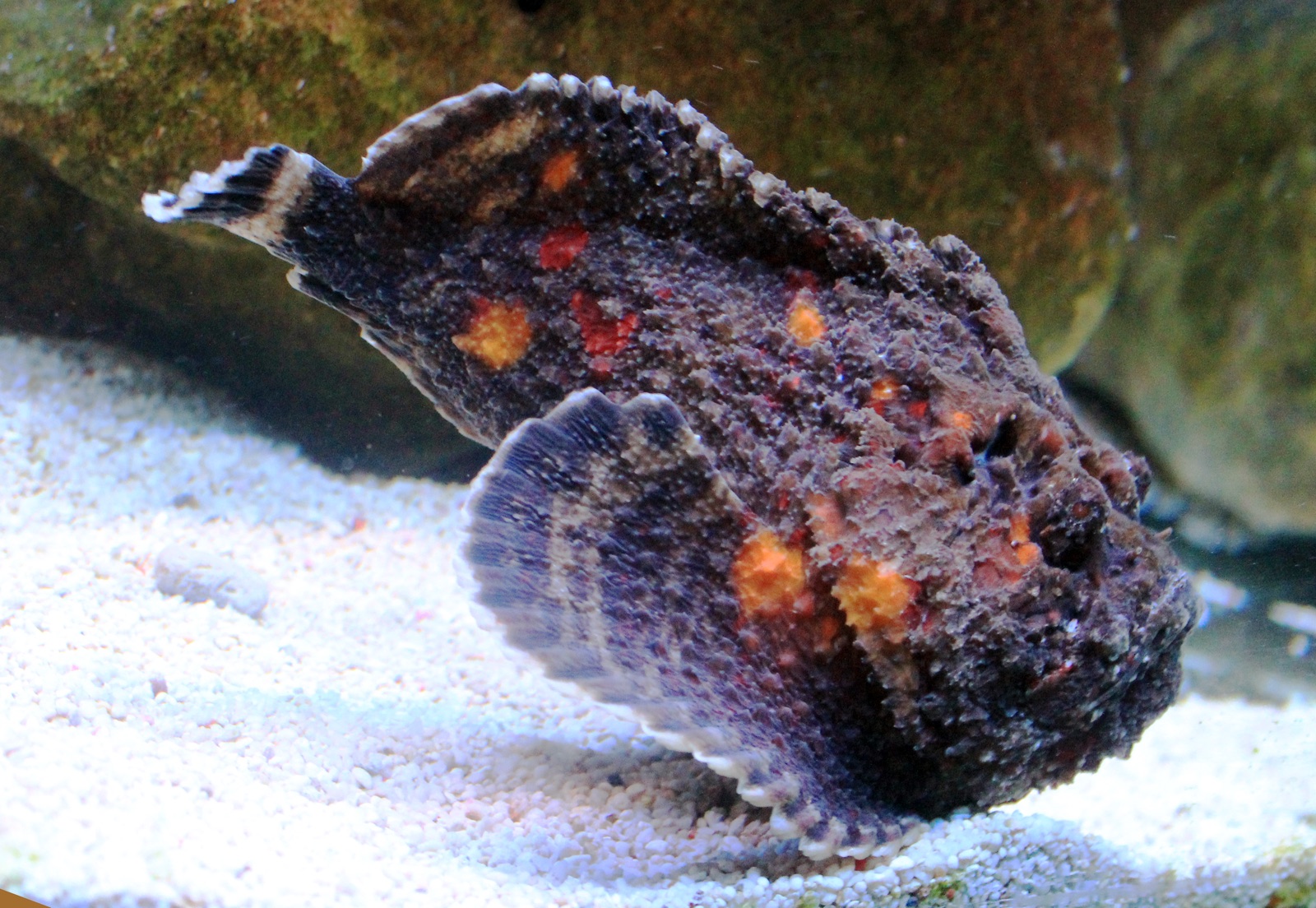
Nothing on the reef rewards good buoyancy like the reef stonefish, because the price of touching the bottom carelessly is written into its anatomy: thirteen dorsal spines, each seated over venom glands that inject under pressure when pressed. It is the most dangerous venomous fish a diver routinely shares water with: envenomation means immediate, severe pain and a trip to hospital, though deaths are very rare and an antivenom exists in Australia. The animal itself is a masterpiece of not being there, a warty, algae-crusted lump that buries into sand or molds against coral for weeks at a stretch, lunging only when prey passes. Divers almost never spot one unaided. Treat every unexamined rock as spoken for: stay off the bottom, never brace a hand blind, and save the close inspection for after the guide points.
Où et quand en observer un
« Résident » signifie que la plupart des plongées sur ce site permettent de les observer ; « saisonnier » signifie qu'ils sont présents de manière fiable durant les mois indiqués ; tout le reste est un bonus, pas une certitude.
| Destination | Fiabilité | Mois | Notes |
|---|---|---|---|
| Bali & Nusa PenidaIndonesia | Resident: seen on most dives | Toute l'année | |
| Cairns & the Ribbon ReefsAustralia | Resident: seen on most dives | Toute l'année | |
| Sharm El Sheikh & Ras MohammedEgypt | Resident: seen on most dives | Toute l'année | |
| Hurghada & El GounaEgypt | Resident: seen on most dives | Toute l'année | |
| Lembeh StraitIndonesia | Resident: seen on most dives | Toute l'année | |
| Similan Islands & Richelieu RockThailand | Occasional | Toute l'année |
Meilleur mois, en un coup d'œil
Les comprendre
Habitat: Sand, rubble, and coral where it half-buries or molds against the bottom, including knee-deep shore entries and reef tops.
Aire de répartition: Indo-Pacific and Red Sea, from East Africa to French Polynesia, north to southern Japan.
Comportement: May hold one ambush spot for weeks, accumulating algae and silt until it reads as rock; relies so completely on camouflage that it rarely moves even for an approaching diver.
Régime alimentaire: Fishes and crustaceans taken in a single explosive lunge from ambush.
Taille: généralement autour de 0.3 m; documenté jusqu'à 0.4 m (total length).
Comment se comporter avec lui
Perfect buoyancy is the protection: stay off the bottom, never brace a hand where you have not looked, and wear solid-soled boots on shore entries.
Conservation
Widespread and not considered threatened; the management story is human safety education rather than protection.
Sites répertoriés connus pour leur présence
Les sites mis en évidence ont été cartographiés pour cette espèce par nos éditeurs ; les chiffres correspondent aux occurrences GBIF enregistrées dans un rayon d'environ 5 km d'un site depuis 1990.
Regarder
Depuis les canaux officiels

Wildlife of Monterey | New film in our auditorium

Live Aviary Cam | Monterey Bay Aquarium

Live Aviary Cam | Monterey Bay Aquarium
Les vidéos sont des liens intégrés vers les chaînes de leurs créateurs. Nous n'hébergeons rien et créditons tout.